

Technical Trekking Peaks
The ultimate gateway to Himalayan alpinism. For climbers possessing elite cardiovascular fitness who seek to push beyond standard trekking trails, our 5,000m and 6,000m peak expeditions provide a highly rigorous, expertly guided entry point into technical mountaineering.
Mera Peak Expedition
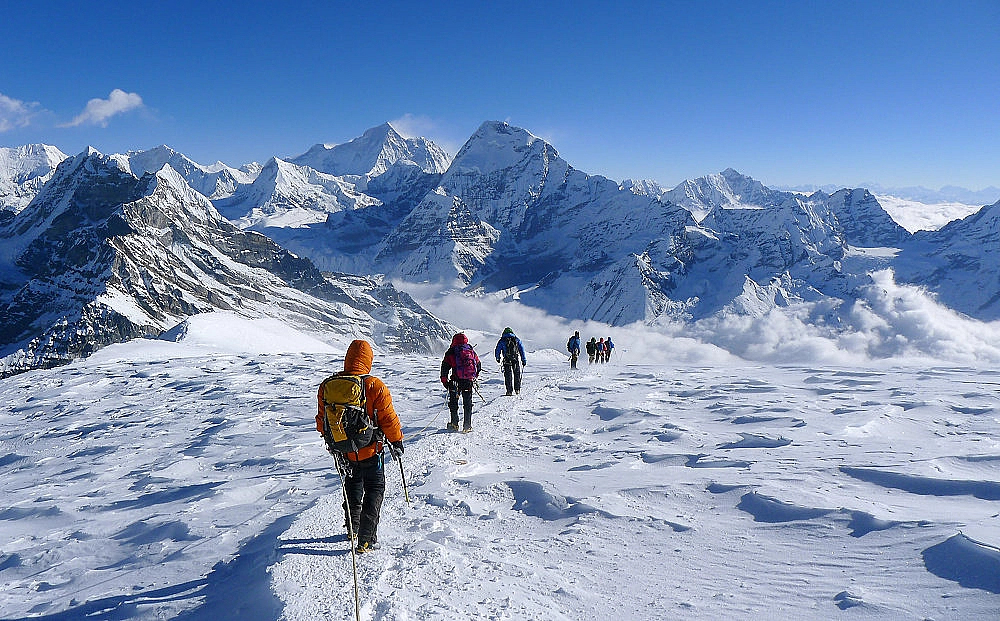
Officially recognized as Nepal’s highest trekking peak. While the standard northern route is relatively straightforward, the sheer altitude makes this a formidable challenge requiring basic crampon and ice-axe proficiency to navigate the upper high-altitude glaciers.
The reward for conquering Mera Peak is arguably the most spectacular vantage point in the Himalayas, offering sweeping, unobstructed views of five of the world’s tallest mountains: Everest, Lhotse, Cho-Oyu, Makalu, and Kanchenjunga.
Island Peak (Imja Tse)
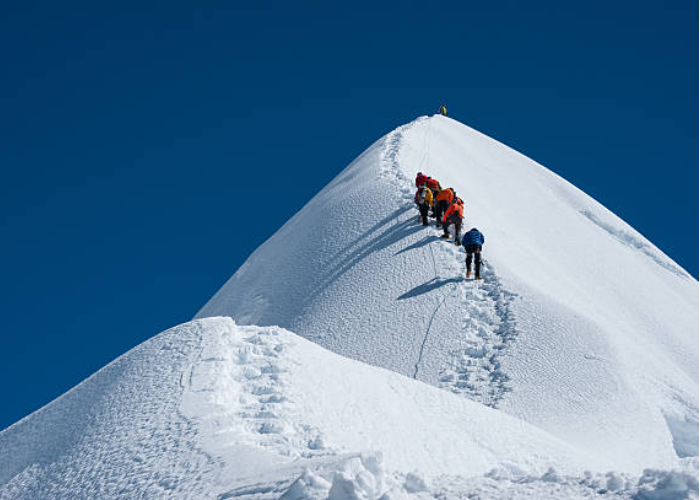
Named for its striking appearance as an isolated island surging from a sea of glacial ice, Imja Tse is a highly sought-after objective in the heart of the Khumbu region. First summited in 1953 as a training exercise for the historic Everest expedition.
This expedition incorporates a complete trek to Everest Base Camp and Kala Patthar to ensure optimal biological acclimatization. The final summit push is technically steep and exhilarating, offering up-close, panoramic views of Lhotse, Makalu, and the Lhotse Shar glacier.
Lobuche East Peak
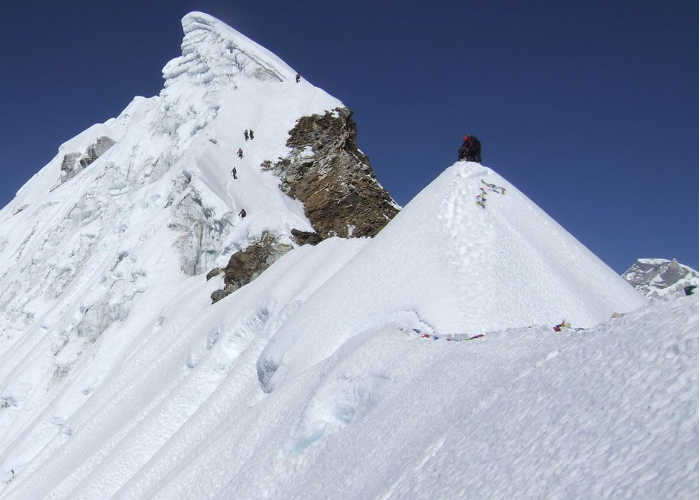
A highly dramatic, three-furrowed pyramid structure that towers directly over the Everest trekking trail. Lobuche East is technically demanding, requiring solid mountaineering skills to navigate its steep rock triangles and icy South Ridge.
The itinerary is heavily focused on acclimatization, taking climbers through Namche Bazaar, Tengboche, and up to Kala Patthar and Everest Base Camp before deploying to Lobuche Base Camp (5,200m) for the final, adrenaline-fueled summit strike.
Yala Peak (Langtang Region)
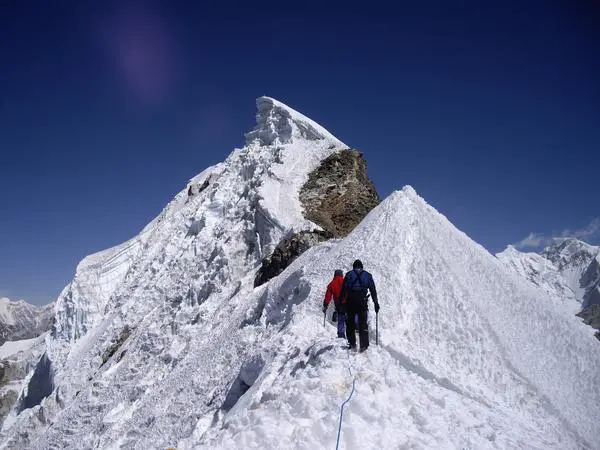
The optimal introductory climb. Located just 19 miles north of Kathmandu in the beautiful Langtang Valley, Yala Peak is a non-technical ascent that requires absolutely no prior mountaineering experience—only baseline physical fitness.
Climbers acclimatize at Kyanjin Gompa and Tserko Ri before establishing camp at 4,800 meters. Technical gear is only required for the final 400 meters of ice, rewarding climbers with jaw-dropping, close-quarters views of the 8,046m Shishapangma across the Tibetan border.
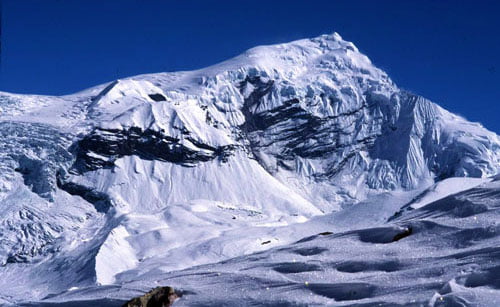
Chulu West Expedition
Dominating the semi-arid flatlands of the Manang Valley, Chulu West is a formidable undertaking. It is considered significantly harder than adjacent peaks, demanding the establishment of two separate high camps to safely breach the summit.
Following a rigorous ascent that offers massive, panoramic vistas of Dhaulagiri and the Annapurna range, the expedition executes a strategic extraction by crossing the legendary 5,416-meter Thorong La pass into Muktinath and Jomsom.
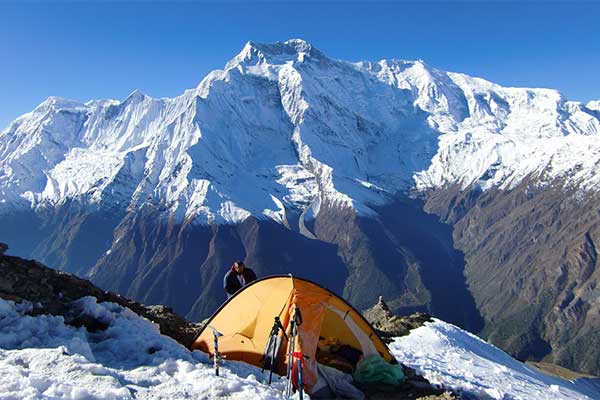
Pisang Peak
Characterized by its striking, uniform pyramid shape, Pisang Peak rises sharply above the Annapurna Circuit trail. While broadly considered an accessible trekking peak, the final approach from High Camp (5,400m) involves navigating a steep, sustained snow slope on the South-West Ridge.
The summit yields incredible, sweeping views of Annapurna II, IV, Gangapurna, and Tilicho Peak. Following the descent, climbers continue the classic circuit route over the formidable Thorong La pass.