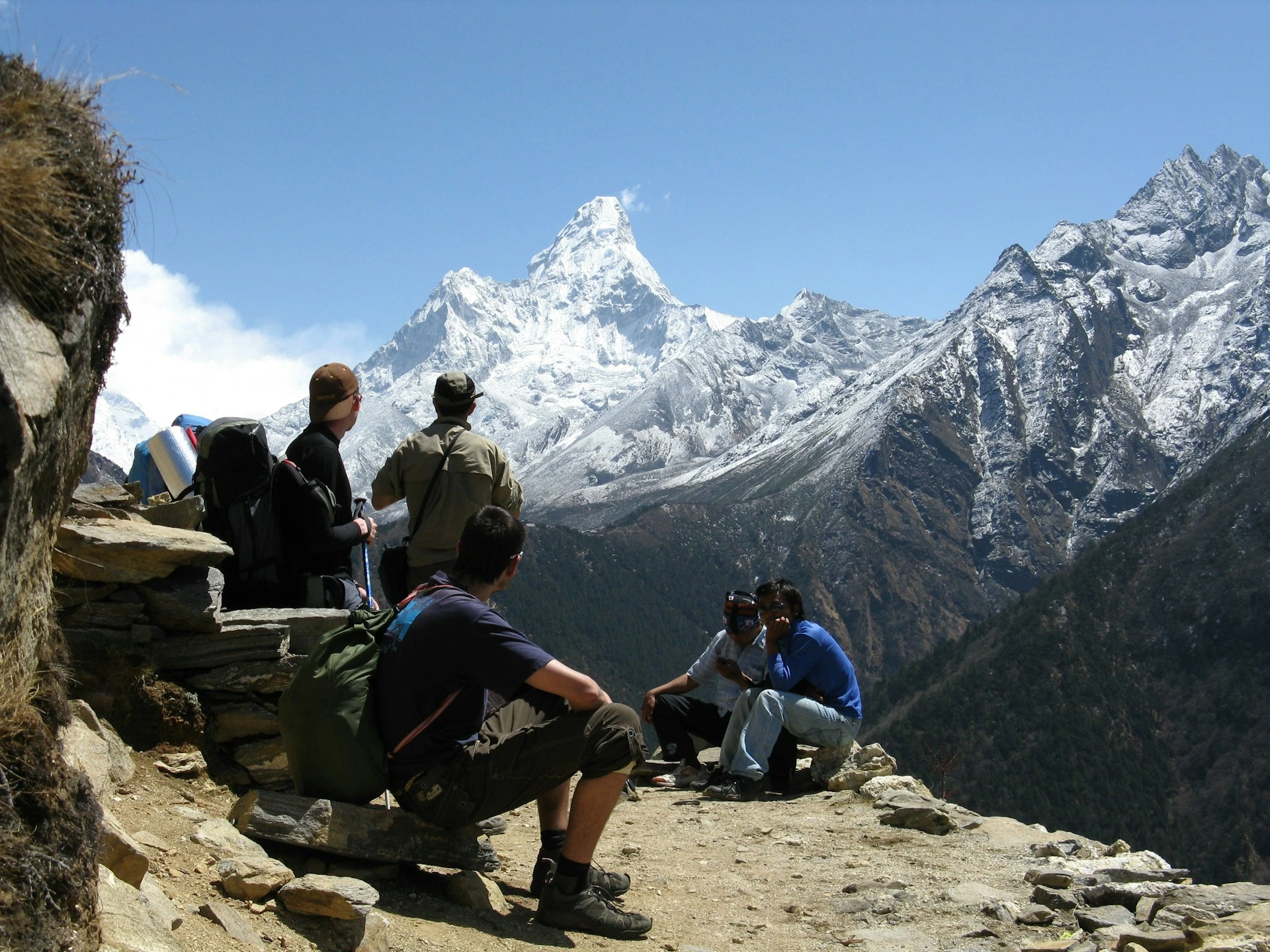
Ama Dablam is not a trekking peak. It is a 6,812-metre technical mountain on the southeast flank of the Everest massif, climbed via its Southwest Ridge — a line that demands competence on steep rock, vertical ice, exposed mixed terrain, and fixed ropes. The mountain’s distinctive shape, dominated by a hanging glacier shaped like a dablam (a traditional Sherpa pendant box), gives it one of the most recognisable profiles in the Himalaya. Climbers who attempt Ama Dablam need rock climbing ability up to 5.7 on granite, the ability to move efficiently on 50-degree ice, and the stamina to sustain consecutive 10–14 hour days above 5,800 metres.
Our 30-day expedition builds in the acclimatisation rotations, weather contingency, and skills preparation that turn a competent high-altitude trekker into an Ama Dablam summit candidate. We run small teams with a high ratio of IFMGA-trained Sherpas, pre-stocked high camps, modern weather forecasting, and a base camp that functions as a proper expedition command centre — not a collection of tents. This page is everything you need to understand the mountain, the route, the demands, and why our Kathmandu-based team operates this expedition with a safety record and summit success rate that the mountain’s statistics should not normally allow.
Quick Facts: Ama Dablam Expedition
| Detail | Specification |
|---|---|
| Duration | 30 days Kathmandu to Kathmandu |
| Summit altitude | 6,812 m (22,349 ft) |
| Maximum camp altitude | Camp 3 at approx. 6,300 m |
| Region | Khumbu, Sagarmatha National Park, Nepal |
| Difficulty | High-altitude technical expedition (Grade 3/D) |
| Climbing grade | Alpine TD+ / Scottish III–IV / Rock 5.7 / Ice AI2–3 |
| Best season | Spring (mid-April to late May) and autumn (mid-October to late November) |
| Permit | Ama Dablam climbing permit from Nepal Department of Tourism, plus national park entry |
| Expedition style | Guided, fully supported with pre-fixed ropes, high camps established, Sherpa support |
| Accommodation | Hotels in Kathmandu, teahouses on trek, full base camp with individual tents, shared high-camp tents |
| Food | All meals included throughout; Western & Sherpa cuisine at base camp, high-altitude freeze-dried and local food on the mountain |
| Sherpa ratio | 1 climbing Sherpa per 2 climbers on summit push |
| Oxygen policy | Supplementary oxygen not routinely used; available as emergency backup at base camp |
| Group size | 4–8 climbers |
| Starting / ending point | Kathmandu (with Lukla flight) |
| Success rate (expedition average) | Historically 60–70% for guided commercial teams; our 5-year average exceeds 75% (weather and conditions dependent) |
Why Choose Our Ama Dablam Expedition
Most commercial operators treat Ama Dablam as an add-on to their Everest product, or they staff the expedition with trekking guides who happen to hold a climbing certificate. We staff Ama Dablam with Sherpas who have summited the mountain multiple times and with expedition leaders who have led technical 6,000–7,000-metre expeditions across Nepal, Patagonia, and the Alps. The difference matters when you are transitioning from fixed ropes on the Yellow Tower onto mixed terrain in spindrift with a pack that weighs 15 kilograms.
We keep team sizes small — never more than eight climbers — so that each rotation, each skills day, and the summit push can be tailored to the group’s pace. Acclimatisation is based on real-time SpO2 and resting heart rate monitoring, not just a calendar. We carry a satellite handset on the mountain, download daily wind and precipitation forecasts from a commercial weather provider, and have the authority to delay a summit push without apology. On this mountain, the window doesn’t care about flight schedules.
Our base camp sits at 4,570 metres, above Pangboche, on a meadow with a direct view of the Southwest Ridge. We run a heated dining tent, a dedicated communications tent, and a solar-charging station. High camps are pre-equipped with stoves, fuel, food, sleeping bags, and emergency oxygen by the Sherpa team before the group arrives. Climbing ropes — fixed lines from Camp 1 to the summit — are inspected, replaced if necessary, and anchored by our own Sherpas each season. We don’t rely on shared community ropes unless they meet our standard.
We handle every permit, every domestic flight rebooking, every liaison officer interaction, and the garbage deposit system that the Nepali government uses to enforce high-altitude cleanliness. You show up in Kathmandu with your technical gear and your fitness. We do the rest.
About Ama Dablam: A Sacred Peak and a Climber’s Dream
Ama Dablam translates as “Mother’s Necklace” — the mountain’s long ridges like a mother’s arms, and the hanging glacier the traditional dablam pendant worn by Sherpa women. The peak is considered sacred by the Sherpa community; many climbing expeditions perform a puja ceremony at base camp before setting foot on the mountain. Understanding that local belief is not a formality but a genuine request for permission helps set the tone for the entire expedition.
The mountain sits just south of Everest and Lhotse, separated by the Imja Khola valley. Its coordinates: 27°51′40″N 86°51′40″E. The first ascent was made on 13 March 1961 by a New Zealand–American team — Mike Gill, Barry Bishop, Mike Ward, and Wally Romanes — via the Southwest Ridge, which remains the standard route today. Edmund Hillary called it “the most beautiful mountain in the world.” Most climbers would not argue.
Despite being barely over 6,800 metres, Ama Dablam has historically had a summit-to-death ratio that commands respect. Modern fixed ropes, weather forecasting, and professional guiding have made it a viable commercial objective, but it remains a mountain on which technical mistakes at 6,300 metres can have consequences that no helicopter can reach in time. Our risk management is built around that understanding.
Complete Expedition Overview: Why Climbers Choose Ama Dablam
Climbers choose Ama Dablam for one of three reasons: as a standalone technical challenge on a world-class line; as a stepping stone between 6,000-metre trekking peaks and an 8,000-metre expedition; or simply because the mountain’s aesthetics are unmatched. It is more technical than any trekking peak in Nepal, more compact than Manaslu or Himlung Himal, and logistically simpler than Everest — but it demands the same rock and ice skills that climbers use on alpine faces in the greater ranges.
Compared to Everest, Ama Dablam requires far more technical rock climbing but far less time in the death zone. The summit altitude is roughly equal to Everest’s South Col, so you can test your body’s response to extreme altitude without entering the 8,000-metre zone where supplemental oxygen becomes a necessity for most. Compared to Manaslu, which is a higher-altitude snow plod with minimal technical sections, Ama Dablam is a sustained technical climb from Camp 1 upward. Compared to Island Peak or Lobuche East — both non-technical snow climbs with short, steep headwalls — Ama Dablam is in a completely different league. Those peaks are good training; they are not adequate preparation in themselves.
The expedition itinerary includes a 9-day trek through the Khumbu, using the classic Lukla–Namche–Tengboche–Pangboche approach, which itself reaches 3,860 metres. The trek is not just transport; it’s the foundation of your acclimatisation. You arrive at base camp with several days above 3,500 metres already banked. Then three rotational climbs on the mountain itself bring you to Camp 2 (5,950 m) and, optionally, a touch at Camp 3 (6,300 m) before the summit push. The route involves 1,200 metres of fixed ropes, with the most demanding climbing between Camp 1 and Camp 2 (the Yellow Tower) and the mixed gully above Camp 2 to the summit ridge.
A successful summit day typically starts from Camp 2, not Camp 3, because the added elevation of Camp 3 rarely justifies the exposure and dehydration risk. We follow a conservative summit plan that maximises turnaround time.
Detailed Day-by-Day Itinerary (30 Days)
Note: This itinerary represents our standard operational plan. Summit day timing and rotation sequence may be adjusted on the mountain based on weather, team fitness, and Sherpa assessment. Altitudes are approximate.
Days 1–2: Arrival in Kathmandu (1,350 m)
You land at Tribhuvan International Airport. We meet you and transfer to a central hotel. Day 2 is a full expedition briefing: gear check, permit documentation, medical review, and a detailed discussion of the route, weather, and safety protocols. We also handle any rental gear adjustments.
Day 3: Fly Kathmandu to Lukla (2,860 m), trek to Phakding (2,610 m) – 3 hrs
The 30-minute flight into Lukla is the gateway. After assembling loads with porters and yaks, we walk a gentle trail through villages to Phakding. This short day aids adjustment.
Day 4: Phakding to Namche Bazaar (3,440 m) – 5–6 hrs
We cross the Hillary Bridge and climb steeply through pine forest to Namche, the Sherpa capital. First views of Everest and Lhotse appear along the trail. Overnight in a comfortable lodge.
Day 5: Namche Bazaar – Acclimatisation Day
Rest day with a hike to the Everest View Hotel (3,880 m) or the Sherpa Museum. Active rest: walk high, sleep low.
Day 6: Namche to Tengboche (3,860 m) – 5 hrs
A spectacular walk with open views of Ama Dablam, Everest, and Nuptse. Tengboche Monastery is the spiritual centre of the Khumbu. We attend the puja if possible. Altitude gain is modest but the body continues acclimatising.
Day 7: Tengboche to Pangboche (3,930 m) – 4 hrs
Short walk descending to the Imja Khola and climbing to the traditional upper village of Pangboche. We settle into a lodge with views directly up the valley toward Ama Dablam’s north face.
Day 8: Pangboche to Ama Dablam Base Camp (4,570 m) – 3 hrs
A steep trail climbs through juniper and rhododendron to a large grassy bench at 4,570 m. This is Base Camp for the next three weeks. Individual sleeping tents, a heated dining tent, kitchen, and toilet tents are already established. Your duffels arrive. Rest of the day: camp orientation and rest.
Day 9: Base Camp – Puja Ceremony, Rope Skills Review
Morning puja with a lama from Pangboche. Afterwards, we spend several hours on a nearby rock face practicing jumaring, abseiling, ice axe arrest, and anchor clipping. This is mandatory regardless of experience.
Day 10: Base Camp to Camp 1 (5,700 m) and return – Acclimatisation Rotation 1
We leave before dawn. The route climbs rocky moraine, then a series of fixed ropes on slabby rock and snowy gullies. Camp 1 sits on a narrow saddle. After a short rest and hydration, we descend. This rotation lasts 7–9 hours, introduces the terrain, and spikes the red blood cell production.
Day 11: Base Camp – Rest and Skills
Recovery day with light stretching, equipment organisation, and one-on-one coaching if needed.
Day 12: Base Camp to Camp 1 – Sleep at Camp 1 (5,700 m)
We climb to Camp 1 again and stay overnight. This is the first sleep above 5,500 m. Tents are pre-pitched and supplied.
Day 13: Camp 1 to Camp 2 (5,950 m) and return to Base Camp
We ascend the Yellow Tower — the crux of the lower route — on fixed lines. Steep granite with good holds but tremendous exposure. After tagging or reaching Camp 2, we descend all the way to Base Camp. A long, tiring day (10–12 hrs) that builds significant acclimatisation.
Day 14: Base Camp – Rest
Complete rest. Hydration, calorie loading, equipment drying.
Day 15: Base Camp – Weather monitoring, short hike
Active recovery, light skills refresh.
Day 16: Base Camp to Camp 2 – Sleep at Camp 2 (5,950 m)
Second rotation. With the route now familiar, the climb is more efficient. We stay at Camp 2, perched on a narrow ledge with views into the face.
Day 17: Camp 2 to Camp 3 (6,300 m, optional) and return to Base Camp
Some teams push to Camp 3 for a touch, but we often limit to the lower part of the grey tower, practicing mixed climbing on fixed ropes before descending. Return to Base Camp by evening. Summit readiness is assessed.
Day 18: Base Camp – Rest and Summit Preparations
Final weather window review. We decide on the summit push schedule.
Day 19: Base Camp – Rest / Contingency Day
Built-in buffer for weather or fatigue.
Day 20: Base Camp to Camp 1 – Summit Push Begins
Loaded with summit gear, we climb to Camp 1 and overnight. The team is now fully acclimatised.
Day 21: Camp 1 to Camp 2 (5,950 m)
Move to Camp 2. Rest, hydrate, eat, sleep early.
Day 22: Summit Day – Camp 2 to Summit (6,812 m) and return to Camp 2
Alpine start (1–2 a.m.). From Camp 2, the route climbs the Grey Tower, a steep mixed gully with fixed ropes, onto the summit ridge. The ridge is exposed, with a corniced drop on one side and a sheer face on the other. The summit is a small platform at 6,812 m. After a brief stay, we descend to Camp 2. 10–14 hours. The hardest physical day of your life.
Day 23: Summit Contingency Day
If Day 22 was postponed, we use this day. If successful, we descend to Base Camp.
Day 24: Descend to Base Camp
Pack up. Celebrate.
Day 25: Base Camp Rest / Contingency
Recovery, packing.
Day 26: Trek Base Camp to Namche (or Pangboche)
Long trek descending through Pangboche and Tengboche to Namche. Altitude drop accelerates recovery.
Day 27: Namche to Lukla
Final day trekking. Farewell with Sherpa team in Lukla.
Day 28: Fly Lukla to Kathmandu
Return flight, transfer to hotel, hot shower.
Day 29: Kathmandu Contingency / Sightseeing
Buffer for flight delays. Free day.
Day 30: Departure
Transfer to airport.
Expedition Route Described Section by Section
Base Camp to Camp 1 (4,570 m – 5,700 m)
The initial section crosses moraine, then steepens onto rock slabs that vary from polished to gritty. Fixed ropes begin after 30 minutes. The route weaves through a rocky gully and then a snow rib. Rock difficulty is moderate (5.4–5.5), but heavy with a pack. You jumar constantly, clipping and unclipping anchors. The final approach to Camp 1 is a narrow snow ridge. Camp 1 is a cluster of tents on a saddle, exposed to wind.
Camp 1 to Camp 2 (5,700 m – 5,950 m) – The Yellow Tower
The defining feature of the Southwest Ridge. A steep granite tower ascended via a series of dihedrals and cracks. The climbing is sustained 5.7 with sections of 5.6, all on fixed lines. Holds are small but positive. Some moves are high-step or mantle on exposed bulges. The tower is about 150 metres of vertical, followed by easier snow slopes to Camp 2. This is where prior rock competence pays off. If you struggle here, you’ll be exhausted before the summit push. At Camp 2, tents sit on a narrow ledge carved into the slope.
Camp 2 to Camp 3 (5,950 m – 6,300 m) – Grey Tower and Mushroom Ridge
Above Camp 2, the ridge narrows and the rock becomes looser. Mixed climbing with snow and ice patches. The Grey Tower is a vertical section of layered rock, often verglassed in autumn. Ascending requires careful crampon work. Above, a series of rocky steps and snow mushrooms lead to Camp 3, a precarious perch at 6,300 m. This section is rarely fully protected by fixed lines because snow conditions bury anchors; we may run additional lines depending on season.
Summit Ridge (6,300 m – 6,812 m)
From Camp 3 or directly from Camp 2, the route traverses a narrow horizontal ridge with massive exposure. One side drops down the face towards the Imja Glacier; the other falls towards the north face. Fixed ropes protect the entire traverse. The final pyramid is snow and ice, steepening to 50° before the summit. A small cairn marks the top. The view encompasses Everest, Lhotse, Makalu, Baruntse, and the Khumbu Icefall.
Descent
Downclimbing and abseiling on fixed ropes. Rappel stations are established at regular intervals. The descent from Camp 2 to Base Camp with tired legs can take 5–6 hours. Getting down safely is as critical as getting up.
Technical Difficulty: What “Grade TD+” Actually Means on Ama Dablam
The overall Alpine grade is TD+ (Très Difficile Plus), with ice commitments up to AI3 and rock to 5.7. This is not a snow plod. You will use ice axes, crampons, jumars, and descenders daily above Base Camp. The climbing includes:
- Rock climbing: Up to 5.7 on solid but sometimes loose granite. Many sections are vertical, with stemming and layback moves. With a heavy pack and altitude, this feels like 5.8.
- Ice climbing: Short but steep water-ice smears and névé slopes up to 50°. The Grey Tower often has AI2–3 sections.
- Mixed climbing: Snow-covered rock with crampons, dry-tooling on fixed ropes.
- Fixed rope management: Constant clipping and unclipping from anchors. You must be able to transfer from ascending to descending smoothly. Incompetence here slows the team and increases cold injury risk.
- Exposure: The ridge has sections where a fall unroped would be fatal. The fixed lines are your lifeline. Psychological comfort with exposure is non-negotiable.
We train all these skills on Days 9 and 15, but we expect you to arrive with a working knowledge. If you cannot lead 5.6 rock at sea level, you need to address that before this expedition. The mountain is not a place to learn basic rope systems.
Fitness Requirements and Training
You need to be comfortable carrying a 15 kg pack on steep terrain for 8–12 hours on multiple days. Before signing up, you should be able to:
- Run 10 km in under 55 minutes or hike 2,000 metres vertical in a day with a pack.
- Do 10 pull-ups and 30 push-ups.
- Carry 20 kg up steep stairs or a stadium for an hour without stopping.
Specific training should include:
- Leg strength: Weighted box step-ups, lunges, squats.
- Core stability: Planks, hanging leg raises — essential for climbing with a pack.
- Aerobic base: 3–4 months of steady state cardio (cycling, running, hiking) before adding intensity.
- Technical practice: Indoor rock climbing 2–3 times per week, leading up to 5.10a. Ice climbing course if possible.
- Altitude exposure: Prior high-altitude treks or climbs to at least 5,500 m.
We provide a detailed training programme upon booking. If you arrive unfit, our expedition leader will pull you from the summit team. This is for your safety and the team’s.
Previous Experience Required
We require:
- At least one previous high-altitude climb above 5,500 metres, preferably above 6,000 m (Island Peak, Mera Peak, Lobuche East, or equivalent).
- Documented experience on steep snow/ice (crampons and ice axe) and basic rock climbing (lead or top-rope).
- Competence in abseiling, prusiking, and fixed rope travel. A climbing CV is required with your application.
If you have climbed peaks like Denali via the West Buttress, the Matterhorn via the Hörnli, or similar technical routes, you are well prepared. If your only experience is Kilimanjaro and Everest Base Camp, you are not yet ready. We can guide you through a preparation path (Island Peak + rock climbing course) before committing to Ama Dablam.
Acclimatisation Strategy
Our rotation schedule builds red blood cell mass and oxygen efficiency:
- Trekking phase: Gradual ascent to Pangboche over 7 days, with a rest day at Namche.
- Rotation 1: Sleep at Camp 1 (5,700 m) after a touch-and-return rotation.
- Rotation 2: Sleep at Camp 2 (5,950 m), possibly touch Camp 3.
- Summit push: Sleep at Camp 1 then Camp 2 before the summit day.
We monitor SpO2 levels daily. A reading below 75% at rest prompts intervention. Our guide has the authority to hold a climber at base camp for an extra rotation. The mountain will still be there.
Weather and Best Season
Ama Dablam lies within the monsoon shadow, so spring (pre-monsoon) and autumn (post-monsoon) are the stable windows.
- Spring (April–May): Temperatures are cold early, warming later. The jet stream can bring high winds, especially at summit level. Snow conditions are generally good, with ice in the Grey Tower. Summit success rates are high. The mountain is busier.
- Autumn (October–November): Clear skies, very cold. Rock is often drier, but snow can be scarce, exposing loose rock. Shorter days. Fewer teams. Our autumn expeditions have slightly lower summit success due to harsher conditions, but the climbing quality is often superb.
We run one spring and one autumn departure each year. Dates are set to coincide with the climatological lull when the jet stream shifts.
Accommodation and Food
- Kathmandu: 4-star hotel, single rooms with breakfast.
- Trekking: Best available teahouses, twin-share, with attached bathrooms where possible.
- Base Camp: Individual mountaineering tents (Mountain Hardwear or similar) with foam mattress and solar light. Heated dining tent with chairs, table, and charging station. Toilet tents with WAG bag system (human waste carried out). Solar-heated water for washing.
- High Camps: High-quality expedition tents (2-person per climber on summit push) with thick sleeping pads and down bags rated to -30°C. Food is a mix of freeze-dried meals, instant noodles, soups, tea, and high-calorie snacks. Sherpas boil water at each camp.
Food at Base Camp is varied and calorific: porridge, eggs, pancakes, dal bhat, pasta, pizza, sherpa stew, fresh vegetables, and canned protein. Special diets accommodated with notice.
Equipment List (Abbreviated; Full List at Booking)
- Technical: Harness, helmet, ice axe (curved shaft), 12-point crampons (automatic), ascender (jumar), descender (ATC Guide or similar), 4 locking carabiners, 4 non-locking, 120 cm sling, 2 prusik cords, belay plate.
- Footwear: 8000m double boots (or equivalent high-altitude single), rock climbing shoes for base camp practice.
- Clothing: Down suit or equivalent (800+ fill), insulated down jacket, hardshell jacket and pants, base layers, mid-layers, expedition-weight gloves, liner gloves, balaclava, goggles, face mask.
- Sleeping: Sleeping bag (-30°C comfort), inflatable pad, foam pad.
- Accessories: Headlamp (with spare batteries), power bank, solar charger, satellite messenger if you own one, camera, water bottles (insulated).
- Medical: Custom first-aid kit, Diamox, dexamethasone, antibiotic, rehydration salts, blister care.
We provide a rental option for down suits, boots, and technical hard goods if you prefer not to purchase.
Permits and Regulations
The Ama Dablam climbing permit is issued by the Nepal Department of Tourism, costing USD 400 per person for spring 2026 (autumn likely $200, subject to change). Additional fees:
- Sagarmatha National Park entry: ~USD 30
- Khumbu Pasang Lhamu Rural Municipality fee: ~USD 20
- Garbage deposit: USD 3,000 per team (refundable upon proper waste removal)
- Liaison officer: his daily allowance, insurance, and transport are shared among team members.
We handle all paperwork. You provide passport copies, photos, and a completed application. The permit process takes 2–3 weeks. We need your documents at least one month in advance.
Safety and Emergency Protocols
Safety on Ama Dablam is a chain of interdependent decisions. Our protocol:
- Fixed ropes: Our Sherpa team fixes new ropes from Camp 1 to summit each season. We inspect and maintain them throughout the expedition. You clip into primary and backup anchors at all exposed sections.
- Weather: We subscribe to a commercial forecasting service that provides summit-level wind and temperature data. Summit windows are chosen with at least 24-hour confidence.
- Medical: Guides carry a comprehensive expedition medical kit including oxygen for emergency use. We have a pulse oximeter, stethoscope, and blood pressure cuff. Severe AMS, HAPE, or HACE triggers immediate descent, assisted by Sherpas.
- Evacuation: Helicopter evacuation is possible from Base Camp (heli landing at 4,570 m). Above Base Camp, evacuation means carrying or lowering the injured climber. This takes hours. Therefore, we never push a climber who is deteriorating.
- Satellite communication: Iridium satellite phone at Base Camp and Camp 2. InReach or SPOT devices carried by the leader.
- Turnaround times: Summit day has a hard turnaround time of 2 p.m. regardless of distance to summit. The leader’s decision is final.
Expedition Leader and Sherpa Team
Our lead guide is a Western IFMGA-certified mountain guide or an experienced expedition leader with multiple Ama Dablam summits and guiding certifications from the AMGA or equivalent. The climbing Sherpa team are all Khumbu locals who have summited Ama Dablam, many also Everest. They fix ropes, carry loads, establish camps, and accompany you on summit day at a 1:2 ratio. They are the best mountaineers on the mountain.
Communications and Connectivity
Base Camp has WiFi via a Nepali telecom router (Everest Link or similar), though bandwidth is limited. You can buy a prepaid data card. Mobile signal is sporadic. High camps have no internet; the satellite phone is for emergencies and weather updates. We provide daily satellite blog updates for families back home (optional).
Insurance Requirements
You must have a high-altitude mountaineering insurance policy that covers medical evacuation and repatriation from 6,812 metres, including helicopter rescue. The policy should also cover trip cancellation, lost equipment, and COVID-related interruptions. We require a copy at booking. We recommend Global Rescue, Ripcord, or similar expedition-specific insurers.
Environmental and Cultural Responsibility
We operate a zero-waste policy above Base Camp. All human waste is packed out in WAG bags. All non-burnable trash is carried down. We participate in the SPCC (Sagarmatha Pollution Control Committee) initiatives. We treat the Sherpa community and the sacred landscape with the respect they deserve. A portion of our permit fees supports the Khumbu municipality.
Photography and Drone Use
Drones are prohibited in Sagarmatha National Park and specifically on Ama Dablam without a special filming permit, which is expensive and time-consuming to obtain. Do not bring a drone. For still photography, wide-angle and telephoto lenses are ideal. Base Camp offers unparalleled early morning views of the southwest face. On summit day, the light is harsh; a camera with good dynamic range helps.
Ama Dablam Expedition Cost Breakdown
Instead of a single opaque price, here is where your money goes (2026 spring pricing, per person, based on 6 climbers):
| Component | Approx. Cost (USD) |
|---|---|
| Climbing permit (spring) | 400 |
| Sagarmatha NP & local fees | 50 |
| Liaison officer costs (shared) | 300 |
| Domestic flights (KTM–Lukla round-trip) | 360 |
| Kathmandu hotels (4 nights, single) | 300 |
| Teahouse accommodation & meals on trek | 450 |
| Base Camp services (tent, food, cook, dining) | 1,800 |
| High-altitude Sherpa support (1:2 ratio) | 2,500 |
| Group equipment (ropes, tents, stoves, fuel, oxygen backup) | 800 |
| Western guide (salary, permit, expenses) | 1,200 (shared) |
| Weather forecasting & communications | 200 |
| Transportation, porterage, yak loads | 400 |
| Agency operational costs & taxes | 800 |
| Total expedition package | ~ 9,560 |
Our 30-day package starts at $9,950 per person for a team of 6. Smaller groups will see a higher per-person cost due to shared Sherpa and guide expenses. We publish full price tables on enquiry.
Frequently Asked Questions
- How difficult is Ama Dablam compared to other 6000m peaks? It’s the most technical 6000m peak in Nepal. The rock climbing, sustained exposure, and altitude make it significantly harder than Island Peak or Lobuche East.
- Do I need Everest experience? No. But you need solid high-altitude experience on steep terrain and technical rock/ice.
- Can I use supplemental oxygen? It’s not standard. The summit is at 6,812 m, where most climbers can manage without. We have emergency O2 at camps. If you need O2 to sleep, you should not be on this climb.
- Is there a minimum age? 18. No upper limit if fitness and experience meet the requirements. We’ve had climbers in their mid-60s succeed.
- How long is the summit day from Camp 2? 10–14 hours round trip, depending on conditions and pace.
- What is the success rate? Historically around 60–70%. Our guided teams have averaged 75–80% over the last five years due to conservative decision-making and weather windows.
- Can I rent a down suit and boots? Yes, in Kathmandu. We recommend trying them on at base camp and using them in rotations.
- How much should I tip the Sherpas? Summit Sherpa tip: $300–500 per climber. Base camp cook and helpers: $100–150 per climber. We provide guidelines.
- What happens if I get sick before the summit push? You stay at Base Camp with a support Sherpa. If you recover, you may join a later summit window (weather permitting). We will not abandon you.
- Do I need to know how to jumar before arrival? Yes. We review, but you must be proficient. Inefficiency risks your safety.
- Is the rock climb on the Yellow Tower vertical? Sections are 80–85 degrees, with good holds. It feels vertical at altitude.
- What’s the weather like in April? Cold with strong winds possible. Nights at Camp 2 can drop to -25°C. Summit day may be -30°C with wind chill.
- Can I bring a drone? No. Illegal without permit. Don’t.
- What if the Lukla flight is delayed? We build two contingency days. If delays persist, we may arrange a helicopter (extra cost).
- Is vegetarian food available? Yes. Base Camp food is customizable.
- How many climbers per guide? 6:1 Western guide, plus 1 Sherpa per 2 climbers on summit day.
- Do I need a personal satellite device? Recommended but not mandatory. We have group devices.
- Is there Wi-Fi at Base Camp? Yes, but slow and paid.
- What’s the biggest cause of failure? Insufficient technical skill, altitude sickness, or weather.
- How much training time is needed? A minimum of 6 months dedicated preparation.
- Can I climb Ama Dablam alone? We require a minimum team size of 4 for fixed departures. Private groups possible.
- Are permits transferable? No. They are issued for a specific expedition and dates.
- What if I summit early? You can rest at Base Camp and assist others. We descend as a group.
- Do you provide crampons and harness? Yes, rental available, but bring your own broken-in boots and harness you trust.
- Is the route fixed all the way? Yes, from Camp 1 to summit, with anchors at regular intervals. The Grey Tower may have less protection depending on conditions.
- How do I book? Complete our application form, submit climbing CV, pay deposit. We’ll send kit list and training plan.
This expedition is for climbers who want to earn their summit with proper skills and support. If Ama Dablam has been on your list, our 2026 dates are now open. Let’s talk about your climbing background and how we can make this season your summit year.
Detailed Info
-
Autumn
-
18
The Expedition Cost Includes
- All airport transfers in Kathmandu
- 4 nights’ accommodation in Kathmandu (4-star) with breakfast
- kathmandu–Lukla round-trip flights
- Teahouse trekking and all meals from Lukla to Base Camp and back
- Fully supported Base Camp (tents, dining, kitchen, toilet, solar power)
- All high-altitude food and tents on the mountain
- 1:2 climbing Sherpa ratio, Western expedition leader
- All group climbing gear (ropes, anchors, snow stakes, etc.)
- Permits: climbing, national park, local fees, garbage deposit (refundable portion returned after cleanup)
- Liaison officer expenses
- Satellite phone for emergencies, daily weather forecast
- Expedition medical kit and oxygen for emergencies
- Porter/yak transport of group equipment and personal duffel (up to 30 kg)
- All government taxes
The Expedition Cost Excludes
- International airfare to and from Nepal
- Nepal entry visa fees
- Personal climbing gear and equipment
- Travel and rescue insurance
- Extra hotel nights in Kathmandu due to delays
- Personal expenses such as laundry, drinks, snacks, and hot showers
- Wi-Fi and charging costs during the trek
- Tips for guides, Sherpas, and porters
- Personal medical expenses
- Alcoholic beverages and soft drinks
- Helicopter evacuation costs if required
- Additional services not mentioned in the included section