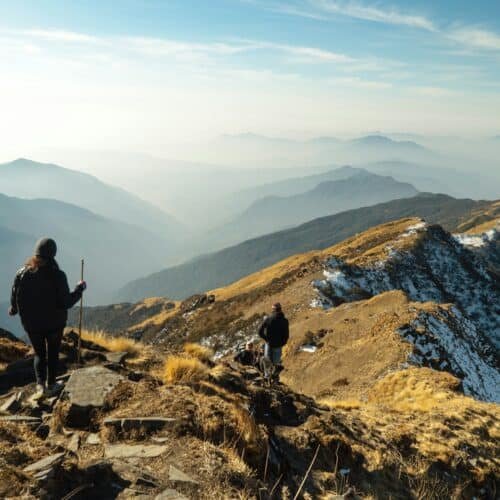
Stand alone on a Himalayan ridge at 3,660 metres and watch the sun set fire to Dhaulagiri and Annapurna South — with no crowds, no queue for the viewpoint, and a warm community lodge waiting behind you.
The Khopra Danda Trek (also called the Khopra Ridge Trek) is the Annapurna region‘s best-kept secret: a short, moderate trek that delivers views the equal of anything on the famous trails, through Gurung and Magar villages and rhododendron forest, to a sacred alpine lake at 4,660 metres — and it does it while most trekkers are still queuing shoulder-to-shoulder for sunrise at Poon Hill a few valleys away.
This is a fully guided 10-day package, Kathmandu to Kathmandu, built by guides who have walked this ridge in every season. What makes Khopra special is not just the quiet; it is the community-lodge model, where the lodges on the ridge are owned and run collectively by local villages, so your money stays in the mountains that host you. We tell you honestly what the trail demands, we pace the altitude sensibly, and we make the sacred Khayer Lake day hike optional because it is genuinely tough.
- Licensed, experienced local trekking guide and porter support
- All ACAP (and TIMS, where applicable) permits, arranged and included
- Community-lodge accommodation on the ridge — your fees support the villages
- Honest altitude pacing and a proper plan for the strenuous Khayer Lake side trip
- Quieter than Poon Hill and the Annapurna Base Camp trail, with equally huge views
- Small groups and private departures; solo and family-friendly options
US$890 per person — fully guided, all-inclusive on the trail. Flexible departure dates from Kathmandu or Pokhara. Send us your dates to check availability.
Tour Highlights
Everything that makes the Khopra Danda Trek worth choosing, at a glance:
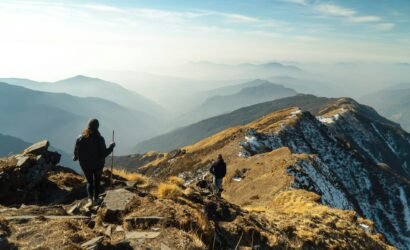
- Khopra Ridge at sunrise and sunset. An open ridge at 3,660 m with an uninterrupted 360-degree sweep from Dhaulagiri (8,167 m) to Annapurna South, Nilgiri, Hiunchuli and Fishtail — arguably the finest single viewpoint in the whole region, and you may have it almost to yourself.
- Sacred Khayer Lake at 4,660 m. An optional, demanding day hike to a holy glacial lake beneath Annapurna South, ringed by peaks — a genuine high-altitude reward and a real sense of achievement.
- A trail without the crowds. Khopra sits just off the busy Ghorepani–Poon Hill and Annapurna Base Camp routes, so you get the same Himalaya with a fraction of the foot traffic.
- Authentic Gurung and Magar villages. Ghandruk, Tadapani, Swanta and Ghorepani — real working mountain communities, not trekking dormitories.
- The community-lodge story. Khopra’s ridge lodges are run collectively for community benefit, one of Nepal’s best examples of tourism that actually reaches local people.
- Poon Hill too, if you want it. The classic Poon Hill sunrise is built into the descent, so you get the icon as a bonus rather than the whole trip.
- Rhododendron forest and wildlife. Blazing red and pink blooms in spring, plus the chance of Himalayan thar and the danphe (Nepal’s national bird) along the way.
Quick Facts Table
| Trek | Khopra Danda Trek (Khopra Ridge) with Khayer Lake |
| Price | US$890 per person (fully guided, all-inclusive on the trail; fixed) |
| Duration | 10 days, Kathmandu to Kathmandu (trek portion approx. 6–7 days) |
| Maximum altitude | Khayer Lake ~4,660 m (optional); Khopra Ridge ~3,660 m |
| Highest overnight | Khopra Danda community lodge, ~3,660 m |
| Difficulty | Moderate — steep ascents/descents; Khayer Lake day hike is strenuous |
| Region | Annapurna Conservation Area, Myagdi/Kaski districts, north-west of Pokhara |
| Accommodation | Teahouses and community lodges (basic, clean, twin share) |
| Permits | ACAP required (and TIMS where applicable) — both arranged and included |
| Guide | Licensed guide mandatory in Nepal since 2023; included |
| Best seasons | Autumn (Sep–Nov) and Spring (Mar–May) |
| Group size | Small groups; private departures available |
| Start / end | Kathmandu (with an internal leg via Pokhara) |
Overview
The Khopra Danda Trek is one of the smartest choices in the entire Annapurna region, and once you understand why, it is hard to un-see. Nepal’s classic short trek — Ghorepani, Poon Hill — became a victim of its own success: the sunrise viewpoint can host hundreds of trekkers on a good autumn morning. Khopra Danda offers the same class of Himalayan panorama, arguably a better one, from a ridge that most of those trekkers never see, a short distance to the east.
The trek sits inside the Annapurna Conservation Area, north-west of Pokhara, bordering the Myagdi and Kaski districts, and threads together several of the region’s best assets. You climb through the beautiful Gurung village of Ghandruk, up through rhododendron and oak forest to Tadapani and the Dobato/Mulde viewpoints, and out onto Khopra Ridge itself at around 3,660 metres — an open, grassy shoulder facing directly into the wall of the Himalaya. From the ridge, the sacred Khayer Lake sits a hard day’s climb higher at roughly 4,660 metres, an optional excursion for those with the fitness and the desire to reach true alpine altitude. You descend via Swanta and Ghorepani, taking in the famous Poon Hill sunrise as a farewell.
The defining feature of this trek is the community lodge. Unlike the privately owned teahouses on most trails, the lodges on and around Khopra Ridge were developed as a community enterprise, with profits directed to local development — schools, health, and conservation. Trekking here is, in a real and measurable sense, a way of putting money into the villages you walk through. That, combined with the quiet trails and the enormous views, is why experienced trekkers and repeat visitors to Nepal increasingly choose Khopra over the busier classics.
This package runs 10 days from Kathmandu, with the trek itself occupying roughly six to seven walking days depending on the Khayer Lake option. It is moderate in difficulty — well within reach of a reasonably fit first-time trekker — with the single strenuous exception of the Khayer Lake day, which we treat with the seriousness it deserves.
Why Choose This Package
There is no shortage of companies selling the Khopra trek. Here is why travellers choose this one, laid out plainly enough to verify.
- Guides who know this specific ridge. Our licensed guides have walked Khopra in every season and know its particular quirks — where the trail is genuinely steep, how the Khayer Lake climb behaves in snow, which lodge has the best sunrise aspect. Generic Annapurna experience is not the same as knowing Khopra, and it shows on the trail.
- Honest altitude and difficulty pacing. We build the itinerary so your body has time to adjust before the Khopra and Khayer Lake heights, and we are frank that the Khayer Lake day is hard — a long, steep climb to 4,660 m and back. We make it optional and support it properly rather than pretending it is a stroll.
- Everything on the trail included, no gate surprises. ACAP and any applicable TIMS permits, guide, porter support, accommodation and meals on the trek are all included. Nepal’s trekking permit rules changed in 2023 and continue to be applied unevenly; as a licensed agency we handle the current requirements so you do not get caught out at a checkpoint.
- We put money where the trek is. By using the community lodges on the ridge, this package channels your spending into the villages that maintain the trail and the landscape. We will happily explain exactly how that works.
- Small groups and real flexibility. Private departures, flexible dates, and the freedom to add or drop the Khayer Lake excursion based on how you feel on the ridge — decided with your guide, on the day, honestly.
- We will tell you if it is not for you. If you are short on time or fitness, we will suggest a shorter Poon Hill or Mardi Himal option rather than sell you a trek you will not enjoy. Straight advice is how we earn repeat trekkers.
Why Trek Khopra Instead of Poon Hill?
This is the single most common question, and the honest answer is: for most trekkers, Khopra is the better experience — but not for everyone. Here is the straight comparison.
| Factor | Khopra Danda Trek | Ghorepani–Poon Hill Trek |
|---|---|---|
| Crowds | Very quiet; you may have the ridge to yourself | Very busy, especially at sunrise |
| Highest point | 3,660 m ridge (4,660 m with Khayer Lake) | 3,210 m (Poon Hill) |
| Views | 360° open ridge; arguably superior | Excellent, but from a crowded platform |
| Difficulty | Moderate (Khayer Lake day strenuous) | Easy to moderate |
| Duration | ~6–7 trek days | ~4–5 trek days |
| Accommodation | Community lodges + teahouses (basic) | Established private teahouses |
| Community benefit | High (community-lodge model) | Standard private ownership |
| Best for | Those wanting quiet, altitude and authenticity | Those wanting the shortest, easiest classic |
Choose Khopra if you want solitude, a genuine high-altitude option, a bigger sense of adventure, and to know your money supports the community. Choose Poon Hill if you have very limited time or fitness and want the gentlest possible introduction. The good news: this package gives you Poon Hill anyway, on the way down — so you are not choosing one over the other, you are getting the quiet ridge and the famous sunrise.
Detailed Day-by-Day Itinerary
Altitudes, distances and walking times are indicative; your guide adjusts each day around weather, trail conditions, and how the group is feeling. All trek nights are in teahouses or community lodges on a twin-share basis.
Day 1 — Arrive in Kathmandu (1,400 m)
Arrival and transfer to your hotel. Your guide meets you for a full trek briefing — route, kit check, permits and what to expect at altitude. Overnight in Kathmandu.
Day 2 — Kathmandu to Pokhara (822 m)
Travel to Pokhara, the lakeside town that is the gateway to the Annapurnas, by scenic tourist coach or optional short flight. The afternoon is free to relax by Phewa Lake and make any last kit purchases. Overnight in Pokhara.
Day 3 — Drive to the trailhead and trek to Ghandruk (1,940 m)
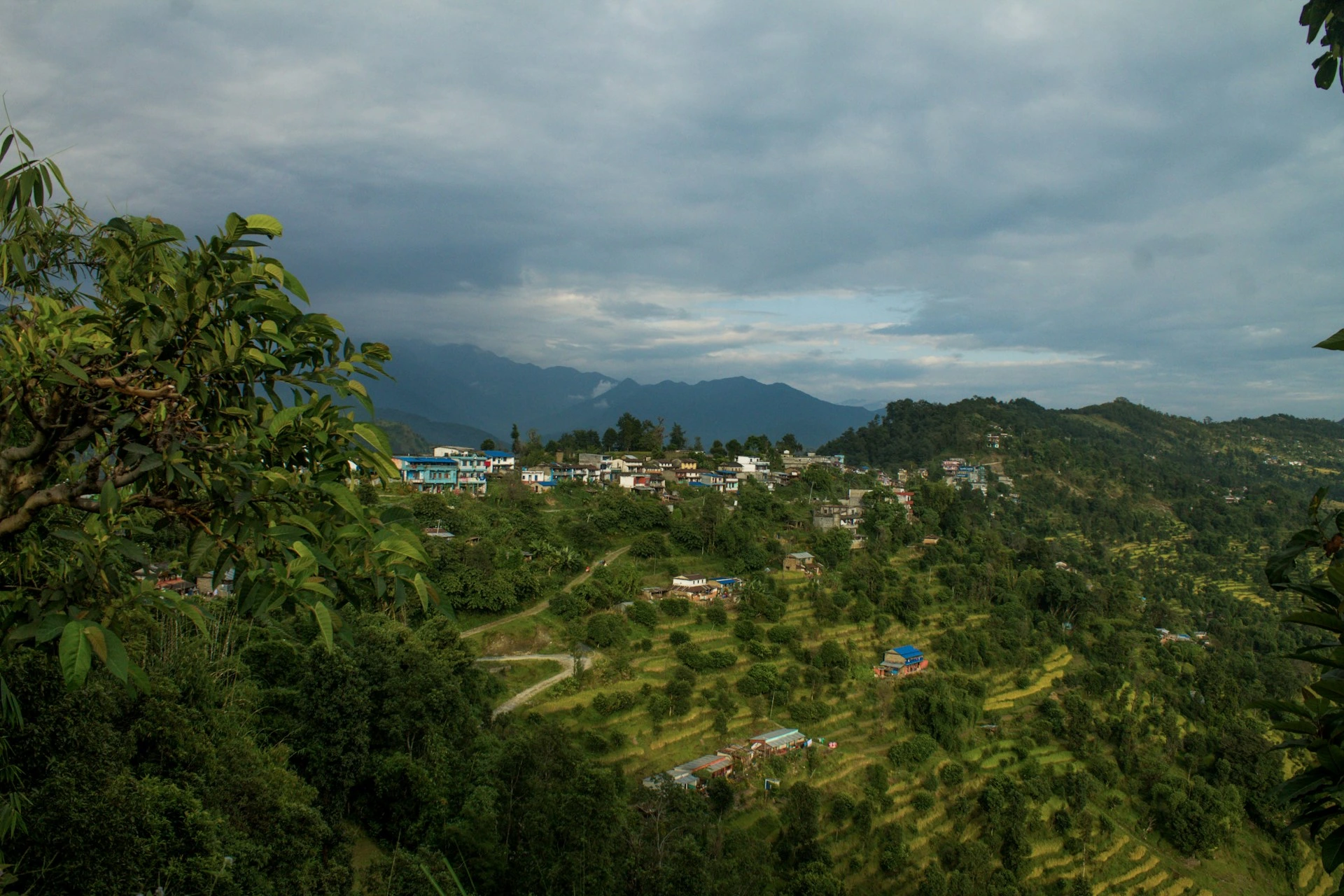
A morning drive brings you to the trail near Kimche, from where you climb to Ghandruk, one of the largest and most beautiful Gurung villages in Nepal, with stone houses, terraced fields and a first close look at Annapurna South and Fishtail. Approx. 3–4 hours walking. Overnight in Ghandruk.
Day 4 — Ghandruk to Tadapani (2,630 m)
A steady climb through dense rhododendron and oak forest — spectacular when in bloom (Mar–Apr) — to Tadapani, a small ridge settlement with fine mountain views. Approx. 5–6 hours. Overnight in Tadapani.
Day 5 — Tadapani to Dobato (3,420 m)
You leave the busier trail behind and head into quieter country, climbing to Dobato via the Bayeli area, with the option of the nearby Mulde (Muldai) viewpoint for a superb sunrise/sunset over Dhaulagiri and Annapurna. This is your first taste of real altitude, so we walk it steadily. Approx. 5–6 hours. Overnight in Dobato.
Day 6 — Dobato to Khopra Danda (3,660 m)
A memorable day along ridgelines and through forest to Khopra Danda itself, the trek’s centrepiece. Arriving in the afternoon, you settle into the community lodge and, weather permitting, watch the sunset ignite Dhaulagiri and Annapurna South directly across the valley. The night skies here are extraordinary. Approx. 5–7 hours. Overnight at the Khopra community lodge.
Day 7 — Khopra Danda: Khayer Lake day hike (4,660 m) or rest/acclimatise
The big optional day. Those with the fitness make the long, steep round-trip climb to the sacred Khayer Lake at roughly 4,660 m, set beneath Annapurna South, with a small Barah shrine on its shore — a demanding 7–9 hour outing and the trek’s highest, hardest point. Those who prefer can take an easier acclimatisation day on the ridge, exploring the viewpoints. Either way, a second sunrise from Khopra. Overnight at the Khopra community lodge.
Day 8 — Khopra Danda to Swanta to Ghorepani (2,860 m)
A long descent off the ridge through Chistibung and the village of Swanta, then a climb across to Ghorepani, rejoining the classic Annapurna trail. Approx. 6–7 hours. Overnight in Ghorepani.
Day 9 — Poon Hill sunrise (3,210 m), descend, drive to Pokhara
A pre-dawn climb to Poon Hill for the celebrated sunrise over the Annapurna and Dhaulagiri ranges, then back for breakfast and a long descent through Ulleri’s famous stone staircase to the road, and a drive back to Pokhara. Approx. 5–6 hours walking plus drive. Overnight in Pokhara.
Day 10 — Pokhara to Kathmandu and departure
Return to Kathmandu by coach or optional flight, and onward to your international departure or next adventure. (We recommend a buffer day in Kathmandu for flight safety, which we are happy to add.)
Itinerary flexibility: the trek can be shortened, lengthened, started from Nayapul/Ghandruk differently, or combined with Mardi Himal or Annapurna Base Camp. Tell us your dates and priorities and we will tailor it.
Accommodation
Accommodation on this trek is part of its character. In Kathmandu and Pokhara you stay in comfortable tourist-standard hotels (upgradable on request). On the trail, you stay in teahouses and, on the ridge, in community lodges.
Be clear-eyed about what mountain lodges are: rooms are simple, usually twin-share with basic beds and shared bathrooms, and the higher you go the more basic they become. At Khopra, the community lodge is well-run and clean but genuinely remote — expect solar power, bucket hot showers (sometimes for a small charge), and cosy dining rooms warmed by a stove. This simplicity is the trade-off for sleeping on one of the great viewpoints in the Himalaya, and most trekkers find it a fair one. What the community lodge lacks in luxury it makes up for in the knowledge that your stay directly supports local villages.
| Location | Accommodation type | Comfort level |
|---|---|---|
| Kathmandu / Pokhara | Tourist-standard hotel | Comfortable, en-suite, upgradable |
| Ghandruk, Tadapani, Ghorepani | Established teahouse | Basic to comfortable, some en-suite |
| Dobato, Khopra Ridge | Community lodge / teahouse | Basic, twin-share, shared facilities, remote |
Meals
On the trek, all meals are included — breakfast and dinner at your overnight lodge, and lunch at a teahouse along the day’s trail. Mountain menus are simple, hearty and carbohydrate-heavy, which is exactly what you want at altitude.
The staple, and the smart choice, is dal bhat — lentil soup, rice, vegetable curry and pickles — nourishing, freshly cooked, and traditionally served with free refills (the trekker’s saying “dal bhat power, 24 hour” exists for a reason). You will also find noodle and pasta dishes, fried rice, momos, potatoes, eggs, soups, and endless tea. Higher up, menus shrink and prices rise, because everything is carried in by porter or mule.
- Dietary needs — vegetarian is easy and often the freshest choice; vegan and other needs can be managed with notice, though options narrow at altitude.
- Hydration — drink plenty (3+ litres a day helps with acclimatisation). We advise treating or buying safe water rather than relying on untreated sources; your guide will point you to safe options.
- A note on hygiene — we favour lodges we trust. Be sensible with anything raw at altitude.
Transportation
The package includes all ground transport on the itinerary: airport transfers, the Kathmandu–Pokhara legs, and the drives to and from the trailhead.
- Kathmandu ⇄ Pokhara by comfortable tourist coach (roughly 6–7 hours through river-valley scenery), or by optional 25-minute flight for those short on time (at extra cost).
- Pokhara ⇄ trailhead by private vehicle or shared jeep to the road-head near Kimche/Ghandruk on the way in, and from the Ulleri/Tikhedhunga side out. Road conditions in the hills can be rough and are weather-dependent; your guide manages this.
If you would prefer private vehicles throughout, or to fly the Kathmandu–Pokhara legs, tell us and we will quote the upgrade.
Permits
Two permit matters apply to the Khopra Danda Trek, and both are handled for you in this package.
ACAP (Annapurna Conservation Area Permit). This is mandatory for the entire trek, which lies within the Annapurna Conservation Area. The current fee for foreign nationals is NPR 3,000 (about US$25), and NPR 1,000 for SAARC nationals; children under 10 are exempt. The permit is issued by the National Trust for Nature Conservation via the Nepal Tourism Board offices in Kathmandu and Pokhara, and the fees fund conservation, trail maintenance and community development in the region.
TIMS (Trekkers’ Information Management System). The TIMS card is a trekker-registration and safety system. Its status for the Annapurna region has changed since 2023 and has been applied inconsistently, with the fee typically NPR 2,000 for individual foreign trekkers and NPR 1,000 for those trekking in a group through a registered agency (SAARC nationals pay less). Because the rules have shifted, we arrange whatever is currently required so you are always compliant at checkpoints.
Guide requirement. Since 2023, Nepal requires trekkers in most regions, including Annapurna, to trek with a licensed guide or through a registered agency; fully independent solo trekking is no longer permitted on these trails. This package includes your licensed guide, so the requirement is met.
| Permit | Foreign national | SAARC national | Included? |
|---|---|---|---|
| ACAP | NPR 3,000 (~US$25) | NPR 1,000 | Yes |
| TIMS (where applicable) | NPR 2,000 (individual) / 1,000 (group) | Lower | Yes |
| Licensed guide | Mandatory | Mandatory | Yes |
Permit fees are set by the authorities and revised periodically; we confirm current rates at the time of your trek.
Cost Breakdown
This trek has one clear, fixed price — US$890 per person — covering everything on the itinerary: your licensed guide and porter support, all permits (ACAP and any applicable TIMS), accommodation throughout, all meals on the trek, and all ground transport on the listed route. No confusing ranges, and no fees sprung on you at a checkpoint.
| What you pay | Price per person |
|---|---|
| Khopra Danda Trek (10 days, fully guided) | US$890 |
The price is fixed year-round so you can plan with confidence.
| Season | Months | Price per person |
|---|---|---|
| Peak (autumn) | September–November | US$890 |
| Peak (spring) | March–May | US$890 |
| Off-peak | December–February, June–August | US$890 |
Group and private rates: the per-person price is lower for larger private groups and can be quoted for your party — send us your group size for a fixed group rate.
What is priced separately (so your total is always clear in advance): the optional Kathmandu–Pokhara flights, hotel upgrades in the cities, single-room supplements where lodges allow, and any extra nights or itinerary extensions.
An honesty note. Be sceptical of unusually cheap “all-inclusive” Khopra prices. Rock-bottom quotes usually mean an underpaid or unlicensed guide, permits excluded and charged later, or corners cut on safety. Everything in our US$890 price is spelled out below under Includes and Excludes so you can compare like for like.
Difficulty
The Khopra Danda Trek is rated moderate. It is not a technical climb — there is no ice-axe or rope work — but it is a genuine mountain trek with sustained ups and downs, some long days, and real altitude. In plain terms: a reasonably fit person who prepares with some hill walking will manage the main trek comfortably; the Khayer Lake day is a step harder.
What makes it moderate rather than easy is the terrain. Himalayan trails go up and down relentlessly — the descent from Khopra and the stone staircase near Ulleri are hard on the knees, and the climbs are long. Expect roughly five to seven hours of walking on most days, on trails that range from good stone paths to rough, rocky sections higher up. The single strenuous element is the Khayer Lake excursion: a long, steep round trip to 4,660 m, which is optional precisely because it is demanding and altitude-sensitive.
Fitness Requirements
You do not need to be an athlete, but you do need to be trek-fit. The best preparation is specific: get out and walk hills.
- Start 4–8 weeks out. Build up regular walks, ideally on hills or stairs, working toward being comfortable walking 5–6 hours with a light daypack.
- Add cardio and legs. Running, cycling, swimming and stair climbing all help; so does basic leg-strength work for the long descents.
- Break in your boots. Blisters ruin treks; wear your boots in thoroughly beforehand.
- Trekking poles help enormously, especially on the descents — use them.
If you can walk for several hours over hilly ground without undue distress, you are ready for the main trek. For the Khayer Lake day, honestly assess your fitness and altitude tolerance, and decide with your guide on the ridge.
Altitude and Acclimatization
Altitude is the one aspect of this trek to take seriously. You sleep as high as roughly 3,660 m at Khopra, and the optional Khayer Lake day reaches about 4,660 m — high enough that altitude sickness (Acute Mountain Sickness, AMS) is a real, if usually manageable, possibility.
The itinerary is designed to bring you up gradually rather than jumping to altitude, which is the single best defence. Beyond that, the rules are simple and evidence-based:
- Ascend gradually and do not overexert. Our pacing is built for this; let your body set the tempo.
- Hydrate well — aim for 3+ litres of fluid a day.
- Know the symptoms of AMS: headache, nausea, dizziness, loss of appetite, poor sleep. Mild symptoms are common; tell your guide about anything you feel.
- The golden rule: if symptoms are more than mild or are worsening, do not go higher — and descend if they persist. Descent is the definitive treatment.
- Diamox (acetazolamide) is used by some trekkers as a preventive or treatment; discuss it with your doctor before you travel, and never use altitude medication as a reason to push past worsening symptoms.
The Khayer Lake day is where altitude matters most — a fast climb to 4,660 m. Your guide watches everyone closely, and turning back is always an acceptable, sensible choice. No view is worth serious altitude illness, and we will always err on the side of your safety.
For deeper reading, we point trekkers to reputable resources on altitude illness such as the guidance published by mountain-medicine bodies; ask your guide or doctor.
Khayer Lake Side Trip
Khayer Lake (Khayer Tal, or Khayer Barah) is the spiritual and physical high point of the trek — a small, sacred glacial lake at roughly 4,660 m, cradled beneath the south face of Annapurna South. On its shore stands a small Barah shrine, and the lake is holy to Hindus and Buddhists alike; during the Janai Purnima festival (around the July/August full moon) pilgrims make the arduous journey up to bathe in its waters.
For trekkers, the day hike from the Khopra community lodge is the trek’s toughest and most rewarding outing: a long, steep climb of roughly 1,000 m of ascent and the same in descent, typically 7–9 hours round trip, on rough alpine ground that can hold snow well into the season. The reward is genuine high-mountain scenery — the lake, the shrine, and an amphitheatre of peaks including Annapurna South, Nilgiri, Barah Shikhar and the Dhaulagiri range — and the quiet satisfaction of standing somewhere very few people reach.
We make this excursion optional for good reason: it is strenuous and altitude-sensitive, and not every trekker will want or be ready for it. Those who skip it lose nothing of the trek’s core — Khopra Ridge alone justifies the journey — and enjoy an easier acclimatisation day on the ridge instead. Your guide helps you make the honest call on the morning, based on weather, snow and how you feel.
Khopra Ridge
Khopra Danda — danda means ridge — is the heart of the trek: a broad, open, grassy shoulder at around 3,660 m that faces directly into the Himalaya with nothing in the way. Where Poon Hill gives you a fine but distant panorama from a crowded platform, Khopra puts you on an unobstructed ridge, close and high, with the great peaks filling the sky across the valley.
The magic is in the light. At sunrise and sunset the snow walls of Dhaulagiri and Annapurna South turn gold, then rose, then a deep alpenglow, and because you are staying right there at the community lodge, you experience it without a dawn scramble or a crowd. After dark, the absence of any light pollution makes Khopra one of the finest stargazing spots in the region — the Milky Way arcs overhead on clear nights. It is the kind of place that reorders your sense of scale, and the reason trekkers who have done the famous routes come back for this quieter one.
The Views: Peaks You’ll See
Khopra’s viewpoint is remarkable for how many major peaks it gathers into one sweep. The headline summits:
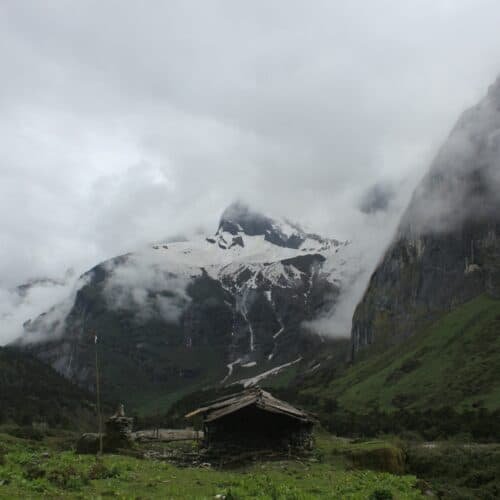
- Dhaulagiri (8,167 m). The seventh-highest mountain on earth dominates the western skyline — a colossal, isolated massif, and from Khopra you see it in full, an experience few viewpoints in Nepal offer so completely.
- Annapurna South (7,219 m). Rearing up close and steep to the north-east, Annapurna South is the peak that towers over Khopra and looms above Khayer Lake — the trek’s defining presence.
- Nilgiri (up to ~7,061 m). The striking Nilgiri peaks rise to the north above the Kali Gandaki, sharp and photogenic beside Annapurna.
- Hiunchuli (6,441 m). The rugged peak that guards the entrance to the Annapurna Sanctuary, seen clearly along the trek.
- Machhapuchhre / Fishtail (6,993 m). The sacred, unclimbed “fishtail” peak — perhaps Nepal’s most recognisable summit — appears from viewpoints along the route.
On clear days you can also pick out Tukuche Peak, Barah Shikhar (Fang), Gangapurna and other Annapurna summits. Your guide will name them for you, ridge by ridge, in the morning light.
Best Time to Visit and Weather
Timing shapes your trek more than almost anything else. Two seasons stand out, and two are for the well-prepared only.
| Season | Months | What to expect |
|---|---|---|
| Autumn | September–November | The premier season: stable weather, clear skies, crisp air and the sharpest mountain views. Cool nights at altitude. Peak trekking time. |
| Spring | March–May | The other great season: warmer, with the rhododendron forests in spectacular bloom. Some afternoon haze/cloud builds later in spring. |
| Winter | December–February | Cold and quiet, with snow at altitude that can block the Khayer Lake climb. Clear, beautiful, but for prepared trekkers with warm kit. |
| Monsoon | June–August | Wet, with leeches, cloud and slippery trails; views often obscured. Generally avoided, though the rain-shadow effect and Janai Purnima pilgrimage draw a few. |
Weather in brief: the lower villages are mild to warm by day in the trekking seasons, while nights on the ridge are cold — near or below freezing in late autumn and winter, and genuinely cold on the Khayer Lake heights. Mountain weather changes fast; we build the days to catch the clear mornings and plan around afternoon cloud. Whatever the season, come prepared for cold at altitude even if the valleys are warm.
Culture: Gurung and Magar Communities
The Khopra trail is as much a cultural journey as a scenic one, winding through the heartland of two of Nepal’s most storied hill communities.
The Gurung are the dominant community in villages like Ghandruk and around Ghorepani. Traditionally herders and farmers of the middle hills, the Gurung are also famous as soldiers — the backbone of the legendary Gurkha regiments — and many village households have a Gurkha history. Their culture blends Tibetan Buddhist and indigenous traditions, and their stone-built, slate-roofed villages, set among terraced fields with the Himalaya behind, are among the most beautiful in Nepal. Ghandruk in particular, with its museum and immaculate stone lanes, is a highlight in its own right.
The Magar are one of Nepal’s largest indigenous groups and, like the Gurung, are strongly associated with military service and hill farming. You pass through Magar settlements such as Swanta and villages on the Ghorepani side, where you will see traditional houses, farming life, and warm hospitality. Both communities are central to the community-lodge enterprise that makes this trek special — the people who host, feed and guide you are the same people whose villages your fees support. Take the time to talk with your hosts; it is where the trek’s real richness lies.
Wildlife
The Annapurna Conservation Area is rich in Himalayan wildlife, and Khopra’s quieter trails improve your chances of encounters. The forests are a mosaic of rhododendron, oak, bamboo and pine, home to a wide variety of birds and mammals.
Look (and listen) for the danphe (Himalayan monal / Impeyan pheasant), Nepal’s dazzling, iridescent national bird, often seen along the higher forest edges. Higher up, on rocky slopes toward Khopra and Khayer Lake, you may spot Himalayan thar, the wild mountain goat, sure-footed on the crags. The area is also home — though sightings are rare and lucky — to musk deer and a host of Himalayan bird species, from raptors soaring on thermals to colourful forest passerines. Spring adds the spectacle of the rhododendron bloom, when whole hillsides turn red and pink. Your guide will help you spot and name what you see; keeping quiet and looking up pays off.
Photography Tips
- Own the golden hours. Sunrise and sunset from Khopra Ridge are the shots of the trek — and because you sleep on the ridge, you can shoot them without a crowd. Be set up early.
- Shoot the scale. Place a lodge, a person or a prayer flag against the peaks to convey how vast Dhaulagiri and Annapurna South really are.
- Bring for the cold and the dark. Batteries drain fast in the cold — keep spares warm in an inside pocket. For the Khopra night sky, a tripod and a fast wide lens turn the Milky Way into a portfolio piece.
- Rhododendron season (spring) is a gift — frame the red blooms with snow behind.
- Respect people and rituals. Ask before photographing villagers and at the Khayer Lake shrine; a smile and a moment’s courtesy earn far better portraits.
- Protect your gear from dust on the descents and moisture in cloud; a simple rain cover and lens cloth go a long way.
Packing List
Layering is everything in the mountains. The essentials:
Clothing
- Moisture-wicking base layers (top and bottom)
- Insulating mid-layers (fleece) and a warm down jacket for the ridge
- Waterproof/windproof shell jacket and trousers
- Trekking trousers, trekking shirts, warm hat, sun hat, gloves, buff/scarf
- Broken-in trekking boots and camp shoes; several pairs of trekking socks
- Thermal sleepwear for cold nights at Khopra
Gear
- Daypack (20–35 L) and a duffel for the porter
- Four-season sleeping bag (comfort rated to around −10 °C for the ridge)
- Trekking poles (strongly recommended)
- Headlamp with spare batteries
- Reusable water bottles/bladder plus purification (tablets, filter or SteriPen)
- Sunglasses (high UV at altitude) and high-SPF sunscreen and lip balm
Health and personal
- Personal first-aid kit; any personal medication; blister care
- Altitude medication if advised by your doctor (Diamox)
- Quick-dry towel, wet wipes, hand sanitiser, basic toiletries
- Power bank (charging is limited and sometimes charged for) and adapters
- Some cash in NPR for drinks, showers, charging, tips and extras
Internet
Mobile coverage follows the trail: reasonable in the lower villages (Ghandruk, Tadapani, Ghorepani), patchy to non-existent as you climb toward Khopra and especially on the Khayer Lake heights above 4,000 m. Nepal Telecom (NTC) generally gives the best hill coverage, so a local NTC SIM with data is worth buying in Kathmandu or Pokhara. Many teahouses offer Wi-Fi, sometimes for a small fee and usually slow, and it thins out higher up. Treat Khopra as a chance to disconnect — the ridge rewards it.
Electricity
Nepal runs on 230V, 50Hz with Type C, D and M plugs, so bring a universal adapter. In the cities, power is normal. On the trek, lower teahouses have mains electricity; higher up, and at the Khopra community lodge, power is often solar, and charging your devices usually costs a small fee and cannot be guaranteed. Carry a good power bank (and keep it warm; cold drains batteries), and bring spare camera batteries.
Money
- Currency: Nepalese Rupee (NPR). Carry enough cash for the whole trek — there are no ATMs on the trail, and lodges are cash-only.
- Where to withdraw: get your trek cash in Kathmandu or Pokhara, where ATMs are plentiful (with per-withdrawal limits and fees).
- What you’ll spend on top of the package: drinks, hot showers and charging where charged, snacks, Wi-Fi, and tips. Budget a comfortable daily buffer.
- Tipping: customary and genuinely appreciated. A fair guideline is to tip your guide and porter as a group at the end of the trek, according to service — they work hard for you, and it matters to them.
Safety
Your safety is the priority that shapes every decision on this trek.
- Experienced licensed guides trained in mountain safety and first aid lead every departure and monitor the group for altitude and fatigue.
- Sensible altitude management — gradual ascent, honest assessment, and a readiness to descend — is our first line of defence, and it works.
- The Khayer Lake day is optional and closely supervised; turning back is always an acceptable choice.
- On the trail: trekking poles for the steep descents, care on rough or snowy sections, and staying with your group. Mountain weather can change fast; your guide plans around it.
- Emergencies: in the event of serious illness or injury, evacuation (including by helicopter where warranted) is arranged — which is exactly why comprehensive insurance is non-negotiable (below).
The Khopra trek is a low-risk experience when run properly by professionals, and that is how we run it.
Insurance
Comprehensive travel insurance is mandatory for this trek and must explicitly cover high-altitude trekking (to at least 4,660 m / around 5,000 m to be safe) and emergency helicopter evacuation, as well as medical treatment, trip cancellation and your belongings. Many standard policies exclude high-altitude activity, so check the wording carefully and get written confirmation of the altitude limit. Insurance is not included in the package and is the trekker’s responsibility; we ask to see proof before departure, for your protection and ours.
Responsible Tourism
Trekking here should leave the mountains and their communities better, not worse.
- This trek is built on community benefit. Choosing the community lodges directs your spending to local development — one of the most tangible examples of responsible trekking in Nepal.
- Respect local culture. Ask before photographing people, dress modestly in villages, and treat the Khayer Lake shrine and other sacred spots with care.
- Leave no trace. Carry out your rubbish, minimise single-use plastic (refill and purify rather than buying bottled water), and stay on established trails.
- Support local, tip fairly. Local guides, porters, lodges and shops keep tourism’s benefits in the hills.
- Treat porters well. We cap porter loads and ensure their wages, insurance, food and shelter — please respect their work and pack sensibly so they are not overloaded.
- Your permit fees protect the region. ACAP fees fund conservation and trail maintenance across the Annapurna Conservation Area.
For official information we point trekkers to the Nepal Tourism Board (ntb.gov.np) and the National Trust for Nature Conservation / ACAP.
Solo Travelers
Khopra is an excellent choice for solo trekkers. Since 2023, Nepal requires a licensed guide for trekking in this region, so you will not be walking alone regardless — and that is a genuine safety benefit, especially at altitude. Solo travellers can join a small-group departure to share the experience and lower the cost, or take a fully private guided trek for maximum flexibility. Solo female trekkers report the Annapurna region as welcoming and safe with a professional guide, and we can arrange female guides or specific support on request. Tell us your preference and we will match you to the right departure.
Family Suitability
For active families, the core Khopra trek (without the Khayer Lake day) is a rewarding and achievable adventure. Children who are used to day hikes generally cope well with the moderate walking days, and the community lodges, mountain wildlife and village life make a vivid, screen-free experience. That said, be realistic: this is a genuine mountain trek with altitude, cold nights and basic facilities, and it is best suited to older children and teenagers rather than very young ones. The Khayer Lake excursion, at 4,660 m, is not recommended for children. We are happy to adapt the pace, shorten days, and advise honestly on whether the trek suits your family’s ages and experience — and to suggest gentler alternatives if it does not.
Frequently Asked Questions (40)
1. What is the Khopra Danda Trek? A moderate trek in the Annapurna region to Khopra Ridge (about 3,660 m), with an optional day hike to the sacred Khayer Lake (about 4,660 m). It offers huge views of Dhaulagiri and Annapurna South from a quiet, community-lodge trail east of the famous Poon Hill route.
2. How high is Khopra Danda? Khopra Ridge sits at roughly 3,660 m. The optional Khayer Lake side trip reaches about 4,660 m, the highest point of the trek.
3. How high is Khayer Lake? Khayer Lake is a sacred glacial lake at approximately 4,660 m (sources cite figures between about 4,500 and 4,700 m), beneath Annapurna South.
4. How long is the trek? This package is 10 days from Kathmandu to Kathmandu, with about six to seven days of actual walking. It can be shortened or lengthened to suit your schedule.
5. How difficult is the Khopra Danda Trek? Moderate. The main trek suits reasonably fit first-timers who prepare with hill walking; the optional Khayer Lake day is strenuous due to a steep climb to 4,660 m.
6. Do I need trekking experience? No prior trekking experience is required for the core trek, but good general fitness and some hill-walking preparation make it far more enjoyable. The Khayer Lake day rewards a higher fitness level.
7. Is Khopra better than Poon Hill? For most trekkers, yes — Khopra offers arguably better views with far fewer crowds and an optional high-altitude lake. This package includes Poon Hill on the way down, so you get both.
8. What is the best time to trek Khopra Danda? Autumn (September–November) for the clearest skies and spring (March–May) for the rhododendron bloom. Winter is cold with snow at altitude; monsoon is wet and often cloudy.
9. What permits do I need? The ACAP (Annapurna Conservation Area Permit) is required, plus a TIMS card where applicable. Both are included in this package. A licensed guide is also mandatory and included.
10. How much is the ACAP permit? NPR 3,000 (about US$25) for foreign nationals and NPR 1,000 for SAARC nationals; children under 10 are exempt. It is included in your package.
11. Is a TIMS card required? TIMS rules for Annapurna changed in 2023 and have been applied inconsistently; the fee, where charged, is typically NPR 2,000 (individual) or NPR 1,000 (group). We arrange whatever is currently required, and it is included.
12. Can I trek Khopra without a guide? No. Since 2023, Nepal requires trekkers in the Annapurna region to use a licensed guide or registered agency; independent solo trekking is not permitted. A guide is included in this package.
13. How much does the Khopra Danda Trek cost? This package is a fixed US$890 per person, fully guided and all-inclusive on the trail. Larger private groups get a lower per-person rate — contact us for a group quote.
14. What is included in the price? Guide and porter support, all permits, accommodation, all trek meals, and all ground transport on the itinerary. Full details are in the Includes and Excludes sections.
15. What is not included? International airfare, visa, insurance, optional flights and hotel upgrades, city lunches/dinners, personal gear, drinks and personal expenses, and tips.
16. What is the accommodation like? Tourist-standard hotels in Kathmandu and Pokhara, and basic but clean teahouses and community lodges on the trek (twin-share, shared facilities higher up). The Khopra community lodge is remote and simple.
17. What is a community lodge? On and around Khopra Ridge, the lodges are run collectively for community benefit, with profits supporting local development. Staying there means your money directly supports the villages.
18. What food is available on the trek? Simple, hearty mountain fare — dal bhat (the smart, refillable staple), noodles, pasta, fried rice, momos, potatoes, eggs, soups and tea. All trek meals are included.
19. Can dietary requirements be met? Yes — vegetarian is easy and fresh; vegan and other needs can be managed with notice, though options narrow at altitude.
20. Will I get altitude sickness? It is possible above roughly 3,000 m, and the Khayer Lake day (4,660 m) carries the highest risk. Our gradual pacing minimises it; tell your guide about any symptoms, and remember that descent is the definitive treatment.
21. How do I prevent altitude sickness? Ascend gradually (the itinerary is built for this), hydrate well, avoid overexertion, and do not go higher if symptoms are more than mild. Discuss Diamox with your doctor before travel.
22. Is the Khayer Lake side trip compulsory? No — it is optional because it is strenuous and altitude-sensitive. The core trek is complete and spectacular without it, and you can decide on the ridge with your guide.
23. What mountains will I see? Dhaulagiri (8,167 m), Annapurna South (7,219 m), Nilgiri, Hiunchuli (6,441 m), Machhapuchhre/Fishtail (6,993 m), and others including Tukuche Peak and Annapurna summits.
24. Where does the trek start and end? It starts and ends in Kathmandu, routed via Pokhara and the trailhead near Kimche/Ghandruk, exiting via Ghorepani, Poon Hill and Ulleri.
25. How many hours a day will I walk? Typically five to seven hours on trek days. The Khayer Lake day is longer at seven to nine hours round trip.
26. What should I pack? Layered clothing including a down jacket, waterproof shell, warm sleeping bag, broken-in boots, trekking poles, headlamp, water purification and personal first aid. See the full packing list above.
27. Do I need insurance? Yes — comprehensive insurance covering high-altitude trekking and helicopter evacuation is mandatory. Check the altitude limit in your policy wording.
28. Is there internet and phone signal? Reasonable in lower villages, patchy to none as you climb toward Khopra and above 4,000 m. A Nepal Telecom SIM gives the best hill coverage; treat the ridge as a chance to disconnect.
29. Can I charge my devices? Yes in lower teahouses; higher up (and at Khopra) charging is limited, often solar, and usually costs a small fee. Bring a power bank and spare batteries.
30. Is the trek safe? Yes, when run professionally. Licensed guides, sensible altitude management, and a readiness to descend keep risk low. Comprehensive insurance covers the rare emergency.
31. Is Khopra suitable for solo travellers? Very much so. A guide is required and included, so you are never truly alone; join a small group to share costs or go private. Solo female trekkers are well supported.
32. Is the trek suitable for families? The core trek suits active families with older children or teenagers; the Khayer Lake day is not recommended for children. We adapt the pace and advise honestly on suitability.
33. How do I get to the trailhead? By coach or optional flight from Kathmandu to Pokhara, then a drive to the road-head near Kimche/Ghandruk. All transport on the itinerary is included.
34. What is the community-lodge model, and why does it matter? It is a locally owned, collectively run lodge system that channels tourism income into community development, rather than to a single private owner. It is a core reason to choose this trek.
35. Can I combine Khopra with other treks? Yes — it combines naturally with Poon Hill (already included on the descent), Mardi Himal, Mohare Danda or Annapurna Base Camp. Tell us your time frame and we will design it.
36. What wildlife might I see? The danphe (Nepal’s national bird), Himalayan thar on the higher crags, various Himalayan birds, and — rarely and luckily — musk deer, amid rhododendron and oak forest.
37. How cold does it get? Days are mild to cool in the trekking seasons; nights on the ridge drop to around or below freezing in late autumn and winter, and the Khayer Lake heights are colder. Pack a warm sleeping bag and down layer.
38. Are porters provided, and how are they treated? Yes, porter support is included (typically one per two trekkers). We cap loads and ensure their wages, insurance, food and shelter, and ask trekkers to pack sensibly and tip fairly.
39. What happens if I can’t finish the trek? Your guide will arrange a safe descent and, if needed, evacuation and onward care. This is exactly what your mandatory insurance is for; your safety always comes first.
40. How do I book? Send us your preferred dates, group size and any add-ons (flights, extensions), and we will confirm availability, your guide and your fixed price. Flexible dates and private departures are welcome.
Trek Cost Includes
- Airport pick-up and drop-off in Kathmandu
- Hotel accommodation in Kathmandu before and after the expedition
- Domestic flight tickets between Kathmandu and Lukla
- All required trekking and climbing permits
- Sagarmatha National Park entry fees
- Experienced expedition leader and professional Sherpa climbing guides
- Porters for carrying expedition equipment during the trekking section
- Full board meals during the trek and expedition period
- Teahouse accommodation during trekking days
- Tented accommodation at Base Camp and higher camps
- Group climbing equipment including ropes and fixed-line support
- Base Camp services including kitchen, dining tent, and communication setup
- Medical kit and emergency oxygen support
- Staff insurance, salary, food, and accommodation
- Expedition completion certificate
Trek Cost Excludes
- International airfare to and from Nepal
- Nepal entry visa fees
- Personal climbing gear and equipment
- Travel and rescue insurance
- Extra hotel nights in Kathmandu due to delays
- Personal expenses such as laundry, drinks, snacks, and hot showers
- Wi-Fi and charging costs during the trek
- Tips for guides, Sherpas, and porters
- Personal medical expenses
- Alcoholic beverages and soft drinks
- Helicopter evacuation costs if required
- Additional services not mentioned in the included section