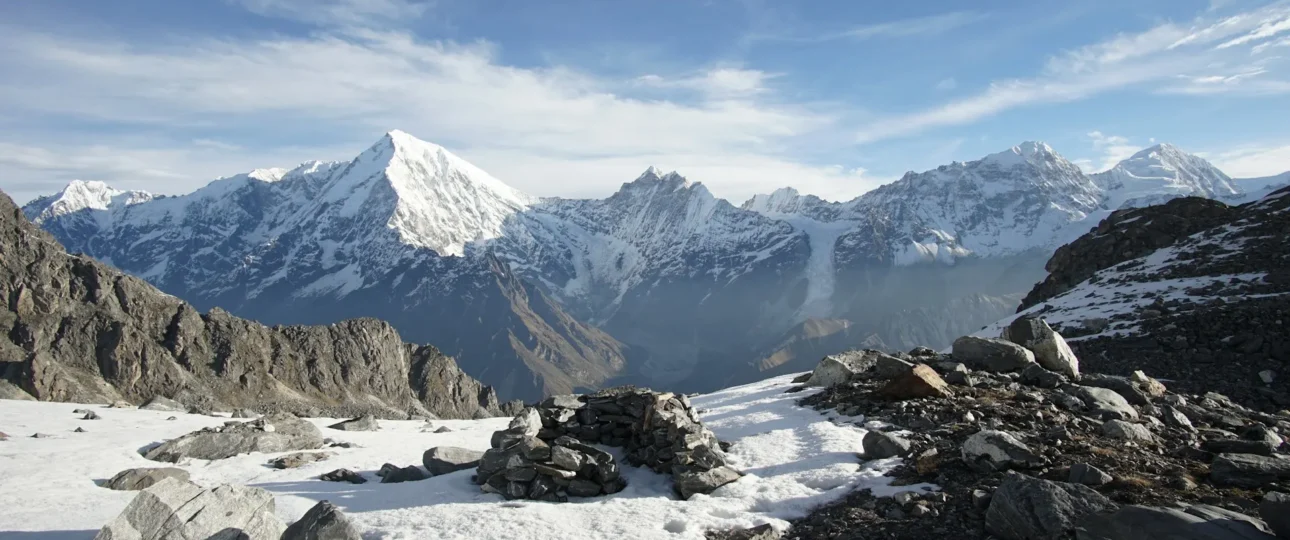
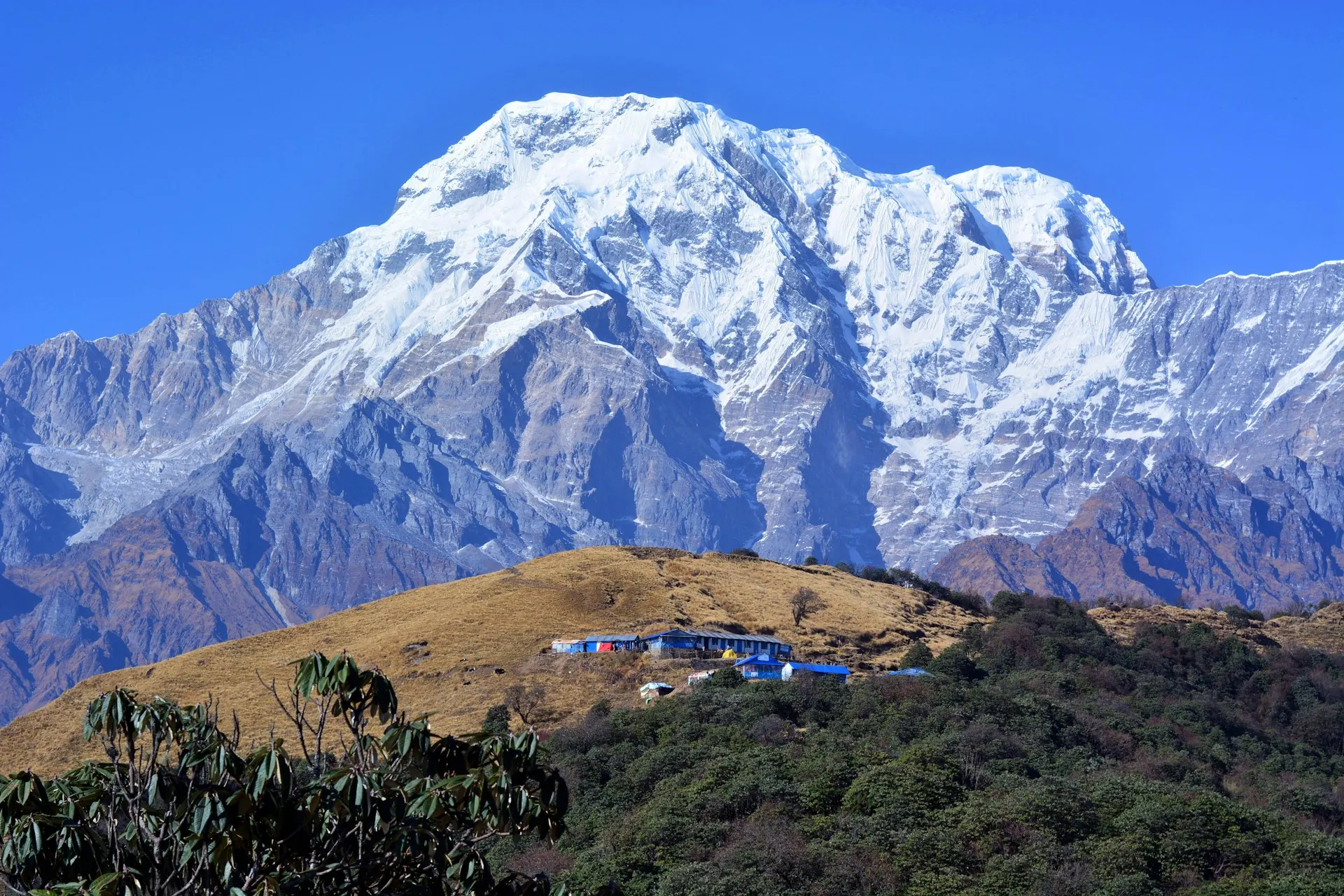
Mardi Himal Base Camp Trek sits at 4,500 metres on a narrow ridgeline in the Annapurna region, offering what many trekkers consider the most intimate view of Machhapuchhre—the sacred “Fishtail” peak—in Nepal. Unlike the crowded Annapurna Base Camp trail, this 4-to-7-day trek delivers panoramic mountain views from the moment you clear the tree line, with a fraction of the foot traffic.
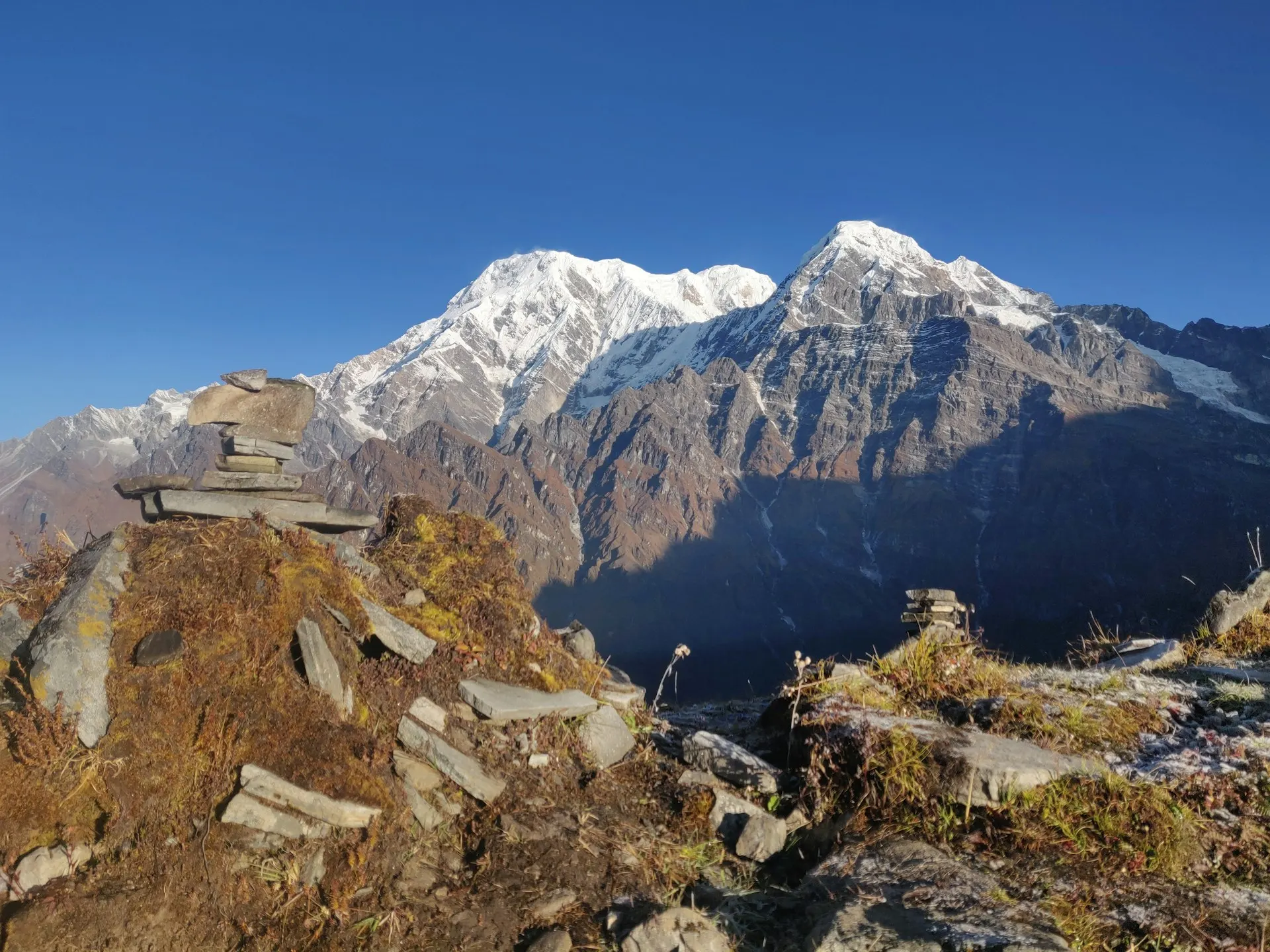
What makes Mardi Himal different is the ridge itself. You don’t simply arrive at a base camp surrounded by mountains; you walk along the spine of the ridge for the final two days, with the Annapurna range unfolding beside you. At the Upper Viewpoint—often referred to as Mardi Himal Base Camp—you stand directly beneath the south face of Machhapuchhre, close enough to see individual seracs on its glacier.
The trek is considered moderately difficult, though the altitude gain is steeper than many trekkers expect. You climb from 1,770m at Kande to 4,500m in just three to four days . Acclimatisation becomes the main challenge, not technical difficulty. This guide gives you everything you need to decide whether this trek is right for you, when to go, what it costs in 2026, and how to plan it properly.
Quick Facts at a Glance
| Fact | Detail |
|---|---|
| Highest Point | 4,500m (Upper Viewpoint / Mardi Himal Base Camp) |
| Total Distance | ~43-60km depending on route |
| Duration | 4-7 days trekking |
| Starting Point | Kande or Phedi (Australian Camp), near Pokhara |
| Ending Point | Siding (drive back to Pokhara) |
| Difficulty | Moderate |
| Permits Required | ACAP (NPR 3,000) + TIMS (USD 20 individual / USD 10 agency) |
| Best Season | October-November, March-April |
| Guide Requirement | Not legally required for Mardi Himal as it is not a restricted area; however, strongly recommended for safety and permit handling |
Where Is Mardi Himal Base Camp and How Do You Get There?
The Mardi Himal trek lies within the Annapurna Conservation Area, about 28km northeast of Pokhara. Most trekkers start from Pokhara, drive to the trailhead at Kande (about 1-1.5 hours), and begin walking from there. Some itineraries start at Phedi and climb to Australian Camp before joining the main Mardi route.
The standard route follows this progression:
Kande (1,770m) → Australian Camp → Deurali → Forest Camp (2,600m) → Low Camp (2,985m) → Badal Danda (3,210m) → High Camp (3,550m) → Upper Viewpoint / Mardi Himal Base Camp (4,500m)
Descent is typically via the same route back to Low Camp, then down through Siding village, where a vehicle meets you for the return drive to Pokhara .
Key Distinction: The “Mardi Himal Base Camp” most trekkers refer to is actually the Upper Viewpoint at 4,500m. The viewpoint and the true Base Camp are sometimes differentiated, but for planning purposes, the 4,500m viewpoint is your goal—this is where the view of Machhapuchhre is most dramatic .
How High Is Mardi Himal Base Camp? (Altitude Explained)
The highest point of the trek is 4,500 metres (14,764 feet) at the Upper Viewpoint, often called Mardi Himal Base Camp .
To put this in perspective:
| Altitude Comparison | Height |
|---|---|
| Mardi Himal Base Camp | 4,500m |
| Annapurna Base Camp | 4,130m |
| Everest Base Camp (Nepal) | 5,364m |
| Kilimanjaro (summit) | 5,895m |
At 4,500m, you are well above the threshold (3,000m) where altitude sickness becomes a genuine concern. The oxygen level is roughly 60% of sea level, and many trekkers experience symptoms including headaches, breathlessness, and fatigue.
What this means practically:
-
The climb from High Camp (3,550m) to Upper Viewpoint (4,500m) is a 950m elevation gain in about 3-4 hours of walking
-
That is a steep ascent by any standard
-
The return descent takes 2-3 hours
-
Many trekkers find this final section the hardest part of the trek, not because of the distance but because of the altitude
How Difficult Is the Mardi Himal Trek? (Realistic Assessment)
The Mardi Himal Trek is classified as moderately difficult . However, “moderate” requires unpacking, because the trek’s difficulty comes from different factors than most trekkers expect.
What Makes It Challenging
1. Altitude gain per day
You climb from roughly 1,770m to 4,500m in 3-4 days. That’s a faster altitude gain than the Annapurna Base Camp route, which typically takes 5-7 days to reach a lower altitude (4,130m). This speed increases the risk of altitude sickness and makes each day feel physically demanding.
2. Steep ascent sections
-
Low Camp to High Camp: A steady climb of about 595m over 3-4km with few flat sections
-
High Camp to Upper Viewpoint: The final push is a 950m climb along a narrow ridge
3. Ridge walking
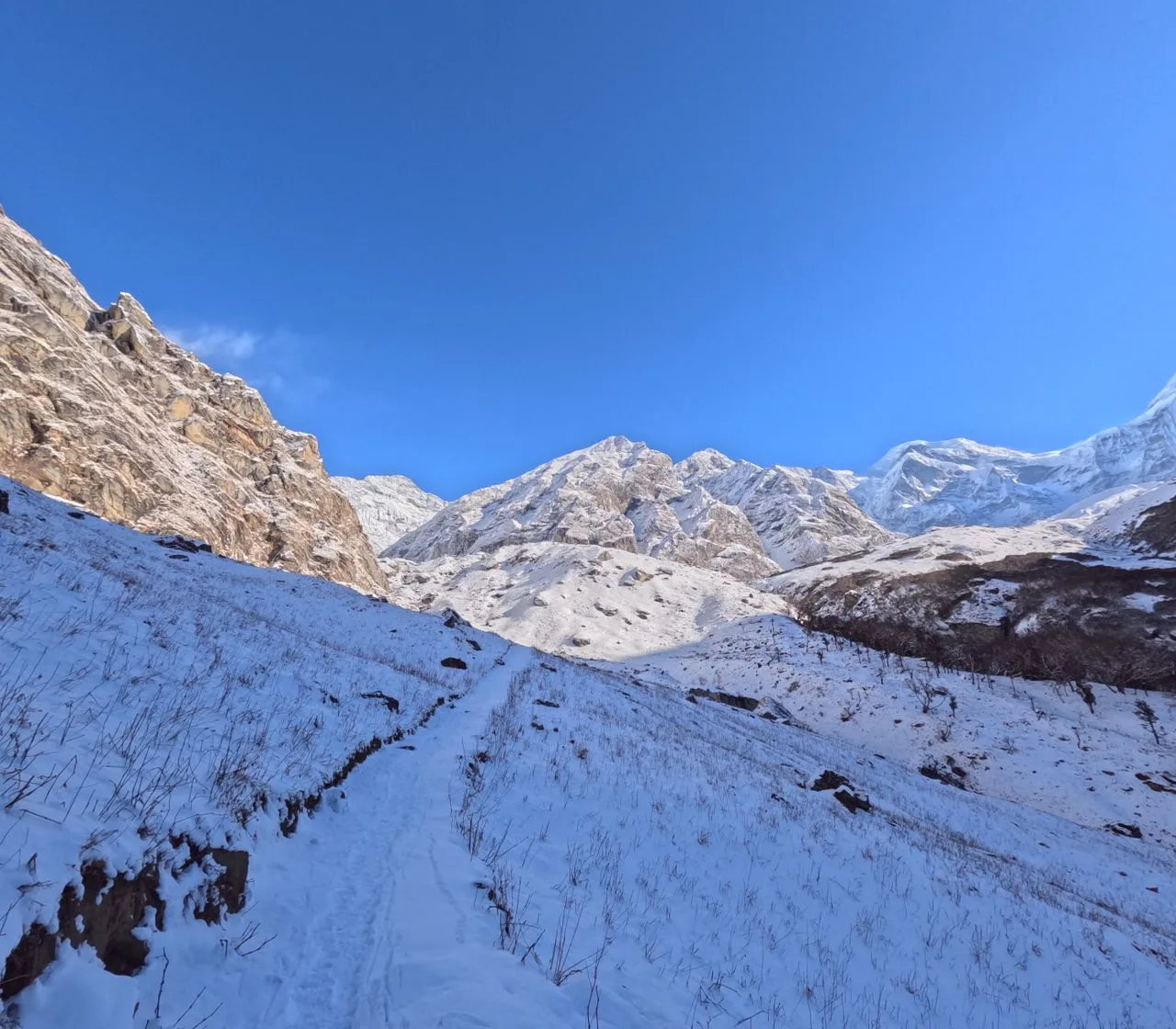
Above High Camp, the trail follows a narrow ridge. The path is obvious but exposed in places, and weather can make it slippery. During winter months (January, February, March), heavy snow can make this section challenging, so crampons and caution are advised .
4. The descent
A full 5-day itinerary includes a descent from Upper Viewpoint all the way to Low Camp in a single day—7-9 hours of walking . This is physically gruelling, especially on tired legs.
What Doesn’t Make It Challenging
-
No technical climbing—no ropes, ice axes, or harnesses required
-
Clear, well-defined trail—you cannot get lost on the main route
-
No glacier crossings—the trail stays on the ridge, not on ice
-
Multiple teahouses—you’re never far from accommodation
Fitness Requirements
You should be able to walk uphill continuously for 5-7 hours with a light pack. That means:
-
Comfortable with 500-800m elevation gain in a single walk
-
Able to walk on uneven terrain without frequent breaks
-
No serious cardiovascular limitations
If you are a regular walker or hiker, you are likely in sufficient shape. If you are sedentary, 6-8 weeks of cardiovascular training before departure is strongly advised.
When to Go: The Best Time for Mardi Himal Trek (Seasonal Guide)
The best times to trek Mardi Himal are spring (March-May) and autumn (September-November) . Here is what each season actually offers:
| Season | Months | Trail Conditions | Visibility | Crowds | What to Expect |
|---|---|---|---|---|---|
| Autumn (Peak) | October-November | Dry, stable | Excellent, clear air | Busiest | Best mountain views; crisp, cold nights; popular with trekkers |
| Spring | March-May | Dry, warming | Good, occasional haze | Moderate | Rhododendrons in bloom; pleasant daytime temperatures; second-best season |
| Winter | December-February | Cold, possible snow above 3,000m | Clear, excellent | Lowest | Temperatures below 0°C at High Camp; ice on ridge; fewer services |
| Monsoon | June-September | Wet, muddy, leeches | Poor, cloud cover | Very low | Heavy rain; poor visibility; not recommended |
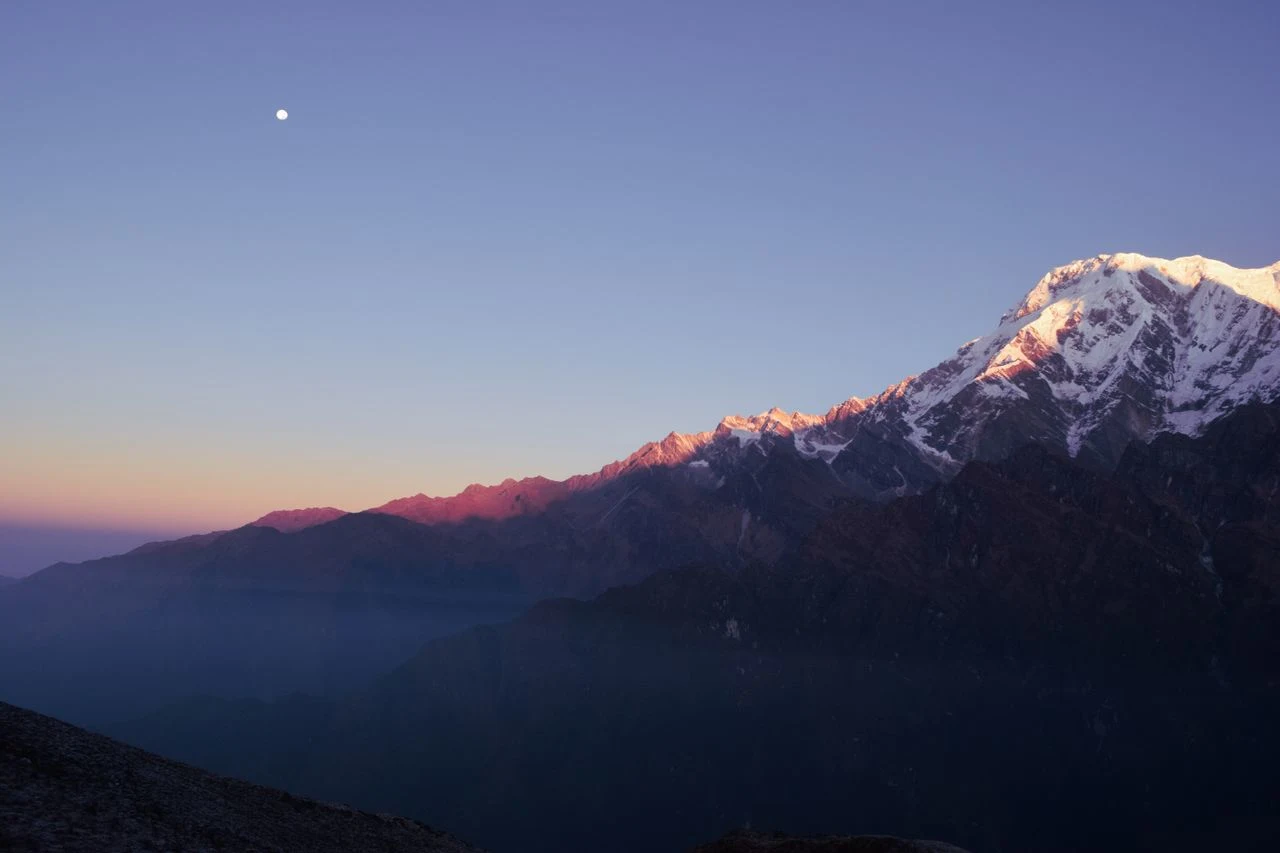
October is widely considered the single best month. The post-monsoon air is clean, visibility is exceptional, and daytime temperatures are manageable—though nights at High Camp (3,550m) and the Upper Viewpoint (4,500m) are cold regardless of season.
Spring offers the bonus of rhododendron forests in full bloom through the lower sections, which is a spectacular sight that autumn trekkers miss.
Mardi Himal Trek Itinerary Options (Day-by-Day)
The Mardi Himal trek is unusually flexible—you can complete it in 4 days (aggressive) or stretch it to 7 days (comfortable with acclimatisation). The right choice depends on your fitness, altitude sensitivity, and how much time you have.
Option 1: 5-Day Trek (Most Common)
| Day | Route | Walking Time | Altitude Change |
|---|---|---|---|
| 1 | Pokhara → Kande → Forest Camp | 5-7 hrs | 1,770m → 2,600m (+830m) |
| 2 | Forest Camp → Badal Danda | 5-6 hrs | 2,600m → 3,210m (+610m) |
| 3 | Badal Danda → High Camp | 3-4 hrs | 3,210m → 3,550m (+340m) |
| 4 | High Camp → Upper Viewpoint → Low Camp | 7-9 hrs | 3,550m → 4,500m → 3,150m |
| 5 | Low Camp → Siding → Pokhara | 5-6 hrs | 3,150m → 850m |
Note: Day 4 is the hardest—the climb to Upper Viewpoint at 4,500m followed by a long descent to Low Camp. This is a very demanding day.
Option 2: 4-Day Trek (More Aggressive)
| Day | Route | Walking Time |
|---|---|---|
| 1 | Pokhara → Kande → Forest Camp | 5-7 hrs |
| 2 | Forest Camp → High Camp | 5-6 hrs |
| 3 | High Camp → Viewpoint → Low Camp | 7-9 hrs |
| 4 | Low Camp → Siding → Pokhara | 5-6 hrs |
Which Itinerary Should You Choose?
| If You… | Choose |
|---|---|
| Have good fitness and limited time | 4-5 days |
| Are concerned about altitude or are a beginner | 5-6 days |
| Want a relaxed pace with cultural stops | 6-7 days |
| Have done other high-altitude treks | 4-5 days |
The shorter itinerary isn’t “better” simply because it’s shorter. The faster ascent increases altitude sickness risk. The 5-6 day option allows you to climb to Upper Viewpoint, return to High Camp to sleep, and descend the next day—giving your body an extra day to acclimatise.
What Permits Do You Need for Mardi Himal in 2026?
ACAP Permit (Annapurna Conservation Area Permit)
Mandatory for all trekkers.
| Detail | Information |
|---|---|
| Cost (Foreign Nationals) | NPR 3,000 (~$22-23 USD) |
| Cost (SAARC Nationals) | NPR 1,000 |
| Where to Obtain | Nepal Tourism Board (Kathmandu/Pokhara) or through your agency |
| What to Bring | Passport copy, passport photos, passport for ID verification |
TIMS Card (Trekkers’ Information Management System)
Mandatory for all trekkers. The TIMS application requires:
-
A valid passport (original and photocopy)
-
1-2 passport-size photographs (35mm × 45mm, white background, taken within 6 months)
-
Travel insurance proof covering high-altitude trekking up to 5,587m
-
Emergency contact details
Cost Structure (2026) :
| Trekker Category | Individual TIMS Fee | Agency TIMS Fee |
|---|---|---|
| Foreign Nationals | USD 20 (approx. NPR 2,700) | USD 10 (approx. NPR 1,350) |
| SAARC Nationals | NPR 600 | NPR 300 |
Total Permit Cost for 2026
| Booking Type | TIMS | ACAP | Total |
|---|---|---|---|
| Individual Trekker | USD 20 | USD 30 | USD 50 |
| Agency-Organized | USD 10 | USD 30 | USD 40 |
Where to Get Permits
-
Kathmandu: Nepal Tourism Board, Bhrikutimandap, Thamel (open Sunday-Friday, 9:00 AM to 5:00 PM)
-
Pokhara: TAAN office, Tourist Service Centre, Damside (open Sunday-Friday, 9:00 AM to 4:00 PM)
Processing time averages 15-30 minutes during off-peak hours and up to 90 minutes during peak trekking season (October-November and March-April) .
Important Permit Notes
-
No online self-service TIMS portal is available as of March 2026; the e-TIMS pilot announced in 2023 remains under review
-
Apply at least 1 day before the trek start date
-
The TIMS card is not issued at any Mardi Himal trailhead checkpoint, only at NTB offices or through trekking agencies
-
Insurance must cover altitudes up to 5,587 metres (Mardi Himal’s summit elevation)
Do You Need a Guide for Mardi Himal in 2026?
No, you are not legally required to use a guide on the Mardi Himal Base Camp trek. The Government of Nepal’s mandatory guide regulation applies specifically to restricted trekking areas, and Mardi Himal is not classified as a restricted area .
However, there are practical reasons to consider a guide:
Benefits of a guide:
-
Permits are cheaper (TIMS: USD 10 vs USD 20)
-
Safety: Someone to monitor your condition, adjust pace, and handle emergencies
-
Cultural context: Local guides provide deeper insight into Gurung culture and the region
-
Logistics: Guides handle permits, teahouse bookings, and transportation
-
Weather assessment: Experienced guides make the final call on whether conditions allow pushing to the Viewpoint
A typical guided trek includes an experienced English-speaking guide, guide salaries, insurance, equipment, transport, food, and lodging—all built into the package cost . Licensed guides in the region average over 15 years of trekking experience .
How Much Does the Mardi Himal Trek Cost in 2026? (Full Breakdown)
Costs vary significantly based on group size, season, and itinerary length. Here is a realistic breakdown.
Permit Costs (Mandatory)
| Permit | Cost |
|---|---|
| ACAP | USD 30 (~NPR 3,000) |
| TIMS (agency rate) | USD 10 |
| Total | USD 40 (agency-organized) |
Package Costs (Agency, 5-Day Trek)
Group size makes a significant difference. Based on Holy Kailash Tours’ 2026 estimates for a standard 5-day teahouse package including permits, guide, and ground transport :
| Group Size | Estimated Cost Per Person (USD) |
|---|---|
| 1 person | $550 – $650 |
| 2 people | $450 – $490 |
| 3 people | $400 – $450 |
| 4 people | $380 – $410 |
| 5 people | $360 – $390 |
| 6 people | $350 – $380 |
| 7 people | $330 – $360 |
| 8 people | $315 – $330 |
| 10 people | $295 – $310 |
| 12-14 people | $275 – $285 |
What’s Usually Included in a Package
-
Licensed English-speaking guide
-
Porter (typically one per two trekkers, 15kg baggage limit)
-
ACAP permit and TIMS card
-
Teahouse accommodation (twin-sharing)
-
All meals on the trail
-
Pokhara ↔ trailhead transport
-
Guide insurance, equipment, food, and lodging
-
Emergency first aid kit and oximeter
What’s Usually Not Included
-
Nepal visa (USD 50 for 30 days)
-
International flights
-
Kathmandu ↔ Pokhara transport
-
Travel insurance (required for high-altitude trekking)
-
Personal equipment (down jacket, sleeping bag can be hired)
-
Personal expenses (hot showers, WiFi, charging, drinks)
Teahouse Costs (If Booking Separately)
| Item | Cost |
|---|---|
| Teahouse room (lower altitudes) | $6-10 per night |
| Teahouse room (High Camp) | $10-15 per night |
| Dal Bhat (meal) | $4-6 |
| Hot shower | $2-4 |
| WiFi | $2-4 |
| Battery charging | $2-4 |
Mardi Himal vs Annapurna Base Camp: Which Trek Should You Choose?
This is one of the most common comparisons trekkers make. Here is a side-by-side breakdown.
| Factor | Mardi Himal (MBC) | Annapurna Base Camp (ABC) |
|---|---|---|
| Highest Point | 4,500m | 4,130m |
| Duration | 4-7 days | 7-12 days |
| Distance | ~43-60km | ~60km |
| Difficulty | Moderate; steep altitude gain | Moderate; gentler acclimatisation |
| Crowds | Quieter, less commercial | Busier, very established |
| View Experience | Ridge walking; intimate Machhapuchhre view | Surrounded by Annapurna Sanctuary; 8 peaks visible |
| Cost (Est.) | $300-650 (4-7 days) | $650-1,100 (7-12 days) |
| Teahouse Variety | Fewer, more basic | More, more services |
| Best For | Limited time, quieter experience, intimate peak views | Gradual pace, classic trekking experience, village culture |
Which One Is Right for You?
Choose Mardi Himal if:
-
You have 4-6 days for trekking
-
You prefer quieter trails with fewer trekkers
-
You want close-up views of Machhapuchhre specifically
-
You are comfortable with faster altitude gain
-
You prefer ridge walking over valley walking
Choose Annapurna Base Camp if:
-
You have 7+ days for trekking
-
You want a more gradual, better-acclimatised ascent
-
You prefer more teahouse variety and services
-
You want to see multiple 8,000m peaks from one viewpoint
-
You are new to Nepal trekking and want a more established route
Teahouses, Food, and Facilities on the Mardi Himal Trek
Teahouse Availability by Camp
| Camp | Altitude | Teahouses | Facilities |
|---|---|---|---|
| Forest Camp | 2,600m | Several | Basic rooms, hot food |
| Low Camp | 2,985m | Several | Hot showers, WiFi (sometimes), electricity |
| Badal Danda | 3,210m | Several | Hot food, basic rooms |
| High Camp | 3,550m | Several | Hot food, blankets, WiFi (limited), hot showers |
| Upper Viewpoint | 4,500m | 1-2 | Very basic—no WiFi, no hot showers |
Food Options
Most teahouses serve:
-
Dal Bhat (lentil soup with rice and vegetables)—the trekker staple, filling and cheap
-
Noodles, pasta, fried rice
-
Potato dishes (boiled, fried, or mashed with cheese)
-
Pancakes, eggs, toast for breakfast
-
Tea, coffee, hot chocolate
Practical Facility Facts
-
WiFi: Available at most teahouses below High Camp, but slow and usually costs $2-4
-
Hot Showers: Available at most teahouses below High Camp for a fee ($2-4)
-
Charging: Available at most teahouses ($2-4 per full charge)
-
Toilets: Basic squat toilets at most teahouses; flushing toilets at lower elevations
-
Mobile Network: NTC and Ncell networks are available in some lower sections, but signal is weaker at High Camp and Base Camp
What to Pack for the Mardi Himal Base Camp (2026 Packing List)
Clothing (Layering System)
| Layer | Items |
|---|---|
| Base | Merino wool or synthetic base layers (2 sets) |
| Mid | Fleece jacket or light down jacket |
| Outer | Waterproof and windproof jacket |
| Legs | Trekking trousers (convertible recommended), warm thermal leggings for cold nights |
| Feet | Waterproof trekking boots (broken in), thick wool or synthetic socks (3-4 pairs) |
Essential Gear
-
Sleeping bag (rated to -10°C—teahouse blankets are thin at high altitudes)
-
Headlamp (power outages are common; early morning starts require one)
-
Trekking poles (strongly recommended for steep sections and the descent)
-
Water bottle or hydration bladder (2L capacity minimum)
-
Water purification (tablets or filter)
-
Sunscreen and sunglasses (snow glare is intense at high altitude)
-
Personal first aid kit (including altitude sickness medication and pain relief)
-
Portable power bank (charging is limited, especially above Low Camp)
-
Cash (Nepalese rupees—no ATMs on the trail)
What You Can Hire
Many agencies provide or rent:
-
Down jacket
-
Sleeping bag with liner
-
Duffel bag for porter carrying
Safety, Altitude Sickness, and Emergency Planning
Altitude Sickness at 4,500m
Altitude sickness (Acute Mountain Sickness / AMS) is a genuine risk above 3,500m. At 4,500m, the risk is significant.
Symptoms to watch for:
-
Headache (persistent and not relieved by painkillers)
-
Nausea or loss of appetite
-
Fatigue or weakness
-
Dizziness
-
Shortness of breath at rest
Action plan if symptoms appear:
-
Stop ascending immediately—do not go higher
-
Descend at least 500m if symptoms don’t improve within 1-2 hours
-
Seek medical help if symptoms worsen
Do not push through symptoms with painkillers. Descending is the treatment.
Emergency Planning
-
Travel insurance must cover helicopter evacuation above 4,000m—this is non-negotiable
-
Satellite communication: Some agencies carry satellite phones or communicators
-
Emergency descent plan: Know the route back to lower elevation
-
Oximeter: Many guides carry one to monitor oxygen saturation levels
Travel Insurance: What You Need to Know
Travel insurance is strongly recommended for the Mardi Himal Trek and mandatory for TIMS applications .
Coverage requirements:
-
High-altitude trekking and helicopter evacuation
-
Coverage up to 5,587 metres (Mardi Himal’s summit elevation)
-
Policies that exclude altitude above 4,000 metres are rejected by TIMS counter staff
Why it matters:
Although the Short Mardi Himal trek is closer to Pokhara compared to other remote treks, medical facilities along the trail are limited. In case of severe illness or injury, evacuation might be necessary .
Frequently Asked Questions about Mardi Himal Base Camp
1. How high is Mardi Himal Base Camp?
Mardi Himal Base Camp is at 4,500 metres (14,764 feet). Some sources refer to a “Viewpoint” at 4,200m—the 4,500m destination is the true Base Camp/Upper Viewpoint .
2. How difficult is the Mardi Himal trek?
It is classified as moderate. The main challenges are steep altitude gain (1,770m to 4,500m in 3-4 days), the final 950m climb from High Camp to Base Camp, and the long descent day .
3. Can beginners trek Mardi Himal?
Yes, with proper preparation. The trek has no technical climbing and the trail is well-marked. Beginners should choose a 5-6 day itinerary for better acclimatisation and ensure good cardiovascular fitness .
4. How many days does Mardi Himal take?
The trek takes 4 to 7 days depending on itinerary. The most common option is 5 days, while a more relaxed pace with better acclimatisation takes 6-7 days .
5. What is the best month for Mardi Himal?
October is the single best month (clearest views, stable weather). April is excellent for spring trekkers who want warmer temperatures and rhododendron blooms .
6. Do I need a guide for Mardi Himal in 2026?
No, a guide is not legally required as Mardi Himal is not a restricted area. However, guides provide safety, permit assistance, and cultural context—strongly recommended .
7. Do I need a TIMS card for Mardi Himal?
Yes, a TIMS card is required. Foreign trekkers pay USD 20 individually or USD 10 through a registered agency .
8. What permits are required for Mardi Himal?
Two permits: ACAP (Annapurna Conservation Area Permit, USD 30) and TIMS (USD 10-20 depending on booking type). Total cost is USD 40-50 .
9. How much does the Mardi Himal trek cost?
A 5-day package ranges from USD 300-650 per person depending on group size. Solo trekkers pay $550-650, while groups of 8+ pay $295-330 per person .
10. Is Mardi Himal harder than ABC?
It depends. Mardi Himal is shorter but steeper, with faster altitude gain (reaching 4,500m in 3-4 days vs 4,130m in 5-7 days for ABC). ABC has better acclimatisation but is longer.
11. Where does the Mardi Himal trek start?
The trek starts from Kande (a 1-hour drive from Pokhara). Some itineraries start from Phedi and go via Australian Camp .
12. Where do you stay on Mardi Himal?
You stay in teahouses (basic lodges) at Forest Camp (2,600m), Low Camp (2,985m), Badal Danda (3,210m), High Camp (3,550m), and the viewpoint area (4,500m) .
13. Is there snow on Mardi Himal?
Yes, especially in winter (December-March). During winter months, heavy snow can make the section beyond the Viewpoint challenging—crampons and caution are advised .
14. What should I pack for Mardi Himal?
Layered clothing (base, mid, outer), waterproof trekking boots, sleeping bag rated to -10°C, headlamp, trekking poles, water purification, sunscreen, and a portable power bank .
15. Is Mardi Himal safe?
Yes, with proper precautions. The main risks are altitude sickness, unpredictable weather, and slippery trails in winter. Travel insurance covering helicopter evacuation above 4,000m is mandatory .
Plan Your Mardi Himal Trek with Wonder Hikes Nepal
When you’re ready to book your Mardi Himal Base Camp trek, choosing the right operator makes all the difference. Wonder Hikes Nepal offers transparent, traveller-focused trekking experiences built around safety, clarity, and responsible planning.
What Wonder Hikes Nepal provides:
-
Transparent pricing with clear inclusions and no hidden costs
-
Licensed, experienced guides with extensive knowledge of the Mardi Himal route
-
Complete permit handling (TIMS and ACAP) through the agency channel (USD 10 TIMS rate)
-
Safety-first approach with oximeters, emergency first aid kits, and satellite communication
-
Quality teahouse bookings ensuring comfortable accommodation throughout the trek
-
Customizable itineraries from 4 to 7 days, matched to your fitness and experience level
-
Traveller suitability assessment to ensure you choose the right itinerary for your ability
Why choose Wonder Hikes Nepal:
-
Every package includes an experienced English-speaking guide licensed by the Government of Nepal
-
Guides carry emergency first aid kits and oximeters to monitor your health
-
All permits are arranged in advance—no paperwork stress at the last minute
-
Transport from Pokhara to the trailhead and back is included
-
Porter service is available to reduce your physical burden (one porter per two trekkers, 15kg baggage limit)
How to book:
Contact Wonder Hikes Nepal directly for a quote matched to your group size, preferred itinerary, and travel dates. Whether you’re a solo trekker or part of a large group, they can tailor a package that fits your needs.