The Annapurna Base Camp trek takes you into the Sanctuary, a natural amphitheatre walled by peaks over 7,000 metres. You walk through terraced rice fields, bamboo forests, and rhododendron thickets until the trail opens onto a glacial basin where Annapurna I, Machapuchare, and Hiunchuli stand close enough to feel. This is not a remote expedition. It’s a teahouse trek with well-established lodges, manageable altitude, and a pace that lets you soak in both the landscape and the Gurung villages. But don’t mistake accessibility for ease — 4,130 metres is real altitude, and the final ascent demands the same respect as any Himalayan objective.
We run the Annapurna Base Camp trek as a 12-day package from Kathmandu, with a careful acclimatisation schedule, an experienced guide who knows the Sanctuary’s weather patterns, and a deep respect for the Annapurna Conservation Area. This page is the blueprint — everything you need to understand the trek, prepare for it, and decide if our team is the right partner for your journey.
Quick Facts: Annapurna Base Camp Trek
| Detail | Specification |
|---|---|
| Duration | 12 days Kathmandu to Kathmandu (shorter private options available) |
| Maximum altitude | Annapurna Base Camp – 4,130 m (13,550 ft) |
| Trekking region | Annapurna Conservation Area, central Nepal |
| Starting point | Nayapul (after drive from Pokhara) |
| Ending point | Nayapul or Siwai |
| Accommodation | Teahouses (lodges) on trek; 3-star hotel in Kathmandu and Pokhara |
| Meals | Full board on trek (breakfast, lunch, dinner); breakfast in cities |
| Transportation | Tourist bus or flight Kathmandu–Pokhara; private vehicle Pokhara–trailhead |
| Difficulty | Moderate; good fitness required, no technical climbing |
| Permits | ACAP (Annapurna Conservation Area Permit) + TIMS (Trekkers’ Information Management System) |
| Guide | Government-licensed trekking guide; mandatory for safety, included in package |
| Porter | 1 porter for 2 trekkers (max 20 kg combined); optional extra porter |
| Best season | October–November and March–May |
| Group size | 2–12, small-group focus |
| Internet & power | WiFi and charging at most lodges (fee applies); mobile network coverage sporadic above Chhomrong |
Why the Annapurna Base Camp Trek Still Matters
The Everest region pulls crowds north-east. Annapurna pulls a different kind of trekker — one who wants a complete Himalayan experience without the altitude ceiling of 5,500 metres, the $4,000 permit, or the flight cancellations that plague Lukla. The ABC trek is drivable to the trailhead, meaning you’re on the trail the same day you leave Pokhara. It passes through some of the most culturally intact Gurung villages in Nepal: Ghandruk, Chhomrong, and Landruk, where stone courtyards and slate roofs have stayed unchanged for generations.
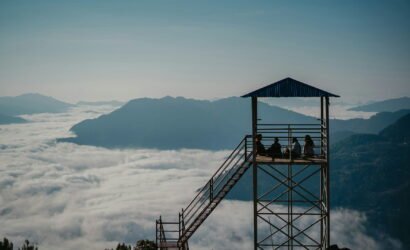
The Sanctuary itself is the draw. You walk into a bowl ringed by Annapurna South, Hiunchuli, Annapurna I, and the unmistakable fishtail spire of Machapuchare. At base camp, the scale is disorienting — 7,000-metre walls rise from a glacier you can touch. You sleep at 4,130 metres, watch sunrise turn the peaks coral, and then descend back into the forest. It’s a compressed, intense mountain experience that fits into a two-week leave window.
Our 12-day itinerary builds in a proper acclimatisation day in Chhomrong and a gradual climb that gives your body time to adjust. We also handle all permits, transport, and lodge bookings. The trek itself is well-marked, but navigating the peak-season bed shortage, understanding the Annapurna Conservation Area rules, and having a guide who can read the weather when snow shuts down the trail below Machapuchare Base Camp — that’s where our experience counts.
Trek Overview: The Annapurna Sanctuary Explained
The Annapurna Sanctuary is a glacial basin surrounded by the giants of the Annapurna range. The entire massif forms a horseshoe; the only entrance is through the narrow Modi Khola valley. The trek essentially walks up this valley, starting from the subtropical lowlands near Nayapul (1,070 m) and climbing to ABC at 4,130 m over the course of six days. This steady ascent is one of the most varied treks in Nepal: you pass through rice terraces, villages, oak forest, dense bamboo, and alpine scrub before reaching the barren moraine of the Sanctuary.
The region is part of the Annapurna Conservation Area, Nepal’s largest protected area. ACAP manages community development, forest conservation, and trail maintenance, funded by your permit fees. The trek is teahouse-based, which means you sleep in lodges run by local families and eat in communal dining rooms. This setup supports the villages directly and keeps the trek affordable compared to tented expeditions.
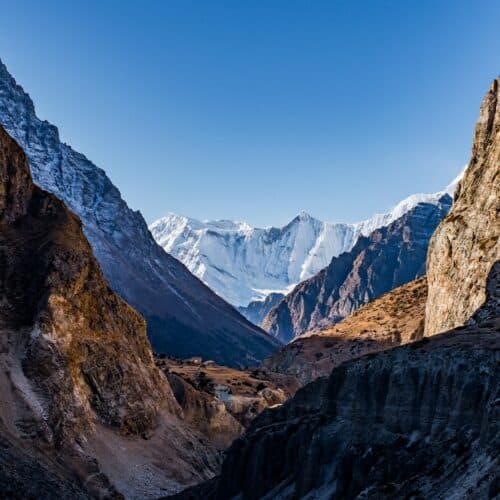
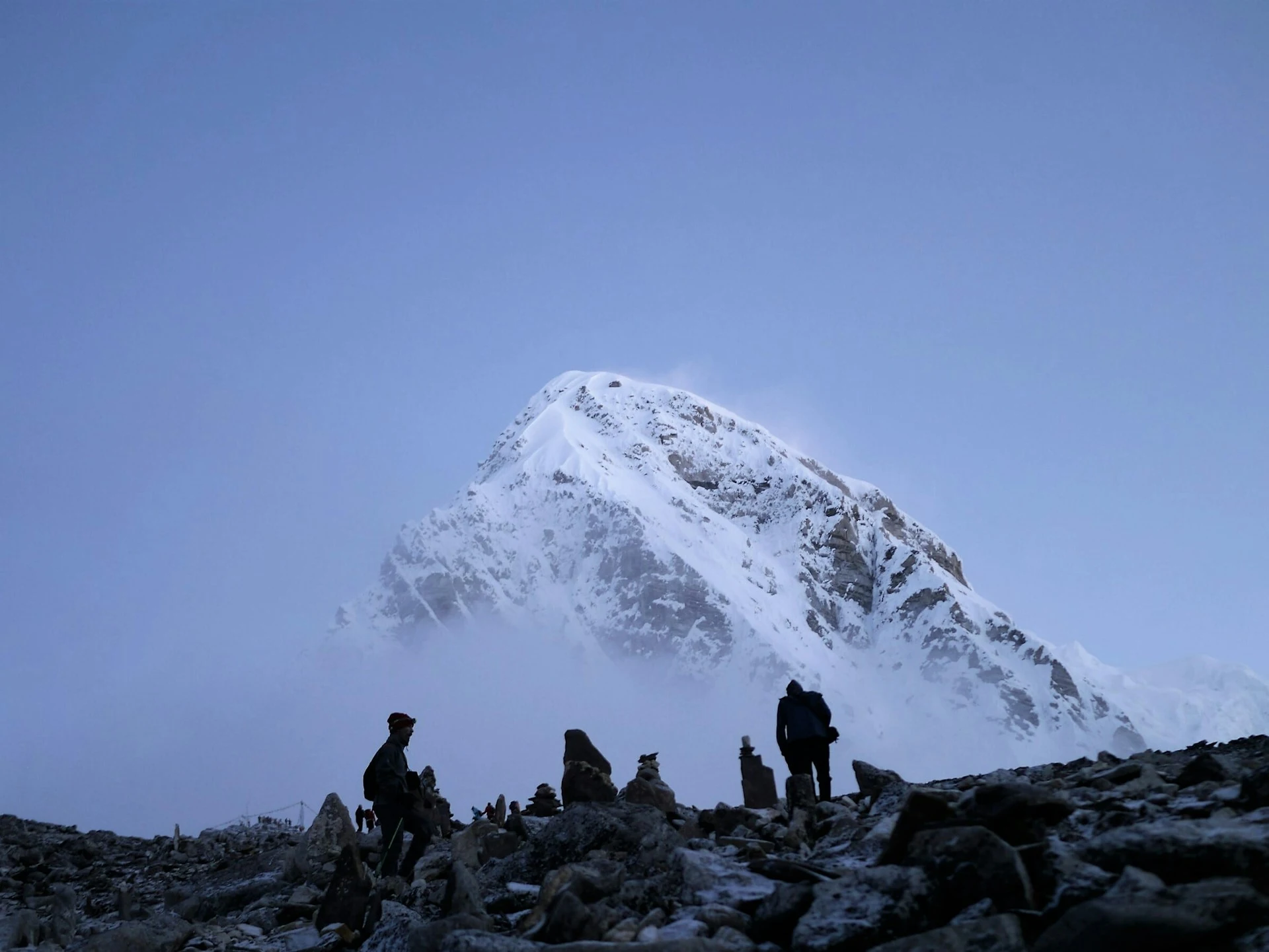
The highest point is Annapurna Base Camp at 4,130 m. Just below it, Machapuchare Base Camp (MBC, 3,700 m) serves as the last overnight stop for many trekkers. Above MBC, the valley opens into the Sanctuary. The ground is glacial rubble, the air noticeably thinner, and the peaks surround you on three sides. It’s a place where the mountains feel close enough to touch, and the silence at dawn is total except for the occasional crack of icefall.
12-Day Annapurna Base Camp Trek – Complete Day-by-Day Itinerary
This is our standard 12-day package. It includes two days in Pokhara (one before and one after the trek) because we’ve learned over years of operation that arriving in Pokhara late and starting the trek the next morning is a recipe for tired legs. The extra day also serves as a weather buffer for the return drive or flight. The itinerary can be compressed to 10 days for experienced trekkers with tight schedules, but we recommend 12.
Day 1: Arrive in Kathmandu (1,350 m)
You land at Tribhuvan International Airport. Our representative meets you and transfers you to a hotel in Thamel. The rest of the day is free. In the evening, we hold a trip briefing: a full run-through of the route, gear check, altitude protocols, and an introduction to your guide. If you arrive early, you can explore the neighbourhood; Thamel is dense with bookshops, gear stores, and restaurants. Overnight at hotel.
Day 2: Drive or fly to Pokhara (820 m)
After breakfast, we take the tourist bus (approx. 7 hours) on the Prithvi Highway. The road follows the Trishuli River through terraced hills and small towns. Lunch stop is at a highway restaurant. If you prefer to fly, the 25-minute flight is an optional add-on — we recommend it in the monsoon when the road can be rough. In Pokhara, you check into a lakeside hotel. The afternoon is yours; you can stroll along Phewa Lake, visit the International Mountain Museum, or just rest. Altitude is low; sleep comes easily.
Day 3: Drive to Nayapul, trek to Ghandruk (1,940 m) – 5–6 hrs
A private vehicle takes us from Pokhara to Nayapul (1.5 hours). The trail starts on a dirt road, then switches to stone steps climbing through villages and rhododendron forest. Ghandruk is a large Gurung settlement with a commanding view of Annapurna South, Hiunchuli, and Machapuchare. The streets are paved with flagstones, and the Gurung Museum is worth a visit. We stay in a comfortable lodge with attached rooms. This is the first night on the trail; the body is still adjusting to the day’s effort.
Day 4: Ghandruk to Chhomrong (2,170 m) – 5–6 hrs
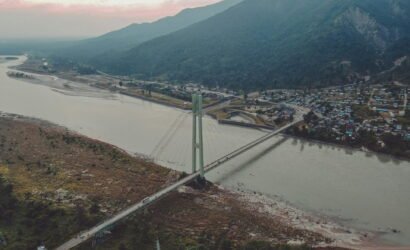
A mix of downhill and a stiff final climb. The trail descends to the Kimrong Khola, crosses a suspension bridge, then climbs steeply through forest to Chhomrong. This village is the last major settlement before the Sanctuary and the gateway to ABC. The lodges have excellent bakeries (apple pie is a tradition). The view of Machapuchare and Annapurna South from the ridge is one of the best on the trek. We stay here two nights to aid acclimatisation.
Day 5: Acclimatisation Day in Chhomrong
A full rest day at 2,170 metres. We walk up to the viewpoint above the village, visit the local school if you’re interested, and do a short hike to a nearby ridge. The point is active rest — walking, hydrating, letting the blood thicken. This is the most common altitude at which AMS symptoms first appear if you ascend too fast, so we use the day deliberately. Our guide checks pulse oximeter readings. You can also do laundry and recharge.
Day 6: Chhomrong to Bamboo (2,310 m) – 4–5 hrs
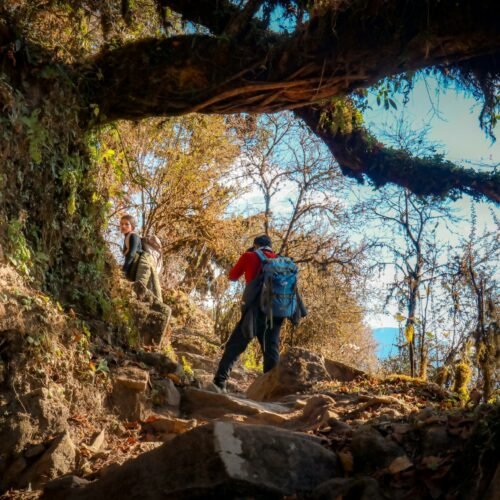
The trail drops steeply on stone steps to the Chhomrong Khola, crosses a bridge, then climbs again through bamboo and rhododendron forest. Bamboo is a small settlement with a few lodges tucked into the foliage. The altitude gain from Chhomrong is minimal, but the day involves a lot of up-and-down, which drains legs. The forest is dense, moist, and alive with bird calls. Overnight at a simple teahouse.
Day 7: Bamboo to Deurali (3,230 m) – 4–5 hrs
We pass through Dovan and the Himalayan Hotel, then enter a zone where the valley narrows and the vegetation thins. The route crosses several avalanche chutes — in winter and early spring, these sections require caution and an early start. Deurali is a cluster of lodges at the base of the final climb to MBC. Altitude becomes noticeable: mild headaches possible, appetite may dip. The guide monitors oxygen saturation. Overnight at a lodge with heating in the dining room (dung-burning stove).
Day 8: Deurali to Annapurna Base Camp (4,130 m) via MBC – 5–6 hrs
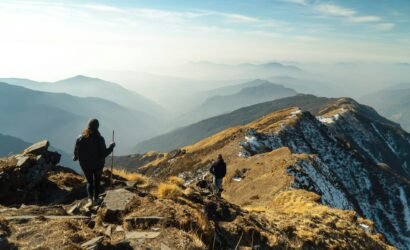
The day everyone remembers. We climb above the treeline, past Machapuchare Base Camp (3,700 m) where we stop for tea and a rest. Then the trail climbs gently over glacial moraine into the Sanctuary. The peaks emerge one by one — Annapurna South, then the Fang, then Annapurna I, and finally the whole amphitheatre. At ABC, a sign marks the altitude. The lodge is basic; the dining room becomes the social hub. Sunset and sunrise are the reward. Overnight in a dorm or twin room. It will be cold, and altitude is at its maximum; sleep may be restless.
Day 9: ABC sunrise, descend to Bamboo – 7–8 hrs
Dawn at base camp: the first light hits Annapurna I and the glacier below the south face of Annapurna lights up. After breakfast, we retrace the route down. The descent feels faster but is hard on knees. By the time we reach Bamboo, the air is thick and warm. You’ll sleep deeply.
Day 10: Bamboo to Jhinu Danda (1,780 m) – 5–6 hrs
We climb back to Chhomrong for lunch, then descend steeply to Jhinu Danda, famous for its natural hot springs by the Modi Khola. A 20-minute walk down from the village, the springs are concrete pools where you soak tired legs. The water temperature sits around 38°C. Overnight at a lodge.
Day 11: Jhinu to Nayapul, drive to Pokhara – 5 hrs trek, 2 hrs drive
An easy walk along the Modi Khola to the roadhead at Siwai or Nayapul. The vehicle meets us and drives back to Pokhara. Hot shower, cold beer, and a farewell dinner with the guide. Overnight at hotel.
Day 12: Drive or fly to Kathmandu, departure
Return to Kathmandu. If you fly, you’ll have time to explore the capital before an evening departure. Transfer to airport. Trek ends.
Note: This itinerary is a template. Snow conditions above Deurali, especially in late December or early March, can delay the push to ABC. We carry a satellite phone and will adjust the schedule to keep the group safe.
Trek Difficulty and Realistic Expectations
ABC is a moderate trek, not a mountaineering expedition. But the term “moderate” can be misleading. You’ll walk 5–7 hours a day on uneven stone steps and dirt trails for six consecutive days. The cumulative ascent from Ghandruk to ABC is over 2,000 metres. The altitude, while modest by Himalayan standards, causes genuine altitude sickness in some people.
The main challenge is the stone steps — thousands of them, especially between Chhomrong and the Chhomrong Khola. Knees take a beating. Trekking poles are non-negotiable. The altitude at ABC (4,130 m) can trigger AMS if you ascend too fast. Our acclimatisation day in Chhomrong and the steady pace mitigate this, but you still need to be fit.
Who can do this trek: Anyone with good cardiovascular fitness, previous multi-day walking experience, and the right mental attitude. You don’t need technical skills, but you do need the ability to walk uphill for extended periods with a daypack. Families with active teenagers, fit retirees in their 60s and 70s, and first-time Himalayan trekkers all complete this route successfully.
Who should reconsider: If you have severe knee problems (the steps on the descent are relentless), uncontrolled hypertension, or a respiratory condition that worsens at altitude, consult your doctor. Pregnant women should avoid sleeping above 3,000 m.
Fitness Requirements and Training
You don’t need a personal trainer, but arriving unfit will make the trek miserable. We recommend:
- Cardio base: 4–6 weeks of brisk walking, jogging, cycling, or swimming, 3–4 times a week.
- Leg strength: Squats, lunges, and weighted step-ups. Train for the descent too — downhill walking stresses quads.
- Hiking practice: At least 3–4 day hikes of 6–7 hours with a pack, preferably on uneven terrain. If you live in a flat area, use a stadium or tall building for stairs.
- Altitude experience: Not required, but if you have done a trek above 3,500 m before, you’ll know how your body reacts.
If you can comfortably walk 15 km in a day with a light pack and still have energy to socialise in the evening, you’re ready.
Altitude, Acclimatisation, and AMS on the ABC Trek
The highest sleeping altitude is 4,130 m (ABC). The rapid ascent from Chhomrong to ABC in three days is the critical window. We manage the risk with:
- An extra night in Chhomrong at 2,170 m.
- A slow climb from Bamboo to Deurali to MBC.
- Daily monitoring of oxygen saturation and heart rate.
- Our guide carries a medical kit, pulse oximeter, and a portable oxygen cylinder for emergencies.
Symptoms of AMS: headache, nausea, dizziness, fatigue, loss of appetite. If mild, we rest and hydrate. If symptoms worsen, we descend immediately. The descent from ABC to Bamboo takes only a few hours and usually reverses symptoms. We never push a trekker who is unwell.
Prevention: drink 3–4 litres of water daily, avoid alcohol, eat regular meals, and communicate any symptoms early. The guide will adjust your pace if you’re struggling.
Best Time to Trek Annapurna Base Camp
The two best windows are the post-monsoon autumn (October–November) and the pre-monsoon spring (March–May). Both offer stable weather, clear mountain views, and manageable temperatures.
- October–November: The air is washed clean after the monsoon. Days are warm at lower elevations, nights cool but not freezing until above 3,000 m. This is peak season; the trail is busiest, and lodges fill up, especially in Chhomrong and Deurali. Book early. Rice terraces are golden during harvest.
- March–May: The rhododendrons bloom, turning the forests between Ghandruk and Deurali into a red and pink canopy. Days are warmer, the landscape is lush, but haze can build in the afternoons, reducing long-distance views. Mornings are still clear. This is the second-busy season.
- Winter (December–February): Very cold at ABC (night temps can drop to -15°C). Snowfall above Deurali can block the trail and sometimes closes the route to ABC entirely. Fewer trekkers. Only for those with winter camping experience and proper gear.
- Monsoon (June–September): Heavy rain, leeches, slippery trails, and clouded peaks. The trail is passable but unpleasant. Not recommended for a first-time trekker.
Monthly Weather Summary
| Month | Lower elevations (day/night °C) | ABC (day/night °C) | Rain/Snow | Trail condition |
|---|---|---|---|---|
| October | 20–25 / 10–15 | 10–15 / -5 to 0 | Low | Excellent |
| November | 18–22 / 5–10 | 8–12 / -8 to -2 | None | Excellent |
| December | 15–20 / 0–5 | 5–10 / -12 to -5 | Occasional snow | Passable; snow possible |
| January | 12–18 / -2 to 3 | 2–8 / -15 to -8 | Snow common | Often blocked above Deurali |
| February | 14–20 / 0–5 | 5–10 / -12 to -5 | Snow melting | Improving |
| March | 16–22 / 5–8 | 8–12 / -8 to -2 | Occasional rain | Good; rhododendrons blooming |
| April | 20–25 / 8–12 | 10–15 / -5 to 0 | Clear mornings, afternoon cloud | Excellent |
| May | 22–28 / 12–15 | 10–15 / -2 to 3 | Pre-monsoon haze, rain possible end of month | Good |
| June–Sept | Hot, humid, heavy rain, leeches; ABC often obscured | Not recommended |
Accommodation: Teahouses on the ABC Trail
The Annapurna Sanctuary trek uses teahouses — family-run lodges that offer basic rooms and communal dining. Standards vary by altitude. In Ghandruk and Chhomrong, lodges are comfortable, with attached bathrooms (squat or Western), hot showers (solar or gas, sometimes paid), and a menu of dal bhat, pasta, and apple pie. Beds have foam mattresses and thick blankets; we still recommend a sleeping bag liner or light sleeping bag for hygiene.
In Bamboo and Deurali, rooms are simpler, often twin with shared bathrooms. The dining room is heated in the evening with a central stove. At ABC and MBC, accommodation is dormitory-style in peak season due to limited rooms. Expect very cold nights, no attached bathrooms, and basic squat toilets outside. The dining room is the only heated space. This is part of the experience; the reward is waking up inside the Sanctuary.
All lodges have electricity, but charging costs NPR 200–400 per device. WiFi is available in most lodges up to MBC for a fee (around NPR 300–500). Above there, connectivity is poor to none.
Food on the Trek
The teahouse menu is remarkably consistent: dal bhat (rice, lentil soup, vegetable curry) is the staple, and it’s unlimited refills — exactly what a tired trekker needs. You’ll also find Tibetan bread, porridge, eggs, pancakes for breakfast; and thukpa, fried rice, noodles, momos, and sometimes pizza or yak steak for dinner. The higher you go, the simpler the food. At MBC and ABC, expect basic dal bhat, noodle soup, and boiled eggs. Meat is available but we advise avoiding it above Chhomrong due to lack of refrigeration.
Our guides help select lodges with good kitchens and hygiene. We accommodate vegetarians, vegans, and those with gluten-free diets with advance notice. Carry some energy bars and snacks from Pokhara for the two days above Deurali.
Transportation to the Trek
The trek starts from Pokhara. We provide the following as part of the package:
- Kathmandu–Pokhara–Kathmandu: By tourist bus (7–8 hrs, air-conditioned, with lunch stop). Private car or flight upgrades available. The flight takes 25 minutes and is recommended for those with time constraints.
- Pokhara–Nayapul–Pokhara: Private jeep or car (1.5 hrs each way). The road is mostly paved.
Domestic flights to Pokhara are operated by Buddha Air and Yeti Airlines. They are generally reliable, but mountain weather can cause delays. We build in a buffer day.
Permits for Annapurna Base Camp
You need two permits:
- Annapurna Conservation Area Permit (ACAP): NPR 3,000 (~USD 25) for foreign nationals. ACAP funds conservation and community development in the region.
- Trekkers’ Information Management System (TIMS) Card: NPR 2,000 (~USD 17). Required for all trekkers; your guide carries it.
We arrange both permits in Kathmandu or Pokhara using your passport copy and photos. You don’t need to queue. Permits are checked at multiple points on the trail.
Note: Permit fees can change. We verify current rates at the time of booking. The costs are included in the package.
Guide and Porter
A licensed English-speaking guide is included in your package. Our guides are trained in first aid and AMS management. They know the trail, the villages, and the best teahouses. They also act as cultural interpreters and trouble-shooters. Having a guide means you don’t worry about navigation, lodge bookings, or emergency planning.
Porter service is also included: one porter for two trekkers, carrying up to 20 kg of combined luggage (10 kg per trekker). You carry only a daypack with water, camera, and layers. Porters are insured and provided with adequate gear. We pay porters above the standard rate and follow the guidelines of the International Porter Protection Group. If you want a private porter, we can arrange one for a supplement.
Equipment and Packing List
Packing right is the difference between comfort and misery. Here’s our recommended list:
- Footwear: Sturdy, worn-in trekking boots with ankle support. Trainers for the lodge.
- Clothing layers: Base layer (merino or synthetic), fleece, insulated down jacket (packable), waterproof/windproof shell. Trekking trousers (2), thermal bottoms for cold nights.
- Accessories: Warm hat, sun hat, buff, gloves, sunglasses, sunblock (SPF 50+).
- Sleeping: A sleeping bag liner or a lightweight sleeping bag (3-season) for hygiene; lodges provide blankets.
- Trekking poles — essential for the steps.
- Headlamp (with spare batteries).
- Water bottle (reusable, 1–2 L) and purification tablets/filter.
- Personal first-aid: Blister kit, rehydration salts, painkillers, any personal meds. Diamox (consult doctor).
- Cash: NPR for permits (we handle, but keep small notes for showers, charging, snacks), and enough for tips and drinks.
- Power bank — charging fees add up and sockets are limited.
- Camera with extra battery and memory cards; dry bag for electronics.
We provide a comprehensive packing list after booking.
Electricity, WiFi, and Mobile Network
- Electricity: All lodges have electricity, but the supply may be limited to evening hours. Charging costs NPR 200–400 per device per full charge. Bring a power bank.
- WiFi: Most teahouses up to MBC have WiFi, but speed is slow and reliability drops with altitude. Cost is around NPR 300–500 for a day’s access. Above MBC, there’s essentially no connection.
- Mobile network: Nepal Telecom (NTC) has better coverage in the Annapurna region. You may get 3G signal in Ghandruk, Chhomrong, and even Bamboo. At ABC, signal is patchy but sometimes works with NTC. A local SIM can be purchased in Kathmandu or Pokhara.
Consider this trek a digital detox. The Sanctuary deserves your full attention.
Drinking Water
Do not drink untreated water. We provide boiled water at teahouses (fill your bottle in the morning). You can also use purification tablets or a water filter. Bottled mineral water is available at lower elevations but should be avoided above Chhomrong to reduce plastic waste. We encourage reusable bottles and purification.
Money and Expenses
The local currency is Nepali rupees (NPR). Carry about NPR 25,000–30,000 for the trek (for hot showers, charging, WiFi, extra drinks/snacks, and tips). There are ATMs in Pokhara and Kathmandu; withdraw cash before the trek. In the mountains, cash is king.
Tipping is customary: budget around NPR 5,000–7,000 for the guide and NPR 3,000–5,000 for the porter (total per trekker for the entire trek). We provide tipping guidelines.
Safety, Insurance, and Emergency Procedures
Safety is our top operational priority. Our guides are trained in wilderness first aid and AMS management. We carry a satellite phone or emergency communication device in areas without mobile signal. In case of serious illness or injury, we arrange evacuation:
- From lower points: A jeep or porter-assisted descent to roadhead, then to Pokhara.
- Helicopter evacuation: Available from ABC and other locations if weather permits. Helicopter rescues cost $3,000–$5,000, which is why we require insurance covering high-altitude helicopter rescue up to 4,200 m.
Travel insurance is compulsory. Your policy must cover medical evacuation, high-altitude trekking, and trip cancellation. We check insurance at booking. Without proof, you cannot join.
Responsible Tourism and Cultural Respect
The Annapurna region is a living cultural landscape. We adhere to ACAP regulations, support local lodges, and minimise waste. We do not use single-use plastic water bottles; we provide boiled water. We pack out all non-biodegradable trash. Please treat the mountains and villages with respect: ask before photographing people, dress modestly when away from the trail, and keep noise to a minimum.
Photography Tips
The Sanctuary offers some of the most dramatic mountain photography in Nepal. Best spots:
- Ghandruk: Sunrise over Annapurna South and Machapuchare from the lodge courtyard.
- Chhomrong: The ridge with the classic view of Machapuchare framed by rhododendrons.
- MBC: Sunrise hits Annapurna South directly behind the lodges.
- ABC: Pre-dawn when the first light paints the north face of Annapurna I. A wide-angle lens captures the amphitheatre; a telephoto isolates details of the glacier and seracs.
Drones are allowed in the Annapurna Conservation Area but require a permit from the Civil Aviation Authority and ACAP. We can help arrange this with advance notice. Flying without permission risks fines and confiscation.
Cost Breakdown (Approximate 2026)
Our 12-day Annapurna Base Camp Trek package is priced from $1,250 per person (twin-share, group of 4–8). Prices vary with group size and season. Here’s how the cost breaks down:
| Item | Approx. Cost (USD) |
|---|---|
| ACAP & TIMS permits | 42 |
| Guide & porter (wages, insurance, transport) | 300 |
| Transport (KTM–Pokhara round-trip bus & trailhead transfer) | 80 |
| Accommodation (2 nights hotels, 9 nights teahouses) | 250 |
| Meals on trek (full board) | 250 |
| Agency service, logistics, emergency support | 200 |
| Contingency & taxes | 128 |
| Total package | ~1,250 |
What’s Included
- Airport transfers in Kathmandu
- 2 nights hotel in Kathmandu (B&B) and 2 nights in Pokhara
- Tourist bus Kathmandu–Pokhara–Kathmandu (flight upgrade available)
- Private vehicle Pokhara–Nayapul–Pokhara
- All teahouse accommodation on trek (twin-share)
- Full board meals during trek
- Experienced English-speaking guide and porter (1:2)
- ACAP and TIMS permits
- First aid kit, pulse oximeter
- All government taxes
What’s Excluded
- International flights & Nepal visa
- Travel insurance (must cover helicopter evacuation)
- Personal expenses: drinks, snacks, hot showers, WiFi, charging, tips
- Extra meals in Kathmandu & Pokhara
- Any extra costs due to early evacuation or itinerary changes (you should claim from insurance)
Frequently Asked Questions
1. How difficult is the Annapurna Base Camp trek compared to Everest Base Camp?
ABC is shorter, lower in altitude (4,130 m vs EBC’s 5,364 m), and has no flight-dependent start. However, the stone steps are steeper and more relentless. EBC is longer with a higher altitude ceiling and higher risk of AMS. ABC is generally considered more accessible, but both require solid fitness.
2. Can a beginner do the ABC trek?
Yes, if you are reasonably fit and have trained. Many first-time trekkers complete ABC. Our 12-day itinerary with acclimatisation day is designed for beginners. The key is training and mental preparedness.
3. Do I need a guide for Annapurna Base Camp?
Technically, independent trekking is possible on the ABC route with a TIMS card (Free Individual Trekker card). However, since April 2023, Nepal requires foreign trekkers to have a licensed guide or porter for safety. We strongly recommend a guide for navigation, cultural insight, safety, and lodge bookings.
4. What permits do I need?
ACAP and TIMS. We arrange both; costs are included.
5. How cold does it get at Annapurna Base Camp?
In spring and autumn, night temperatures at ABC can drop to -5°C to -10°C. In winter, -15°C is common. A good down jacket and a warm sleeping bag liner are essential.
6. Is altitude sickness a risk on ABC?
Yes. At 4,130 m, AMS can affect anyone. Our itinerary includes a rest day in Chhomrong and a slow ascent. Our guide monitors your health daily. If symptoms develop, we descend.
7. Can I charge my phone and camera?
Yes, at all lodges for a fee. Power may be limited; bring a power bank.
8. Is there WiFi on the trail?
Most lodges up to MBC offer paid WiFi. It’s slow and unreliable, especially at higher altitudes. Do not count on it for work or streaming.
9. What is the food like?
Dal bhat is the staple (unlimited refills). You’ll also find Tibetan bread, eggs, porridge, fried rice, noodles, momos, and simple soups. Vegetarian and vegan options are easily available.
10. Can I drink the water?
No. Drink boiled water provided by lodges or use purification tablets/filter. Bottled water is discouraged due to plastic waste.
11. Do I need a sleeping bag?
Lodges provide blankets, but for hygiene and extra warmth, bring a lightweight sleeping bag or liner rated to 0°C. In winter, a proper sleeping bag is recommended.
12. How much should I tip the guide and porter?
A guideline: NPR 5,000–7,000 per trekker for the guide, and NPR 3,000–5,000 for the porter for the entire trek, depending on service. Tipping is not mandatory but is customary.
13. Can I trek Annapurna Base Camp in winter?
Yes, but be prepared for very cold nights and possible snow blockage above Deurali. Only recommended for experienced winter trekkers. Check with us for trail conditions.
14. Is the trek suitable for children?
Yes, for fit children aged 10 and above. They should be used to long walks. The itinerary can be adjusted to shorter days. We have hosted families successfully.
15. Can senior citizens do ABC trek?
Many fit seniors in their 60s and early 70s complete the trek. A medical check-up is recommended. We go at a slower pace and can arrange a private porter if needed.
16. What if I need to be evacuated?
Helicopter evacuation is possible from ABC and other points. Your insurance must cover this. Our guide carries a satellite phone to coordinate rescue.
17. Do I need travel insurance?
Yes, it’s mandatory. Coverage must include medical evacuation and high-altitude trekking up to 4,200 m.
18. Can I extend the trek to Poon Hill?
Yes, you can combine ABC with the Ghorepani Poon Hill trek. We offer a 15-day Annapurna Sanctuary and Poon Hill package. Ask us.
19. How do I get to Pokhara from Kathmandu?
We include a tourist bus. You can upgrade to a flight for a faster, more scenic journey.
20. What is the best month for clear mountain views?
October and November offer the clearest skies. March–May is also good, but afternoon clouds can build.
21. Are there ATMs on the trail?
No. The last ATM is in Pokhara. Withdraw enough cash for the entire trek.
22. Can I use a drone?
Yes, with a permit from CAAN and ACAP. We can assist. Flying without a permit is illegal and can lead to confiscation.
23. Is the trail crowded?
During peak season (Oct–Nov), it can be busy, especially around Chhomrong. We book lodges in advance to secure beds.
24. Can I join as a solo traveller?
Absolutely. You can join a group departure or book a private solo trek. Single room supplement applies if you want a private room where available.
25. How far in advance should I book?
For peak autumn season, at least 3 months ahead to secure the best lodges and flights. For other seasons, 4–6 weeks is sufficient.
26. Can I do this trek without a porter?
You can, but we include a porter in the package. Carrying a heavy pack on those steps increases fatigue and injury risk. Most trekkers appreciate having a porter.
27. Is the trek safe for solo female trekkers?
Yes. With a guide and porter from our company, solo female trekkers are safe. We employ reputable guides and take safety seriously. We can also arrange female guides upon request.
28. What happens if the Pokhara flight is cancelled?
We use a tourist bus as the default, so flights are an upgrade. If you choose to fly and it’s cancelled, we will switch to the bus the same day or the next morning. The buffer day helps.
29. Do you offer private treks?
Yes, we can arrange a private departure for individuals, couples, or families on your own dates. Cost varies based on group size.
30. Can I combine Annapurna Base Camp with other treks?
Yes, common combinations are with Poon Hill, Mardi Himal, or even the Annapurna Circuit. Contact us for custom itineraries.
31. What is the success rate for reaching ABC?
Over 95% of our trekkers reach ABC. The main reasons for turning back are altitude sickness or an unusually heavy snowstorm. Our acclimatisation plan helps keep success high.
32. Do I need a visa for Nepal?
Yes, a tourist visa is available on arrival at Kathmandu airport. Bring USD cash and a passport photo. See our Nepal Visa Guide.
33. Is there any risk of avalanches?
The trail crosses a few avalanche paths, especially between Dovan and Deurali. The risk is very low during the main trekking seasons, but we start early in spring when snow is melting. Your guide will assess conditions daily.
34. Can I rent trekking gear in Pokhara?
Yes, many shops in Pokhara rent sleeping bags, down jackets, and trekking poles. Quality can vary; we recommend bringing your own boots and key gear, but renting is possible for the rest.
35. How do I book?
Contact us via the form on this page, call our Kathmandu office, or email us. We’ll confirm availability, deposit, and send you a detailed pre-departure guide.
The Annapurna Sanctuary is one of those rare places that delivers exactly what the photographs promise. Our 12-day trek gets you in and out safely, comfortably, and with the kind of support that lets you focus on the mountains, not the logistics. If you’re ready to walk into that bowl of peaks, we’re ready to handle the rest.
Check available departure dates for 2026.
Annapurna Base Camp Trek Highlights
- Annapurna Base Camp Trek Highlights
- Annapurna Base Camp Trek Highlights