Kalapathar Everest exists because of a simple, frustrating truth that most trekkers discover only when they arrive: you cannot see Everest’s summit from Everest Base Camp. The Khumbu Icefall and the massive wall of Nuptse block the line of sight. You walk for twelve days to stand at 5,364 metres, and the mountain you came to see is hidden.
Kala Patthar solves that problem. This dark, rocky outcrop rises approximately 380 metres above Gorak Shep—the last teahouse settlement before Base Camp—and puts you directly across the Khumbu Glacier from Everest. From its prayer-flag summit, the world’s highest mountain is fully visible, from the Khumbu Icefall to the summit pyramid. It is the single most important viewpoint on the entire EBC trek, and for most trekkers, it is the moment the journey feels complete.
The hike is short in distance but demanding in every other way. Altitude, cold, loose rock, and thin air make the 1.5-kilometre climb from Gorak Shep a genuine physical challenge. This guide explains what the hike actually involves, why the elevation figures confuse people, and how to plan for it in 2026.
What Kalapathar Everest Actually Is
Kalapathar Everest is not a mountain. It is a rocky outcrop on the south ridge of Pumori, the 7,161-metre peak that towers over Gorak Shep. The name translates as “black stone” in Nepali and Hindi, describing the dark, wind-scoured rock that stands out against the surrounding snow.
The outcrop has only about 10 metres of topographic prominence above Pumori’s shoulder, which means it is technically a subsidiary feature rather than an independent peak. That technical detail does not matter to the thousands of trekkers who climb it every year. What matters is the angle. Kala Patthar sits high enough and far enough across the glacier to see over Nuptse and reveal Everest’s summit pyramid in full.
For most trekkers on the standard Everest Base Camp itinerary, this is the highest point they will ever reach. It requires no climbing permit, no technical skills, and no ropes. It is a steep, rocky hike at extreme altitude—nothing more, and nothing less.
Where Is Kala Patthar Located?
Kala Patthar sits inside Sagarmatha National Park, a UNESCO World Heritage Site covering 1,148 square kilometres of the upper Dudh Koshi basin. The park contains three of the world’s six highest peaks: Everest, Lhotse, and Cho Oyu.
The viewpoint rises directly above Gorak Shep, which sits at approximately 5,164 metres on what was once a glacial lakebed. Gorak Shep is the last permanent settlement on the trail to Everest Base Camp. From there, the trail to Kala Patthar climbs the ridge to the west, reaching the prayer-flag viewpoint at roughly 5,545 metres.
The geography matters because it explains the view. Kala Patthar is positioned directly across the Khumbu Glacier from Everest, high enough to clear the moraine and ice that block the summit from Base Camp, but close enough that Everest feels genuinely within reach.
The Elevation Question: 5,545 or 5,644 Metres?
Kala Patthar elevation is one of the most confusing figures in Nepal trekking. Sources list it as 5,545 metres, 5,550 metres, 5,644 metres, and occasionally 5,675 metres. None of these are wrong. They refer to different points on the same ridge.
The figure most trekkers actually reach is approximately 5,545 metres. This is the prayer-flag viewpoint where most guided groups stop, take photographs, and turn around. It is the number used by the vast majority of trekking operators and guidebooks.
A higher point on the same ridge, approximately 100 metres above the prayer-flag viewpoint, has been surveyed at 5,644 metres. GPS surveys conducted in December 2006 and October 2008 recorded readings of 5,643 metres and 5,644.5 metres at this higher point. Some sources, including Wikipedia’s Italian edition, cite this as the definitive summit elevation.
The 5,675-metre figure that appears in some German-language sources appears to be an outlier. The 5,550-metre figure used by the German Alpine Club (DAV) is essentially the same as 5,545, rounded slightly.
For practical planning: the viewpoint you reach is approximately 5,545 metres. The 5,644-metre figure is real but refers to a spot most guided treks do not visit. Do not let the discrepancy confuse your preparation. The altitude challenge is identical either way.
For comparison: Everest Base Camp sits at 5,364 metres, and Gorak Shep at approximately 5,164 metres. Kala Patthar is roughly 180 metres higher than Base Camp and 380 metres above Gorak Shep.
Can You See Everest From Kala Patthar?
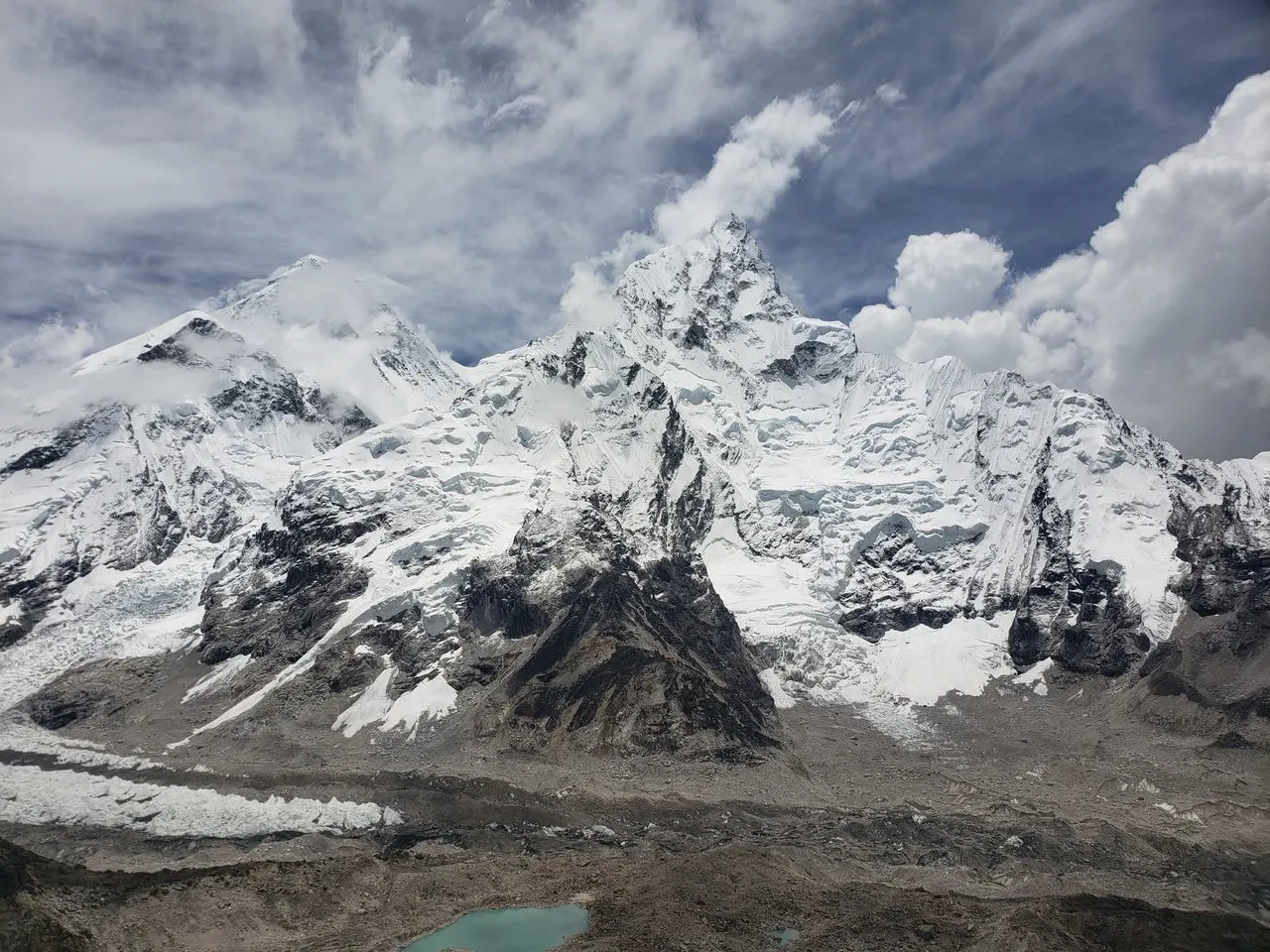
Yes—and this is the entire reason the viewpoint exists. From the prayer-flag summit, Everest’s summit pyramid is clearly visible, rising above the surrounding ridges. You can identify the South Col, the Southeast Ridge, and on clear days, the plume of cloud that often streams from the summit.
The view extends well beyond Everest. Nuptse’s massive dark wall dominates the foreground to the left. Lhotse, the fourth-highest mountain on Earth, stands to the right. Pumori looms directly behind you. And below, the Khumbu Glacier snakes toward Base Camp, a chaotic river of ice and moraine.
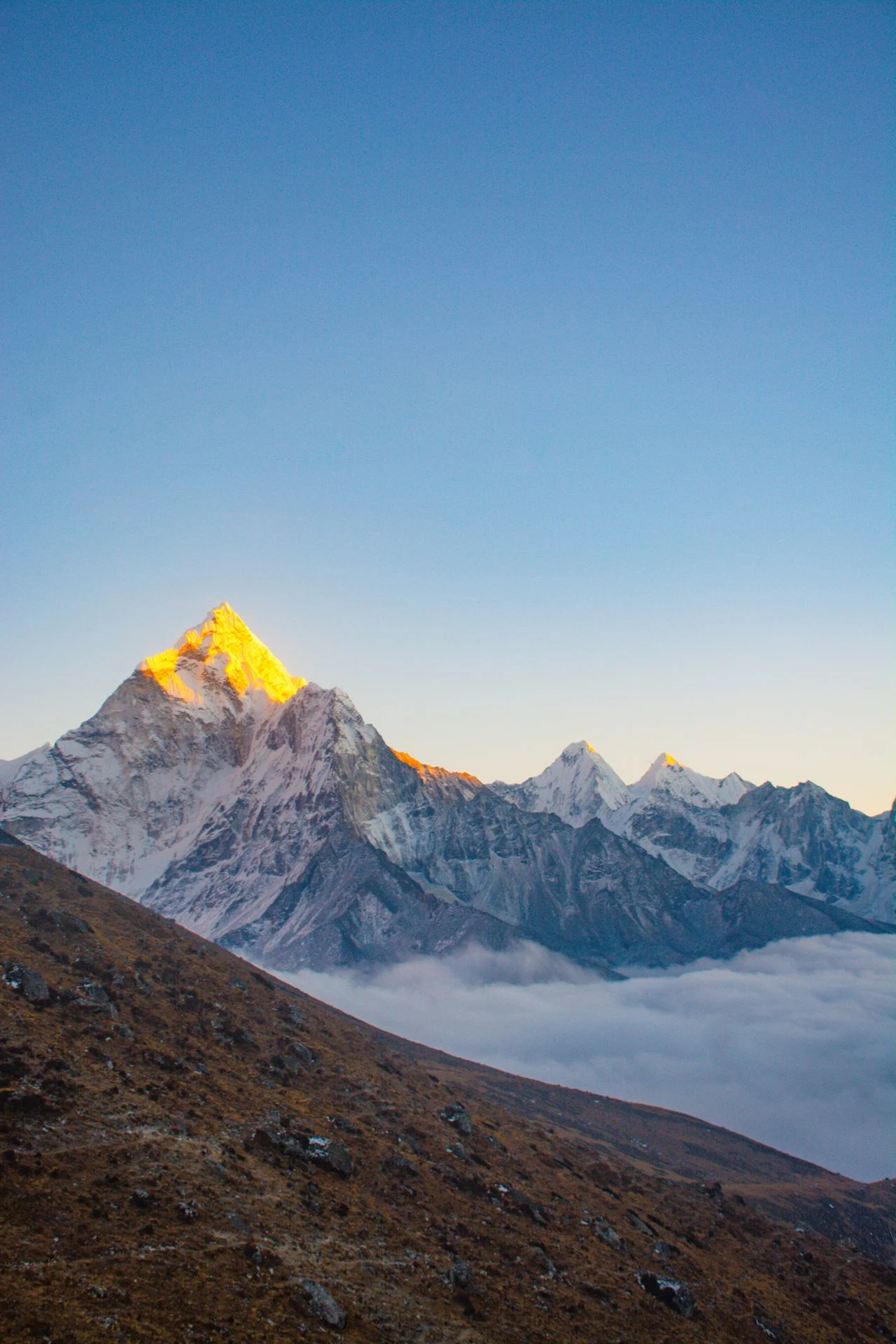
On a clear morning, the first light hits Everest’s summit while everything below remains in shadow. That light—the golden hour on the world’s highest peak—is the reason photographers and trekkers haul themselves out of sleeping bags at 4:00 AM to make the climb in darkness.
Why Everest Base Camp Does Not Show the Summit
Kalapathar Everest exists as a destination because Everest Base Camp fails as a viewpoint. This surprises almost everyone, and it is worth explaining clearly.
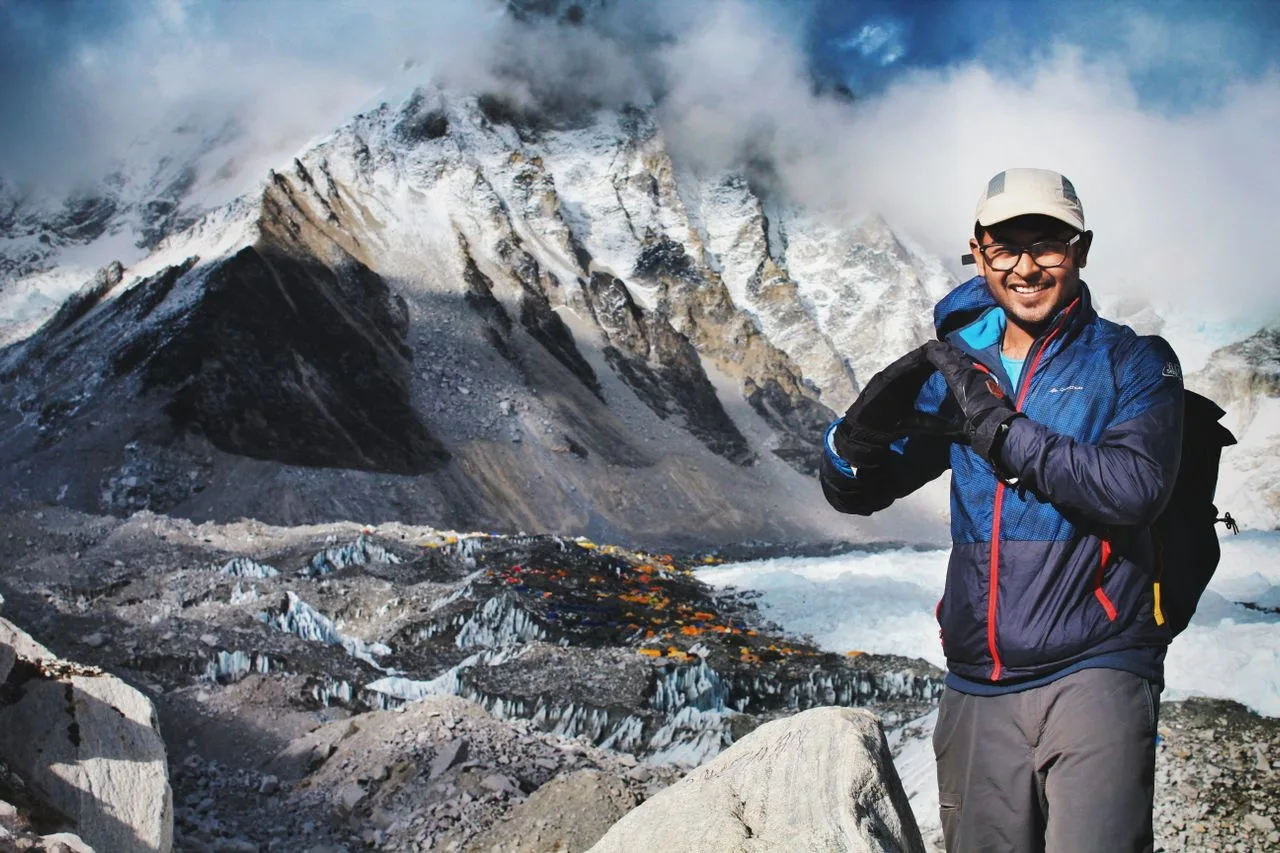
Everest Base Camp at 5,364 metres sits directly at the foot of the Khumbu Icefall. From the Nepal side, you are standing on glacial moraine, looking up at the icefall and the West Shoulder of Everest. The summit itself is hidden behind the mountain’s own bulk and the surrounding ridges.
You can see Everest’s lower slopes. You can see the icefall, the glacier, and the surrounding peaks. But the iconic summit pyramid—the one in every photograph—is not visible from Base Camp. The experience of standing there is historic and atmospheric, but it is not a panoramic viewpoint.
This is why Kala Patthar matters. It is not an optional extra on the EBC trek. It is the only way to complete the visual experience of seeing Everest from the Nepal side.
The Hike From Gorak Shep: What to Actually Expect
The Gorak Shep to Kala Patthar route is approximately 1.5 kilometres one way—about 3 kilometres round trip. That sounds trivial. It is not.
The trail climbs roughly 380 metres in that short distance, over loose rock, scree, and uneven moraine. There is no technical scrambling. There are no ropes or fixed lines. But at 5,000-plus metres, every step demands more oxygen than your body can easily supply.
Most trekkers take 1.5 to 2 hours to reach the summit and 45 minutes to 1 hour to descend. Total round trip: 2.5 to 3.5 hours. Trekkers struggling with altitude may take longer. Those who are well-acclimatised and moving efficiently may do it faster.
The route is not signed in the way lower-elevation trails are. A guide is genuinely useful here, both for navigation and for monitoring how you are handling the altitude. If you are trekking independently, follow the well-worn path and pay attention to the cairns.
Is the Kala Patthar Hike Difficult?
The honest answer is yes, but not in the way technical climbing is difficult. There is no exposure, no scrambling, no glacier travel. The difficulty is altitude and terrain.
At 5,545 metres, atmospheric pressure is roughly half that at sea level. The Nepal Tourism Board specifically warns trekkers to avoid gaining altitude too quickly above 3,000 metres because altitude sickness can become dangerous. Kala Patthar sits well above that threshold. Trekkers who have rushed their acclimatisation—skipping rest days at Namche or Dingboche—often find this short hike disproportionately punishing.
The ground is loose and rocky, which means you cannot settle into a rhythm the way you can on a smooth trail. Every step requires more effort than it should. Fitness helps. Acclimatisation helps more. Ignoring symptoms does not help at all.
Sunrise vs Sunset at Kala Patthar
The Kala Patthar sunrise hike is the classic option. You leave Gorak Shep around 4:00–4:30 AM with a headlamp, climb the rocky trail in darkness, and reach the summit as the first light touches Everest’s summit. The reward is the image that defines the trek for many people.
But weather can ruin it. Cloud, snow, or high wind can obscure the view entirely. A clear sunrise is not guaranteed. Some trekkers climb at sunrise and see nothing but grey. Others climb in the afternoon and get a perfectly clear view with no one else around.
Sunset is the alternative. The evening light on Everest and Nuptse can be spectacular, and there are far fewer people on the summit. Some experienced trekkers argue that the afternoon light is actually better for photography, because the peaks are front-lit rather than backlit. The trade-off is that you descend in fading light, which is slower and requires more care on the rocky trail.
If your schedule allows flexibility, check the weather with your guide and decide in the moment. If you only have one morning, go for sunrise—but accept that conditions may not cooperate.
Where Kala Patthar Fits in the EBC Itinerary
The standard 12–14 day Everest Base Camp itinerary usually places Kala Patthar on Day 9 or Day 10, depending on the operator. A common sequence looks like this:
-
Day 8: Trek from Lobuche to Gorak Shep (5,164 m), then continue to Everest Base Camp (5,364 m), return to Gorak Shep for the night.
-
Day 9: Pre-dawn hike to Kala Patthar (5,545 m), return to Gorak Shep for breakfast, then descend toward Pheriche.
Some itineraries reverse the order—Kala Patthar first, then Base Camp—but the standard approach is Base Camp on the arrival day and Kala Patthar the following morning. The logic is that you are already at Gorak Shep, and the Kala Patthar climb is best done with fresh legs after a night’s rest, however imperfect that rest may be.
Itineraries vary. Some operators build in an extra night at Gorak Shep to allow a second attempt at Kala Patthar if the first morning is clouded out. That flexibility is worth asking about when you compare trekking companies.
Altitude and Acclimatisation: Why This Short Hike Feels So Hard
Kala Patthar altitude places it in a zone where oxygen availability is roughly 50% of sea-level values. That is the single most important fact about this hike.
Acclimatisation is not optional. It is the process by which your body adapts to lower oxygen—increasing breathing rate, producing more red blood cells, and adjusting acid-base balance. It takes time. A well-designed EBC itinerary includes two acclimatisation days: one at Namche Bazaar (3,440 m) and one at Dingboche (4,410 m). These rest days are not padding. They are the difference between a successful Kala Patthar climb and a miserable one.
Symptoms to watch for: persistent headache, nausea, dizziness, fatigue that does not improve with rest, and poor sleep. Severe symptoms—confusion, breathlessness at rest, vomiting that will not stop—require immediate descent. Do not push on to Kala Patthar if you are experiencing severe symptoms. The mountain will still be there.
This is not medical advice. Trek with a guide who is trained to recognise altitude illness, and follow their instructions.
Training for the Kala Patthar Hike
You cannot train your way out of altitude. But you can train your body to handle the physical demands of consecutive days of walking at elevation.
The most useful training focuses on endurance walking on consecutive days, uphill and downhill practice (treadmill incline or stairs), pack training with a loaded daypack, and pacing practice—walking slowly and steadily rather than fast and stop-start. Start at least two months before departure.
What training will not do: prevent altitude sickness. Fit trekkers get AMS. Acclimatisation and honest symptom monitoring are the only reliable defences.
Packing for the Kala Patthar Morning
For the pre-dawn Kala Patthar climb, you need layers, light, and water. Your main duffel stays at the teahouse. Essential daypack items include a down jacket (temperatures before sunrise can drop below -15°C with wind chill), a headlamp with spare batteries, trekking poles for the loose rocky descent, 1–2 litres of water, snacks, sunglasses (category 3 or 4), sunscreen and lip balm, gloves, a hat, and personal medication including Diamox if prescribed by your doctor.
Best Time to Hike Kala Patthar
Kala Patthar is climbed as part of the EBC trek, so the best time to hike it is the best time to trek to Base Camp.
Spring (March–May) offers warmer temperatures and rhododendron blooms lower down. Visibility can be hazier than autumn.
Autumn (late September–November) is widely considered the best season. Skies are clearer, temperatures are cooler but manageable, and the views from Kala Patthar are at their sharpest.
Winter (December–February) brings extreme cold—temperatures at Kala Patthar can drop below -20°C, with strong winds. The trail is quieter, but conditions are genuinely harsh.
Monsoon (June–August) is not recommended. Cloud, rain, and leeches on the lower trails make the trek uncomfortable and the views unreliable.
For 2026, the autumn season looks particularly strong. The Nepal Tourism Board has confirmed that Everest and Khumbu region trekking, including Lukla flights, remains operational for autumn 2026.
Permits and Regulations for 2026
Two permits are required for the EBC trek, including the Kala Patthar hike:
-
Sagarmatha National Park Entry Permit: NPR 3,000 (approximately USD 22) per person. Available at the Nepal Tourism Board office in Kathmandu or at the park entrance at Monjo.
-
Khumbu Pasang Lhamu Rural Municipality Permit: NPR 2,000 (approximately USD 15) per person. Available at the checkpoint in Lukla or Monjo.
TIMS is no longer required in the Khumbu region. That changed in 2018, and many older articles online still have not caught up. The Khumbu Municipality permit replaced TIMS for trekkers entering the Everest region.
Total permit cost: NPR 5,000–6,000 (approximately USD 37–44) per person. Both permits cover the entire EBC route, including the Kala Patthar viewpoint. Rangers check permits at Monjo, Namche, and periodically at teahouses above Namche.
Lukla Flights in 2026: The Ramechhap Diversion
Almost everyone starts the EBC trek with a flight to Lukla. In 2026, that flight is more complicated than it used to be.
During peak trekking seasons (March–May and late September–November), most flights to Lukla are diverted to Ramechhap (Manthali) Airport, roughly 130–140 kilometres from Kathmandu. The drive takes 4.5–6 hours along the BP Highway. Trekkers typically leave Kathmandu around 1:00–2:00 AM to catch the morning weather window.
The flight from Ramechhap to Lukla is about 20–25 minutes. From Kathmandu, it is about 35 minutes. In the off-season, flights may still operate directly from Kathmandu.
Weather delays are common. Build buffer days into your itinerary. Trekkers who schedule tight international connections often miss them.
How Much Does an EBC Trek Including Kala Patthar Cost?
Costs vary significantly by operator, group size, and service level. Reliable 2026 figures show a wide range:
-
Budget guided treks: From around USD 1,200–1,600 for a 14-day trek, though these often cut corners on accommodation and support.
-
Mid-range guided treks: USD 1,800–2,500 for a 14-day itinerary with proper acclimatisation, decent teahouses, and experienced guides.
-
Premium guided treks: USD 2,800–4,000+, with better lodges, smaller groups, and additional support.
The cost typically includes permits, Lukla flights, teahouse accommodation, meals on the trek, guide and porter services, and Kathmandu hotel nights. It usually excludes international flights, travel insurance, personal gear, and tips.
If a price looks too good to be true, it probably is. Extremely cheap treks often compromise on acclimatisation days, guide quality, or emergency support.
Common Mistakes Trekkers Make at Kala Patthar
Rushing the climb. The distance is short, so people try to walk it at a normal pace. At 5,500 metres, normal pace does not exist. Slow down.
Underestimating the cold. Sunrise temperatures at the summit are brutal. Trekkers who leave Gorak Shep without their down jacket regret it within minutes.
Ignoring altitude symptoms. A headache that gets worse is not something to push through. Tell your guide.
Assuming Base Camp has the view. It does not. If you skip Kala Patthar because you already “did Base Camp,” you have missed the best view of Everest on the entire trek.
Trusting one elevation figure. 5,545 metres and 5,644 metres are both real—but they refer to different points. Do not let the discrepancy confuse your planning.
Is Kala Patthar Worth It?
For most trekkers, yes. The view of Everest’s summit, unobstructed and close, is something Base Camp cannot provide. The sunrise, when conditions cooperate, is genuinely spectacular. The climb itself, short but demanding, feels like a proper summit in a way that walking to Base Camp does not.
It is not for everyone. Trekkers who are struggling badly with altitude should not push themselves to the summit. The mountain will still be there. But for those who are acclimatised and feeling well, Kala Patthar is the reason the EBC trek is worth doing.
Wonder Hikes Nepal
Wonder Hikes Nepal organises Everest Base Camp treks that include the Kala Patthar viewpoint as a standard part of the itinerary. The company arranges permits, Lukla flights, teahouse accommodation, guide and porter services, and acclimatisation planning.
For 2026, trekkers should contact Wonder Hikes Nepal to confirm current Lukla flight logistics (including Ramechhap diversions), itinerary options with proper acclimatisation days, and preparation guidance. The company can also advise on whether a second morning at Gorak Shep should be built in as a buffer for Kala Patthar in case of poor weather.
Contact Wonder Hikes Nepal directly for current information before booking.
FAQ
1.What is Kalapathar Everest?
Kalapathar Everest is a rocky viewpoint at approximately 5,545 metres above Gorak Shep in Nepal’s Khumbu region. It offers the clearest view of Everest’s summit available on the standard EBC trek.
2.How high is Kala Patthar?
The commonly used trekking elevation is 5,545–5,550 metres. A higher point on the same ridge measures 5,644 metres. The figure you reach is approximately 5,545 metres.
3.Can you see Everest from Kala Patthar?
Yes. The summit is clearly visible, along with Nuptse, Lhotse, Pumori, and the Khumbu Glacier.
4.Can you see Everest from Base Camp?
No. The summit is blocked by the Khumbu Icefall and the West Shoulder. Kala Patthar is the only place on the standard trek where the summit is clearly visible.
5.How far is Kala Patthar from Gorak Shep?
Approximately 1.5 kilometres one way, 3 kilometres round trip. The climb takes 1.5–2 hours up and 45 minutes to 1 hour down.
6.How difficult is the Kala Patthar hike?
It is short but demanding because of altitude and loose rocky terrain. It is not technical. Acclimatisation is more important than fitness.
7.Is Kala Patthar higher than Everest Base Camp?
Yes. Kala Patthar is approximately 5,545 metres; Everest Base Camp is 5,364 metres. The difference is about 180 metres.
8.What is the best time to hike Kala Patthar?
Autumn (late September–November) offers the clearest views. Spring (March–May) is also good. Winter is extremely cold. Monsoon is not recommended.
9.Do I need a separate permit for Kala Patthar?
No. The Sagarmatha National Park permit and Khumbu Municipality permit cover the entire EBC route, including Kala Patthar.
10.How much does the EBC trek including Kala Patthar cost?
Guided treks range from approximately USD 1,200–4,000+ depending on service level. Mid-range treks with proper acclimatisation typically cost USD 1,800–2,500.
11.Can beginners climb Kala Patthar?
Yes, with proper acclimatisation and pacing. Technical climbing skills are not required. Fitness helps; altitude adaptation matters more.
12.What should I wear for the Kala Patthar sunrise hike?
Down jacket, thermal layers, gloves, hat, headlamp, trekking poles, and sturdy boots. Temperatures before sunrise can drop below -15°C.
13.Is sunrise better than sunset at Kala Patthar?
Sunrise is more popular and offers the classic light-on-summit view. Sunset has fewer people and can be equally beautiful. Both depend on weather.
14.What happens if I cannot reach Kala Patthar?
Return to Gorak Shep with your guide. Do not push through severe altitude symptoms. Descent is the priority.
15.Is Kala Patthar included in the standard EBC trek?
Most reputable operators include it. Confirm with your trekking company. Some budget itineraries skip it or make it optional.
Final Thoughts
Kalapathar Everest is not a summit in the mountaineering sense. It is a viewpoint—a short, steep, rocky climb above Gorak Shep that delivers the view Everest Base Camp cannot. The elevation discrepancy confuses people, but the practical answer is simple: you climb to approximately 5,545 metres, and from there you see the summit.
The hike is short. It is not easy. It is, for most trekkers, the moment the EBC journey feels complete.
Plan for the altitude. Train for the walking. Pack for the cold. And when you reach the prayer flags at the top, take a moment before you reach for your camera. The view is better than the photograph.