The Manaslu Circuit requires more permits than almost any other trek in Nepal — four of them, plus a municipality fee, across two different conservation areas and one restricted zone. That permit stack is also the most inconsistently reported aspect of this trek online, with competing guides listing the wrong fees, including permits that aren’t required, omitting one that is, and in some cases still citing a two-person trekking minimum that was removed in March 2026.
This guide covers every permit you actually need, the exact current costs, where to get each one, and what a realistic total looks like for a standard 14-day itinerary — in peak season and off.
Manaslu Circuit Trek Permits
Before the list, a quick explanation of the geography, because it makes the Manaslu circuit trek permit structure make sense.
The Manaslu Circuit runs through two distinct protected zones. The main body of the trek passes through the Manaslu Conservation Area — the range surrounding Mount Manaslu (8,163 m), Nepal’s eighth-highest peak — before crossing Larkya La Pass at 5,106 m and descending into the Annapurna Conservation Area at Dharapani. This exit into a second conservation zone is why you need an Annapurna permit for a trek named after Manaslu: the final days of the circuit physically take you through ACAP-managed land.
On top of these two conservation permits, the section of the circuit between Jagat and Dharapani runs through a designated restricted area — land that sits close to the Tibetan border, classified as sensitive for national security and cultural preservation reasons. Entering this zone requires a Restricted Area Permit issued by the Department of Immigration, which can only be arranged through a registered trekking agency. And at Jagat specifically, a Chumnubri Rural Municipality development fee is collected in addition to everything else.
This isn’t bureaucratic excess — each permit funds a different layer of management, from national park conservation to local community development to border zone monitoring.
Knowing what each one is for also helps you verify that everything in a quoted package is genuinely included.
The Four Manaslu Circuit Trek Permits You Actually Need
1. Manaslu Restricted Area Permit (RAP)
This is the most expensive and most logistically complex Manaslu Circuit trek permit in the stack, and the one most likely to trip up self-planners.
The RAP covers your presence in the restricted zone between Jagat and Dharapani. It is priced by season and by the number of days you spend inside that zone, which is why total permit costs vary depending on your itinerary length.
- Autumn (September to November):
First 7 days: USD 100 per person
Each additional day beyond 7: USD 15 per person per day - December to August (all other months):
First 7 days: USD 75 per person
Each additional day beyond 7: USD 10 per person per day
Most standard 14-day Manaslu Circuit itineraries spend approximately 10 to 12 days inside the restricted zone, depending on the specific route and pace. For a 10-day restricted zone stay in autumn, the RAP costs $100 (first 7 days) plus $45 (3 extra days at $15) = $145. For the same stay in December, it’s $75 plus $30 = $105.
The RAP can only be obtained through a registered Nepali trekking agency — individual applications are not accepted at the Department of Immigration. Your agency handles this, submitting your passport details, itinerary, and guide and porter insurance documentation on your behalf. Online applications are possible through the Department of Immigration’s website; in-person applications are processed at the Kalikasthan office in Kathmandu after 10 a.m., Sunday to Friday.
The MRAP is checked at multiple points: Jagat, Philim, Samagaon, Samdo, and Dharapani. Keep it accessible throughout the trek, not buried at the bottom of a bag.
Manaslu Conservation Area Permit (MCAP)
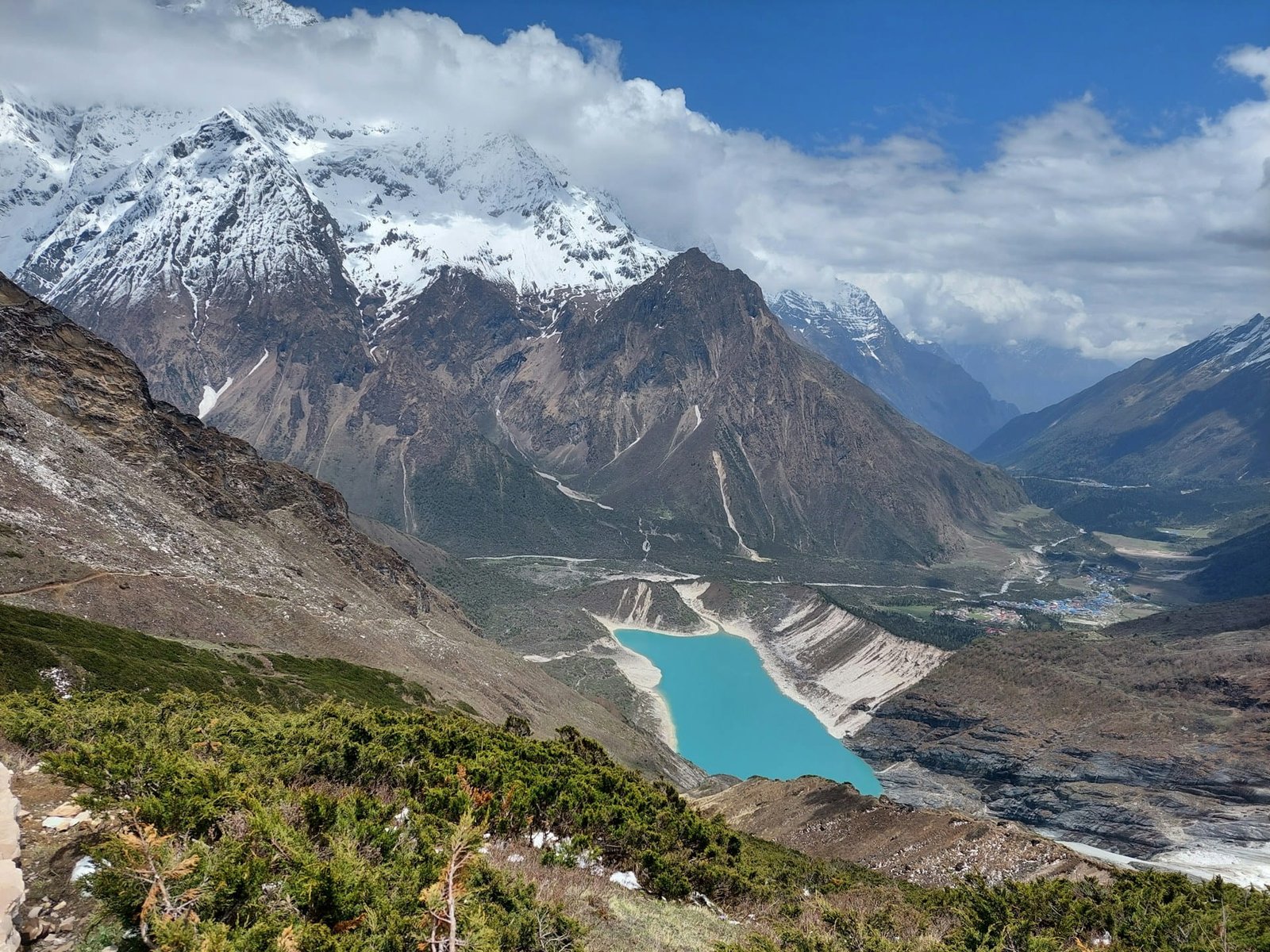
This Manaslu Circuit trek permit covers the protected land around the Manaslu massif and runs for the main body of the circuit from Soti Khola to Dharapani.
Cost: NPR 3,000 per person (approximately USD 22-30 depending on current exchange rate), flat rate throughout the year, for all non-SAARC foreign nationals. SAARC nationals pay NPR 1,000.
The MCAP can be obtained through a registered trekking agency or directly at the Nepal Tourism Board office on Pradarsani Marg in Kathmandu or the NTB office in Pokhara. You’ll need a copy of your passport, a passport-sized photograph, and payment in Nepali rupees.
Annapurna Conservation Area Permit (ACAP)
This permit is required because the circuit exits into the Annapurna Conservation Area at Dharapani after the Larkya La crossing — the same permit that covers the Annapurna Circuit and the area around Pokhara. If you’ve already done any Annapurna-region trekking on the same trip, check whether your existing ACAP is still valid before purchasing again.
Cost: NPR 3,000 per person (approximately USD 22-30) for non-SAARC nationals. SAARC nationals pay NPR 1,000.
Obtainable at the Nepal Tourism Board offices in Kathmandu or Pokhara, or through your agency. If you’re continuing directly from the Manaslu Circuit onto the Annapurna Circuit, this single ACAP covers both sections — a useful detail for anyone doing the combined route.
Chumnubri Rural Municipality Fee
This is the permit most consistently omitted from other travel guides, yet it is collected at the Jagat checkpoint on entry — you cannot continue past this point without it.
Cost: A small local fee — typically cited as a few hundred to one thousand NPR — collected to support local community infrastructure and development in the Chumnubri area. The exact amount can vary slightly; your agency will know the current rate and can factor it into your permit total.
TIMS Card — Not Required
Several travel pages online, list the TIMS Card as a required permit for the Manaslu Circuit Trek, but it is not. The Restricted Area Permit replaces TIMS on this route. If a permit checklist includes TIMS for the standard Manaslu Circuit, that’s outdated or incorrect information. No TIMS is needed, and no permit checkpoint on the Manaslu Circuit will ask for one.
The Solo Trekking Rule: What Changed in March 2026
For several years, the Manaslu Circuit operated under a two-person minimum rule — solo trekkers were required to find at least one other person to join their permit application before the RAP could be issued. This rule was removed effective March 2026.
Solo travelers can now book the Manaslu Circuit through a registered trekking agency with a single licensed guide, without needing a second trekker on the permit. This is a meaningful change for independent-minded travelers, and it’s worth stating plainly because several current guides still describe the two-person minimum as active.
What hasn’t changed is the guide requirement. A licensed guide from a TAAN-registered trekking agency remains mandatory on all restricted area treks, reinforced by the 2023 nationwide guide mandate. The practical reality on Manaslu specifically — which crosses Larkya La at 5,106 m through terrain where weather can change rapidly — is that a guide is a genuine safety asset rather than an administrative formality, regardless of how experienced a trekker you are.
The Restricted Area Permit cannot be obtained without going through a registered agency. This is not optional and is not workaroundable — the Department of Immigration requires the agency’s letterhead, authorized signature, and stamp on the permit application.
Total Permit Cost – Scenario
Here’s what the permit stack totals for a standard 14-day Manaslu Circuit itinerary, assuming approximately 10 days inside the restricted zone.
- Peak season (September to November), 10 days in restricted zone:
Manaslu RAP: $100 (first 7 days) + $45 (3 extra days × $15) = $145
MCAP: ~$30
ACAP: ~$30
Chumnubri fee: ~$5-10
Total permits: approximately $210-215 per person - Off-season (December to August), 10 days in restricted zone:
Manaslu RAP: $75 (first 7 days) + $30 (3 extra days × $10) = $105
MCAP: ~$30
ACAP: ~$30
Chumnubri fee: ~$5-10 - Total permits: approximately $170-175 per person
These figures are permit costs only — guide, porter, accommodation, meals, flights, and transport are separate. The total figures you’ll see quoted from some sources ($160-205 for peak season) typically reflect slightly different itinerary day counts inside the restricted zone, which is why the totals vary: a 12-day restricted zone stay adds $30-45 to the RAP cost compared to a 10-day stay.
The lesson is that the permit total isn’t a fixed number — it’s a calculation. Know how many days your specific itinerary spends inside the restricted zone (your agency can tell you) and apply the per-day formula for your season to get your exact figure.
Where to Get Each Permit and When
- Manaslu Restricted Area Permit (RAP): Through your registered trekking agency only like Travel Wonder Hikes Nepal. Can be arranged in Kathmandu before departure via the Department of Immigration (Kalikasthan office), either in person or online through the Department of Immigration’s official website.
Allow at least two to three working days before your trek start date during peak season; the process can take longer when permit offices are busy in October. - MCAP: Nepal Tourism Board office in Kathmandu (Pradarsani Marg) or Pokhara, or through your agency. Can be obtained on the day with your passport and photographs in hand; no advance booking required.
- ACAP: Same NTB offices as MCAP, or through your agency. Same day, same documents.
- Chumnubri Rural Municipality fee: Collected in cash at the Jagat checkpoint. Bring sufficient Nepali rupees — this cannot be paid in advance and is not included in most agency permit quotes, though some agencies factor it into their package.
Practical note: Most trekkers on a packaged trip simply hand over their passport to their agency and let the agency handle all permit applications, which is the smoothest approach during peak season when NTB offices queue. If you’re partially self-arranging, the RAP is the one permit you genuinely cannot handle yourself — everything else is theoretically self-obtainable with a passport and rupees.
Manaslu Circuit Trek Permit Checkpoints on the Trail
The RAP in particular is checked repeatedly on the Manaslu Circuit, not just at entry. Checkpoints where permits are verified:
- Jagat — the first major checkpoint after the road section from Soti Khola, where the restricted zone begins. All three permits (RAP, MCAP, and the Chumnubri fee) are checked and collected here.
- Philim — a second RAP verification point shortly after Jagat.
- Samagaon — in the upper valley, another checkpoint as you approach the higher altitude section before Larkya La.
- Samdo — the final checkpoint before the pass crossing.
- Dharapani — on the far side of Larkya La, the exit checkpoint from the restricted zone where ACAP may also be verified as you enter the Annapurna region.
Keep all permits in a waterproof document pouch accessible from the top of your pack — not buried in the main compartment. Rangers at these checkpoints are not negotiable, and a missing permit at Jagat means the trek doesn’t continue until it’s resolved.
The Tsum Valley Extension: A Separate Permit Stack
If you’re combining the Manaslu Circuit with the Tsum Valley — a separate restricted area branching off the main circuit above Philim — an additional Restricted Area Permit is required specifically for Tsum Valley. This is a second RAP, priced on the same seasonal/per-day structure as the Manaslu RAP, and adds meaningfully to your total permit cost for a combined itinerary.
The Tsum Valley extension also typically adds 7-10 days to the overall itinerary. If you’re considering this combination, factor the second RAP into your permit budget from the outset — it’s the single most consistently underestimated cost element in Manaslu-Tsum Valley combined trip quotes.
Frequently Asked Questions
- How many permits do I need for the Manaslu Circuit Trek?
Four permits plus one local fee: the Manaslu Restricted Area Permit (RAP), the Manaslu Conservation Area Permit (MCAP), the Annapurna Conservation Area Permit (ACAP), and the Chumnubri Rural Municipality fee collected at Jagat. No TIMS Card is required. - How much does the Manaslu permit cost in total?
For a standard 14-day Manaslu trek itinerary (approximately 10 days inside the restricted zone), permit costs total roughly $210-215 per person in peak season (September-November) and $170-175 in off-season. The exact RAP cost depends on how many days your itinerary spends inside the restricted zone. - Can I trek the Manaslu Circuit solo?
Yes, as of March 2026 — the two-person minimum for permit issuance was removed. Solo trekkers can now apply through a registered agency with a single licensed guide. A guide from a TAAN-registered agency remains mandatory; truly independent trekking without a guide is not permitted. - Do I need a TIMS Card for Manaslu?
No. The Restricted Area Permit replaces TIMS on the Manaslu Circuit. Any permit checklist that includes TIMS for this route is out of date. - Why do I need an Annapurna permit for a Manaslu trek?
Because the circuit physically exits into the Annapurna Conservation Area at Dharapani after the Larkya La crossing. The final section of the route is managed under ACAP, making the permit genuinely required regardless of where the trek is named after. - Can I get the permits myself without an agency?
The MCAP and ACAP can technically be self-obtained at the Nepal Tourism Board offices. The Restricted Area Permit cannot — it must go through a registered trekking agency, and the Department of Immigration requires the agency’s documentation. Since the RAP is the most critical permit and can only come through an agency, most trekkers let the agency handle the full permit stack. - When should I arrange permits?
At least one week before your trek start date in off-season, and ideally two or more weeks in advance during October, when Manaslu is at peak traffic and permit offices queue. The RAP specifically can take two to three working days to process during busy periods. - What happens if I lose a permit on the trail?
Contact your guide and agency immediately. Agencies can generally provide permit details and copies to present at checkpoints. Carrying both digital photos and a physical photocopy of each permit significantly reduces the problem if originals go missing. - Do permit prices differ between peak and off-season for all three permits, or just the RAP?
The seasonal discount applies specifically to the Restricted Area Permit — roughly $70 per week in September-November versus around $50 per week in the off-season months. MCAP and ACAP fees stay flat year-round at their standard foreigner rates regardless of season. - Is there a different permit rate for SAARC nationals?
Yes. Trekkers from SAARC countries pay a reduced rate on the MCAP and ACAP compared to other foreign nationals, though the RAP fee structure applies uniformly by week and season rather than by nationality. Your agency will apply the correct rate once your citizenship is confirmed on the application. - What checkpoints will I need to show my permits at?
Expect checkpoint stops at Jagat (entry into the restricted area and where the rural municipality fee is collected), Philim, and Sama Gaun, with a final ACAP check around Dharapani after the Larkya La crossing. Officials record entry and exit dates at each point, which is part of why the RAP is tied to specific trek dates rather than an open window. - Can I extend my permit if my trek takes longer than planned?
Yes, but it has to be arranged through your agency rather than at a checkpoint. An extension is billed at the standard daily RAP rate for each additional day beyond your original permit dates, so agencies generally build in a buffer day or two when applying to avoid extension paperwork mid-trek. - Do guides and porters need separate permits?
Guides and porters need their own MCAP and ACAP, though at Nepali citizen rates rather than the foreigner fee. The Restricted Area Permit application itself is filed as a group covering the trekker and staff together, which is one more reason the paperwork has to go through a registered agency rather than being split up individually. - Are children required to pay full permit fees?
Most parks apply a reduced or waived rate for young children, but the age threshold and exact discount vary by permit. Since this changes periodically, it’s worth having your agency confirm current child rates at the time of booking rather than assuming a fixed cutoff. - What happens to my permit fees if I have to cancel or cut the trek short?
Permit fees are generally non-refundable once issued, since the payment covers the application and government processing rather than actual trekking days used. If you need to cut the trek short partway through, there’s no partial refund mechanism — the loss is limited to what was already paid rather than the full remaining itinerary cost.