Om Mani Padme Hum Meaning
The literal translation of Om Mani Padme Hum is often given as “Praise to the Jewel in the Lotus.” But this English rendering barely scratches the surface. The six syllables together encode a complete path of Buddhist practice — one that maps the union of compassion and wisdom, purifies the six realms of rebirth, and invokes Avalokiteshvara, the Bodhisattva of Compassion. Understanding the mantra requires moving beyond a single-sentence translation and into the layers of meaning that Tibetan Buddhist traditions have developed over centuries.
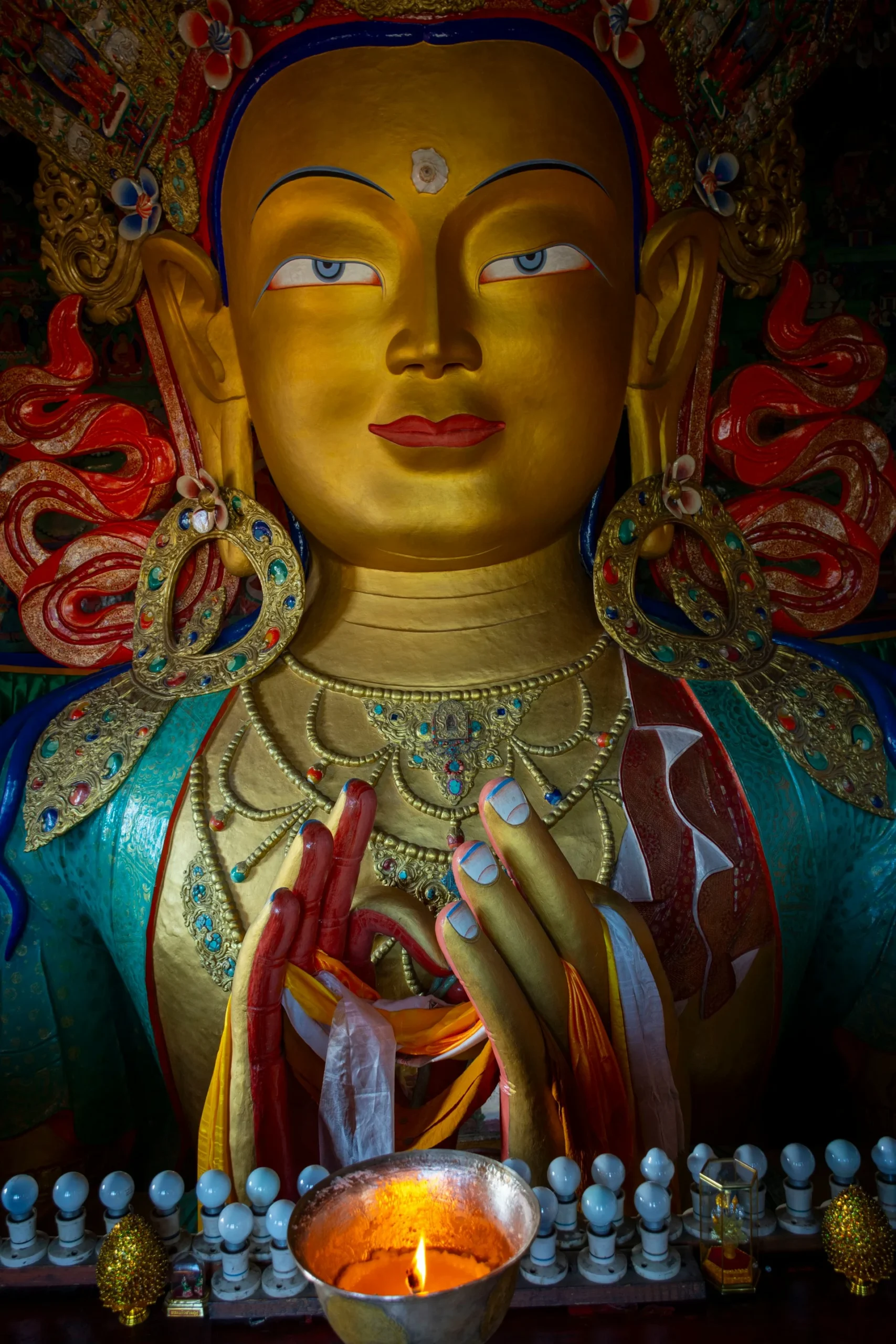
What Does Om Mani Padme Hum Mean?
The phrase comes from Sanskrit, the classical language of ancient India, and is written in Tibetan script across the Himalayan world. At its most basic level, Om Mani Padme Hum is a mantra — a sacred sound formula repeated as a form of prayer, meditation, and devotional practice.
The Tibetan Buddhist Encyclopedia describes it as the most important mantra in Tibetan Buddhism and identifies its core function: it is the six-syllable mantra of the Bodhisattva of Compassion, Avalokiteshvara.
But what does it actually mean? The Oxford Reference entry on the mantra offers the standard literal translation — “Praise to the jewel in the lotus” — while noting that this reading presents grammatical problems. Some scholars have suggested alternative readings, though none are universally accepted. The Dalai Lama himself has provided one of the most widely cited interpretations, explaining that Om denotes the impurities that impede spiritual awareness; Mani (jewel) symbolizes the pathway lit by compassion; Padme (lotus) defines the tool, wisdom; and Hum represents the indivisible union of wisdom and method.
Each syllable works on multiple levels: as sound, as symbol, and as a practical instruction for Buddhist practice.
Why Is It Called the Six-Syllable Mantra?
The name “six-syllable mantra” comes directly from its structure. Each syllable carries distinct meaning and traditional associations.
| Syllable | Transliteration | Traditional Association | Practical Idea |
|---|---|---|---|
| ཨོཾ | Om | The body, speech, and mind of a Buddha | Purifies pride and ego |
| མ | Ma | The realm of jealous gods | Purifies jealousy |
| ཎི | Ni | The human realm | Purifies desire and attachment |
| པ | Pad | The animal realm | Purifies ignorance |
| དྨེ | Me | The hungry ghost realm | Purifies greed |
| ཧཱུྃ | Hum | The hell realm | Purifies hatred and aggression |
Each syllable also corresponds to one of the six perfections, the core practices of the bodhisattva path. This dual mapping — realms and perfections — is a distinctive feature of Tibetan Buddhist interpretation.
What Do Mani and Padme Mean?
Mani translates as “jewel” and Padme as “lotus.” These two words form the heart of the mantra’s symbolic meaning.
In Tibetan Buddhist teaching, the jewel represents the method aspect of the path — compassion, love, generosity, and the aspiration to benefit others. The lotus represents wisdom. The lotus grows from mud and muck, yet rises unstained to bloom on the water’s surface. In the same way, wisdom emerges from the confusion of ordinary life without being contaminated by it.
The Dalai Lama’s interpretation brings these together: Mani (compassion) and Padme (wisdom) are not two separate goals but two inseparable aspects of the awakened mind. The mantra invokes their union.
What Does Hum Mean?
Hum (sometimes written Hung in Tibetan pronunciation) is the final syllable and carries the sense of indivisibility — the union of method and wisdom, compassion and insight. It represents the culmination of the path, the point at which the practitioner’s compassion and wisdom become inseparable.
In tantric Buddhist practice, Hum is also associated with the mind of enlightenment and is considered the seed syllable for certain meditational deities.
Who Is Avalokiteshvara?
Avalokiteshvara is the Bodhisattva of Compassion in Mahayana Buddhism. The name means “the lord who looks down with compassion upon the world.” In Tibetan, this bodhisattva is known as Chenrezig — literally “the All-Seeing Lord”.
The connection between Avalokiteshvara and the mantra is direct. The Kāraṇḍavyūha Sūtra, a Sanskrit scripture from roughly the fourth century CE, is the earliest known text to introduce the mantra. The sūtra describes Avalokiteshvara’s activities rescuing beings from the deepest hells and describes the extreme rarity of his mantra. According to the text, the mantra was obtained by the Bodhisattva Sarvanīvaraṇaviṣkambhin from someone in Vārāṇasī who had broken his monastic vows — a detail that underscores the mantra’s accessibility regardless of one’s status or past actions.
Avalokiteshvara is often depicted with four arms, representing the Four Immeasurables: loving-kindness, compassion, sympathetic joy, and equanimity.
Why Is This Mantra Associated With Compassion?
Compassion — karuna in Sanskrit — is the central theme of the mantra and the deity it invokes. The Dalai Lama has emphasized that all major religious traditions encourage appreciation of compassion, leading followers to act in service of others rather than solely for themselves.
In Buddhist practice, compassion is not a passive sentiment. Bodhichitta — the aspiration to attain awakening for the benefit of all sentient beings — is the active expression of compassion. Reciting the mantra is understood as a way to actualize that aspiration, transforming the mind through repetition and intention.
Om Mani Padme Hum and the Six Perfections
The six perfections — pāramitās in Sanskrit — are the core practices of the bodhisattva path. They are traditionally listed as generosity (dāna), morality (śīla), patience (kṣānti), vigor (vīrya), concentration (dhyāna), and wisdom (prajñā).
| Syllable | Perfection | What It Cultivates |
|---|---|---|
| Om | Generosity | The wish to benefit others |
| Ma | Morality | Ethical conduct and discipline |
| Ni | Patience | Tolerance and forbearance |
| Pad | Vigor | Diligence and perseverance |
| Me | Concentration | Focus and meditative stability |
| Hum | Wisdom | Insight into the nature of reality |
This association is not arbitrary. Each syllable serves as a mnemonic for a specific quality the practitioner seeks to develop.
Om Mani Padme Hum and the Six Realms
In Buddhist cosmology, sentient beings cycle through six realms of existence: the god realm, the jealous god realm, the human realm, the animal realm, the hungry ghost realm, and the hell realm. The mantra is traditionally associated with purifying the afflictions that keep beings trapped in these realms.
Different traditions map the syllables to the realms in slightly different ways. One common version assigns Om to the god realm, Ma to the jealous gods, Ni to the human realm, Pad to the animal realm, Me to the hungry ghosts, and Hum to the hell realm. The Tibetan Buddhist Encyclopedia notes that this interpretation is one of several and is not universally fixed across all lineages.
Is “The Jewel in the Lotus” the Complete Translation?
No — and this is where many online explanations stop short. The translation “the jewel in the lotus” captures the symbolic core of Mani and Padme, but it omits the function of Om and Hum, ignores the mantra’s grammatical complexity, and reduces a multi-layered practice to a poetic phrase.
The Oxford Reference entry notes that the literal reading as “Praise to the jewel in the lotus” presents grammatical problems and that many speculative explanations exist in Tibetan Buddhism. The mantra is not a sentence to be decoded once, but a practice to be recited over a lifetime.
Is Om Mani Padme Hum Sanskrit or Tibetan?
The mantra originated in Sanskrit — the classical language of ancient India — and was transmitted to Tibet as part of the broader movement of Buddhist texts from India to the Himalayas. The Kāraṇḍavyūha Sūtra, the text that introduced the mantra, was a Sanskrit scripture.
In Tibet, the mantra was preserved in its Sanskrit form but written in Tibetan script. Tibetan pronunciation has since shaped how the mantra is chanted across the Himalayan region. One common Tibetan pronunciation is Om Mani Peme Hum, with the padme contracted to peme. The final syllable is often rendered Hung rather than Hum in Tibetan pronunciation.
How Do You Pronounce Om Mani Padme Hum?
There is no single “correct” English pronunciation, because Tibetan phonetics do not map perfectly onto English spelling. A practical beginner’s pronunciation is:
Om — like “home” without the “h”
Ma — like “mah”
Ni — like “nee”
Pad — like “pahd”
Me — like “may”
Hum — like “hum” (with a nasal quality on the “m”)
The vowel in Hum is often pronounced like the “u” in “book,” and the final consonant is sometimes rendered as “ng,” giving Hung.

What Are the Benefits of Chanting It?
This is where careful distinction matters. The benefits of chanting the mantra fall into three categories:
Traditional Buddhist beliefs: Tibetan Buddhist teachings describe many benefits of reciting the mantra — purifying negative karma, accumulating merit, and progressing toward enlightenment. The Gyang Khang Rinpoche website lists benefits including empowering sentient beings, cleansing bad karma, removing obstacles, and liberating from cyclic rebirth. These are statements of religious belief and should be understood as such.
Meditation and practice benefits: The act of chanting — like other forms of repetitive prayer or meditation — may produce a sense of calm, focus, and emotional steadiness. The Dalai Lama has said that reciting the mantra can bring peace of mind. This is consistent with general observations about meditative practices and does not require supernatural claims.
Scientifically established claims: There are no peer-reviewed scientific studies establishing that chanting this mantra cures diseases, guarantees wealth, or produces supernatural protection. Any article that presents such claims as fact is not being responsible.
How Can Beginners Use the Mantra in Meditation?
A simple framework for beginners:
-
Sit comfortably with your spine upright but not rigid.
-
Bring attention to your breath for a few moments.
-
Begin chanting softly, either aloud or mentally. The mantra has a natural rhythm: Om Mani Padme Hum, repeated.
-
Let the sound fill your attention. Some practitioners coordinate the chant with the breath, chanting on the exhale.
-
When the mind wanders, return to the sound. This is the practice — not suppressing thoughts, but returning.
-
Close with a moment of silence, allowing the vibration of the mantra to settle.
There is no required duration. Five minutes of sincere practice is meaningful. The mantra can also be recited during daily activities — walking, commuting, or waiting.
Do You Need Initiation to Chant It?
This is one of the most common questions, and the answer is nuanced. In Vajrayana Buddhism, certain advanced tantric practices require empowerment from a qualified teacher. But the Om Mani Padme Hum mantra is generally considered accessible for simple devotional recitation. One Buddhist source notes that the prerequisites for this mantra are not as stringent as for more advanced practices, though taking Vajrayana Refuge and Bodhichitta is often recommended.
In practice, millions of people across the Himalayan world recite the mantra daily without formal initiation. It is a public mantra, carved on stones, printed on prayer flags, and spun in prayer wheels. The distinction lies between simple recitation — open to all — and advanced tantric practice, which may require specific transmission.
Why Is Om Mani Padme Hum So Common in Nepal?
Anyone who has traveled through Nepal’s Himalayan regions has encountered this mantra. It is carved into mani stones along trekking trails, painted on prayer flags fluttering from ridges, and spun in prayer wheels at monasteries and stupas.
Mani stones — rocks inscribed with the mantra — are a distinctive feature of Tibetan Buddhist culture. They are placed along roadsides, grouped into mounds, or stacked into long walls called mani walls. Buddhist custom dictates that these walls should be passed from the left side, in the clockwise direction.
Prayer wheels contain the mantra printed on scrolls inside. Each spin is understood to release the mantra into the world. At major pilgrimage sites like Boudhanath Stupa in Kathmandu, pilgrims walk the kora — the clockwise circumambulation — spinning the wheels that line the stupa’s base.
Om Mani Padme Hum at Boudhanath
Boudhanath is one of the largest stupas in Asia and the most important Tibetan Buddhist site in Nepal. The stupa’s base is lined with prayer wheels inscribed with the mantra. Pilgrims from across the Himalayan world walk the kora daily, spinning the wheels as they go.
For visitors, the experience is accessible but requires respect. Walk clockwise around the stupa. Spin prayer wheels gently with your right hand. Do not climb on the stupa or treat sacred objects as photo props. The mantra is not decoration — it is the living heart of a devotional tradition practiced by millions.
Seeing the Mantra During a Himalayan Trek
Trekkers in Nepal’s Himalayan regions — the Everest region, Langtang, Manaslu, and the Annapurna region — encounter the mantra constantly. Mani walls mark trail junctions. Prayer wheels turn in village gompas. Prayer flags strung across valleys carry the mantra on the wind.
Understanding what these objects mean transforms them from scenery into encounter. A mani wall is not just a pile of carved stones. It is a repository of prayer, placed there by people who believe that the mantra’s presence benefits all beings who pass.
Companies like Wonder Hikes Nepal guide trekkers through these landscapes. A knowledgeable guide can explain not only trail conditions but also the cultural context of the mani walls, chortens, and monasteries encountered along the route. That context — understanding what you’re walking past — is part of what makes Himalayan trekking different from hiking anywhere else.
Common Misunderstandings About the Mantra
| Misconception | More Accurate Understanding |
|---|---|
| It is a magic formula that grants wishes | It is a devotional and meditative practice, not a spell |
| It guarantees healing or protection | Traditional teachings describe spiritual benefits; no scientific evidence supports medical claims |
| It has one fixed translation | Multiple interpretations exist across traditions |
| Each syllable has one rigid dictionary meaning | Syllables carry layered symbolism and are interpreted differently |
| It is Tibetan in origin | It originated in Sanskrit and was transmitted to Tibet |
| You need initiation to chant it | Simple recitation is generally open; advanced tantric practice may require empowerment |
| It is a prayer to a god | It invokes the compassion of Avalokiteshvara and the qualities of awakening |
Frequently Asked Questions
1.What does Om Mani Padme Hum mean in English?
The common translation is “Praise to the Jewel in the Lotus,” but this captures only the symbolic core. The full meaning involves the union of compassion (the jewel) and wisdom (the lotus) invoked through the syllables Om and Hum.
2.What religion is Om Mani Padme Hum from?
It comes from Mahayana Buddhism and is most closely associated with Tibetan Buddhism and Vajrayana practice.
3.Who is Om Mani Padme Hum associated with?
The mantra is associated with Avalokiteshvara (Chenrezig in Tibetan), the Bodhisattva of Compassion.
4.What do the six syllables mean?
Each syllable has traditional associations with the six realms of rebirth, the six perfections, and the purification of specific afflictions. The Dalai Lama interprets them as the union of compassion and wisdom.
5.What does Mani mean?
Mani means “jewel” and symbolizes the method aspect of the Buddhist path — compassion, love, and the wish to benefit others.
6.What does Padme mean?
Padme means “lotus” and symbolizes wisdom — the mind’s capacity to rise unstained from confusion, like a lotus from mud.
7.What does Hum mean?
Hum signifies indivisibility — the inseparable union of compassion and wisdom that constitutes enlightenment.
8.Is it Sanskrit or Tibetan?
The mantra originated in Sanskrit and was transmitted to Tibet, where it is written in Tibetan script and pronounced according to Tibetan phonetics.
9.How do you pronounce it?
A practical approximation: Om Mah-nee Pahd-may Hum. Tibetan pronunciation often renders padme as peme and hum as hung.
10.What are the benefits of chanting it?
Traditional Buddhist teachings describe spiritual benefits including purification of karma and progress toward enlightenment. Meditative recitation may also produce calm and focus. No scientific evidence supports supernatural claims.
11.Can anyone chant it?
Yes. The mantra is widely accessible for devotional recitation. Advanced tantric practices associated with it may require empowerment.
12.Do you need initiation?
Simple recitation is generally open. For advanced Vajrayana practices, initiation from a qualified teacher is traditionally required.
13.Why is it common in Nepal?
Nepal’s Himalayan regions have large Tibetan Buddhist communities. The mantra appears on mani stones, prayer wheels, prayer flags, and monastery walls throughout the country.
14.What is the connection between the mantra and Avalokiteshvara?
The Kāraṇḍavyūha Sūtra, the earliest text to introduce the mantra, presents it as the mantra of Avalokiteshvara. Reciting it is understood as invoking the bodhisattva’s compassion.
15.Is it a prayer or a mantra?
It functions as both. A mantra is a sacred sound formula; reciting it can be a form of prayer, meditation, or devotional practice.
Ready to plan your trek?
Tell us your dates and group size. We reply on WhatsApp within a few hours.