How Many Days to Climb Annapurna
Climbing Annapurna I takes between 40 and 50 days— and that duration is not a bureaucratic formality. It is the minimum realistic timeframe for proper acclimatization, high-camp establishment, and the weather-window flexibility that this specific mountain demands more urgently than almost any other 8,000 m peak.
The reason that urgency matters comes from Annapurna I’s particular character. At 8,091 m, it is the tenth highest mountain in the world — lower than Everest, lower than K2, lower than several peaks climbers typically use as stepping stones. Yet as of early 2026, 75 climbers have died on Annapurna I while 559 have successfully summited — a current fatality-to-summit ratio of approximately 13.4%, down significantly from its historic high of around 38.7% in the early expedition era.
That improved number still makes it the deadliest 8,000 m peak relative to summits achieved. The mountain’s danger doesn’t come from altitude alone — it comes from route-wide avalanche hazard that cannot be engineered around, only navigated with timing, experience, and patience.
Understanding why the expedition takes as long as it does is inseparable from understanding what the mountain actually is.
The Short Answer: 40-48 Days, With Three Distinct Phases
Most commercial Annapurna I expeditions in 2026 are structured across 40 to 48 days total, with the most common itineraries falling at 42-43 days. The variation between operators reflects different approach routes, the amount of built-in buffer for weather delays, and whether the itinerary includes helicopter access to base camp (which shortens the approach phase considerably).
The expedition is divided into three phases. Understanding what each phase involves — and why it takes as long as it does — is the most useful framework for answering the question.
Phase 1 — The Approach (Days 1-10 approximately): Kathmandu arrival, briefings, permit processing, and the trek or drive-and-helicopter transfer to base camp.
Phase 2 — The Climbing Period (approximately 29-30 days): Acclimatization rotations, high-camp establishment, waiting for weather windows, and the summit push and descent.
Phase 3 — The Return (Days 4-5 approximately): Trek or helicopter out from base camp to the road network, drive to Pokhara, fly back to Kathmandu, and debrief.
Phase 1: The Approach to Base Camp
Annapurna I has two base camps, approached from different sides of the mountain, and which one your expedition uses changes the character and length of the approach phase.
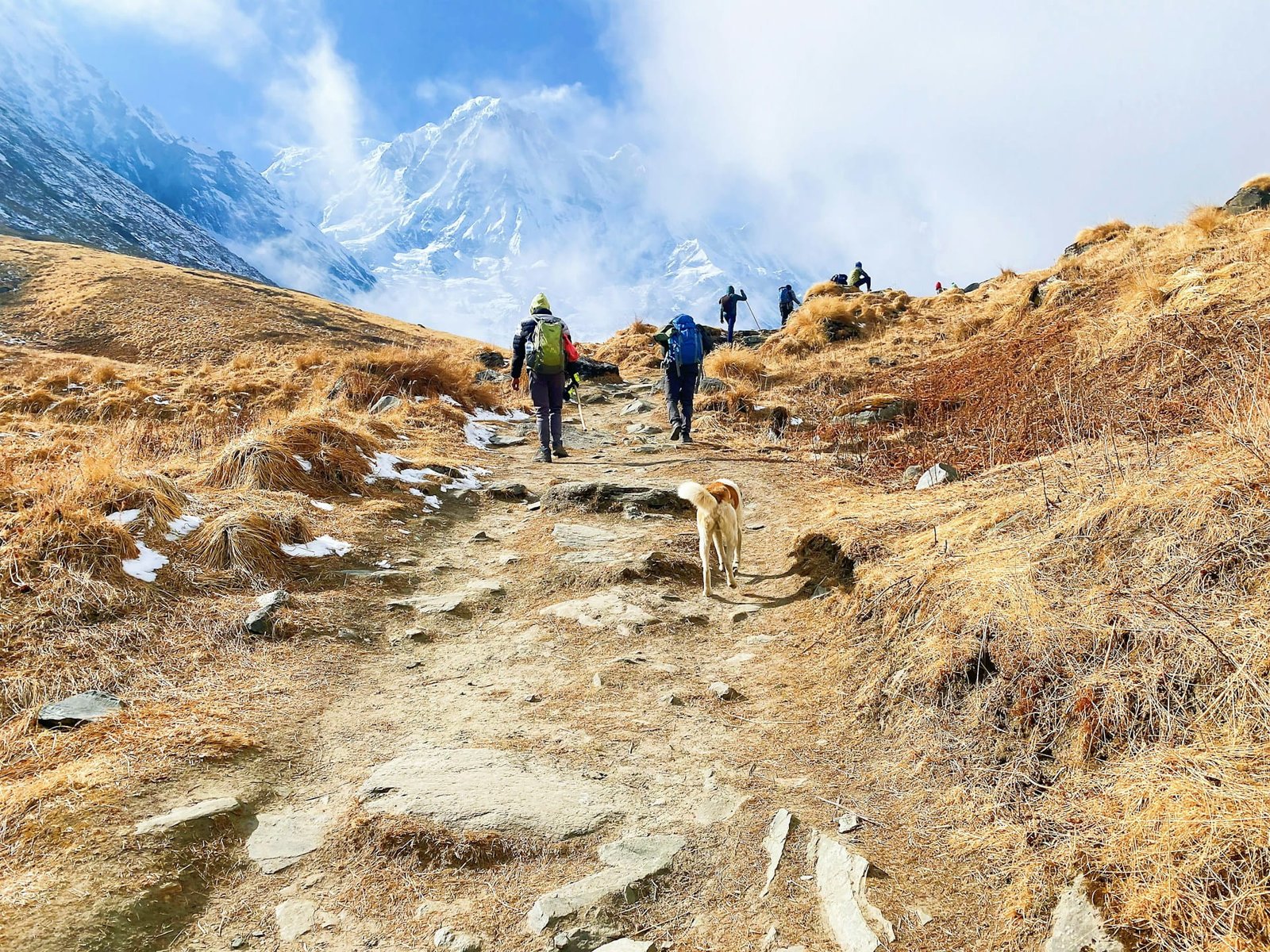
- The North Base Camp (approximately 4,200 m) is reached via the Annapurna region’s western approach — the classic route historically used for the northwest face and north spur routes. The approach passes through Nayapul, Tikhedhunga, Ghorepani, Tatopani, Ghasa, Lete, Thulobugin, Hum Khola, and Miristi Khola before reaching Annapurna North Base Camp. This multi-day approach on foot typically takes 8-10 days from Pokhara. Some expeditions now use helicopter transfer from Dana or a lower road point to the base camp, compressing the approach to 2-3 days.
- The South Base Camp (approximately 4,190 m) sits in the Annapurna Sanctuary — the high glacial basin enclosed by Annapurna I, Annapurna South, Hiunchuli, and Machhapuchhre. This approach follows the Annapurna Base Camp trek route through Nayapul, Ghorepani, and the Modi Khola gorge — a more frequently trekked approach that takes 7-9 days on foot.
Some expedition teams fly from Kathmandu to Pokhara, then drive to Dana (1,440 m), followed by a helicopter transfer to Annapurna Base Camp (4,190 m), which can reduce the approach phase to as little as 2-3 days. This option costs significantly more but is increasingly used by commercial expeditions prioritizing time efficiency over the cultural and physical acclimatization value of the walking approach. - The acclimatization question during the approach: Walking to base camp across multiple days serves a genuine physiological purpose — gradual altitude gain reduces the severity of the acclimatization burden once you arrive at base camp. Trekkers who helicopter directly to 4,200 m after sleeping in Pokhara arrive significantly less acclimatized than those who have been walking at increasing altitude for a week. This affects how the early base-camp period unfolds and is one reason some experienced expedition operators still advocate for the walking approach despite helicopter availability.
Phase 2: The Climbing Period — Why It Takes 29-30 Days
This is the longest phase and the one most people underestimate when they first look at the total expedition duration.
About 29 days are required to climb up and down the summit from the Annapurna North Base Camp. Those 29-30 days are not spent continuously ascending. They involve three overlapping activities: acclimatization rotations, high-camp establishment, and waiting.
Acclimatization Rotations
On arrival at base camp, no immediate ascent toward the summit begins. The body needs time to begin producing additional red blood cells and adjusting to the reduced oxygen environment — a process that cannot be shortcut regardless of prior high-altitude experience. The standard acclimatization protocol on Annapurna involves one or more rotation climbs to progressively higher elevations — climbing to Camp I, sleeping there, returning to base camp; then climbing to Camp II, sleeping, returning — before any serious summit attempt begins. These rotations typically consume 10-14 days of the climbing period.
High-Camp Establishment
Simultaneously with acclimatization rotations, Sherpa climbing teams are establishing and stocking the high camps. A series of high camps at approximately Camp I (5,500 m), Camp II (6,400 m), Camp III (7,200 m), and Camp IV (7,400 m) is established on fixed ropes before summit attempts. Each camp requires tents, sleeping equipment, fuel, food, and oxygen to be carried up and cached — work that takes multiple load-carry days by the Sherpa team, often while climbers are resting or doing their own rotations.
Fixed ropes are established from base camp through the technical sections — a critical safety infrastructure on Annapurna’s avalanche-prone terrain. The route-fixing process itself takes days and is often coordinated between multiple expedition teams sharing the mountain in the same season.
The Weather Window Wait
This is the part of the climbing period that most directly explains why the expedition cannot be compressed. The summit window on Annapurna requires specific weather — low wind, acceptable temperatures, stable snow conditions.
Spring (April-May) is the primary season; Autumn (September-October) is the secondary season, significantly colder.
The spring weather window on Annapurna typically opens in late April and closes by late May. Within that five-week period, there may be only 2-4 genuine summit-condition windows — brief stable periods between weather systems, identifiable only 48-72 hours in advance through modern forecasting. An expedition that arrives at base camp in late March, completes acclimatization rotations through April, and waits for the right window in the May peak period might spend 15-20 days of the climbing phase simply waiting at base camp or lower camps for conditions to align.
This waiting is not wasted time — it is the core of what high-altitude expedition planning actually involves. Climbers who force a summit attempt in sub-optimal conditions because their schedule is running out are responsible for a disproportionate share of Annapurna’s historical casualties.
The Summit Push
From Camp III, the departure is typically at midnight. The route involves a 35-40 degree mixed snow and ice slope to reach the upper camp area, where the slope is 40-50 degrees with short sections up to 55 degrees. The upper part steepens to some sections up to 60 degrees with exposed ridges.
Supplemental oxygen is used above Camp III. Most commercial expeditions allocate approximately four oxygen bottles per climber for the summit push and descent, with additional oxygen for Sherpa support. A single oxygen bottle costs approximately USD 465, and most climbers use around seven bottles on a standard expedition.
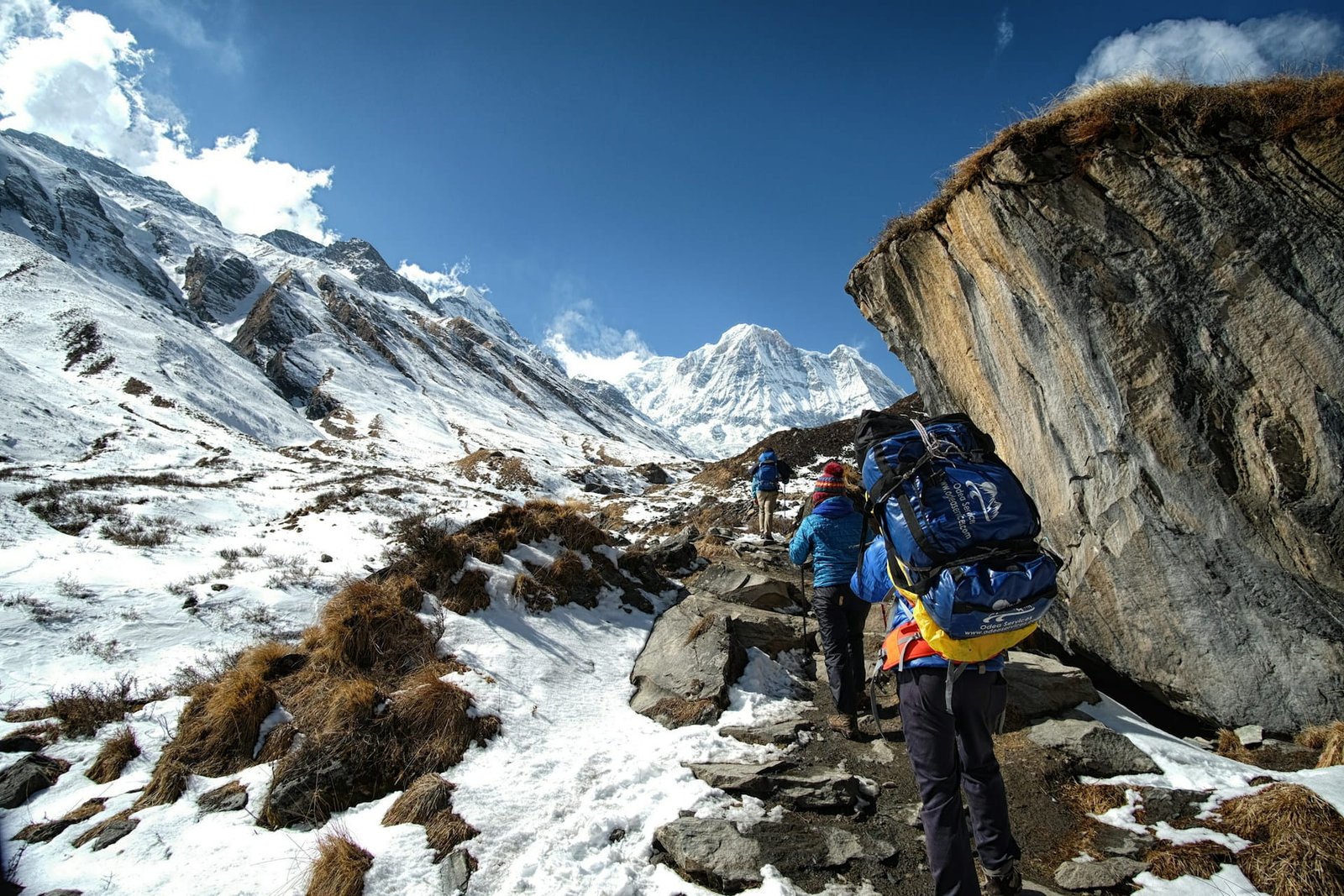
The summit push from high camp to summit and back to a lower camp typically takes one very long day — 12-18 hours depending on conditions and individual pace. The descent, particularly from the upper camps to base camp, is when most Annapurna accidents historically occur. The commercial era has changed the statistics.
Helicopter-supported expeditions, better forecasting, and fixed-rope seasons brought dozens of summits per year from 2021 onward, and the all-time fatality ratio now sits near 13 percent and falls further each season.
Phase 3: The Return
After the summit attempt — successful or not — the descent to base camp takes 1-3 days. Camp teardown follows. The trek or helicopter transfer back to the road network takes the same 8-10 days walking or 2-3 days helicopter as the approach. Drive to Pokhara, flight back to Kathmandu, one to two days of debrief, certificate processing through the Nepal Mountaineering Association, and final departure.
Satori Adventures’ 42-day Annapurna I expedition itinerary allows an additional 2-4 days for international travel to and from Kathmandu depending on your location and flight availability, making the total trip approximately 45-46 days door to door.
Can the Expedition Be Done Faster?
The honest answer is: the climbing period cannot meaningfully be compressed. The acclimatization rotations exist for physiological reasons, not logistical ones, and eliminating them increases acute mountain sickness and HACE/HAPE risk at extreme altitude. The weather-window wait cannot be predicted or shortened. The high-camp establishment takes the time it takes given the altitude and the load-carrying involved.
What can technically be compressed is the approach phase — helicopter access reduces 8-10 days of trekking to 2-3 days. This is increasingly used by commercial expeditions and is a legitimate time-saver, at the cost of the gradual acclimatization the walking approach provides. Expeditions using helicopter access often build a longer initial base-camp rest period into the climbing phase to compensate.
A 40-day total itinerary is theoretically achievable with helicopter approach and a very efficient climbing period. Most experienced operators caution that 42-48 days provides more realistic buffer for the weather-window variability that Annapurna specifically demands more than most 8,000 m peaks.
Annapurna I vs. Everest: The Time Comparison
Everest expeditions typically run 60-70 days from base camp arrival to return — significantly longer than Annapurna’s 40-48 days. The difference is not primarily technical or physiological — it is geographical. Everest’s higher altitude (8,849 m vs. 8,091 m) demands a longer acclimatization arc, more high-camp rotations, and more total time in the death zone across the expedition. Everest’s famous commercial infrastructure — extensive fixed ropes, established camp systems, large numbers of Sherpa staff — makes it more logistically supported, but not faster.
Annapurna’s shorter duration makes it appear more accessible on paper. In practice, the mountain’s avalanche hazard and technical upper route mean a shorter expedition window with fewer days to wait for the right conditions — which paradoxically makes timing the summit attempt more, not less, demanding than Everest’s longer window.
What Experience Is Required
The mountain demands strong prior high-altitude experience, ideally one completed 8,000 m peak, plus a full fitness and technical check before departure. This is the minimum credible standard — not a recommendation but a floor. Most serious operators require at least one previous 8,000 m summit (Cho Oyu, Manaslu, or Dhaulagiri are common prerequisites) before accepting an Annapurna application. Technical skills required include proficiency on 40-60 degree mixed snow and ice terrain with fixed ropes, high-altitude camping, oxygen system management, and self-rescue competency.
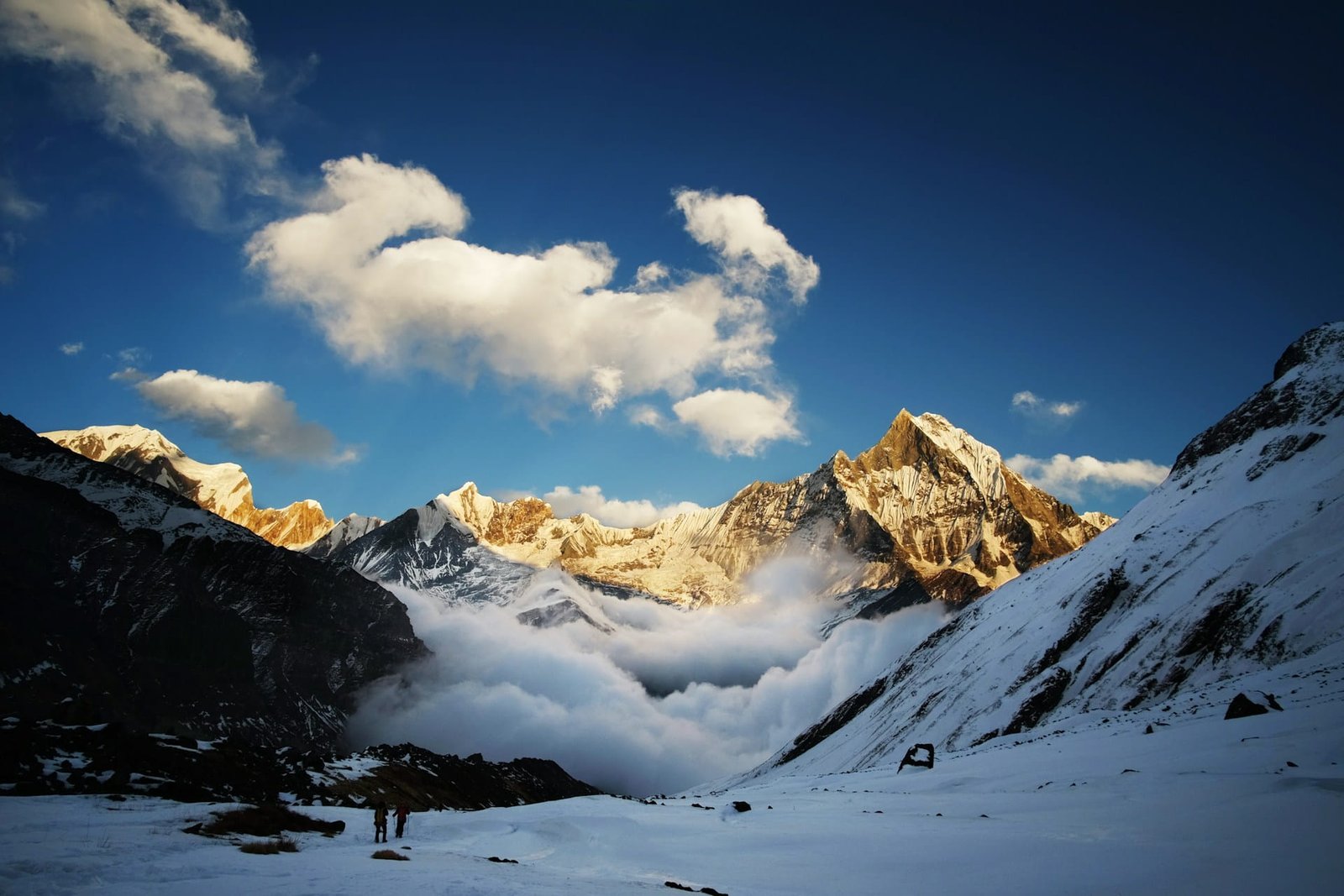
The upper part involves steep slopes up to 60 degrees and exposed ridges. At 7,000-8,000 m, executing these technical sections with progressively depleted oxygen, fatigue accumulated over weeks of expedition life, and conditions that can deteriorate rapidly is the defining challenge — not the technical grade in isolation, but the technical grade at extreme altitude under real expedition conditions.
Frequently Asked Questions about How Many Days to Climb Annapurna
- How many days does it take to climb Annapurna I?
Between 40 and 50 days from Kathmandu. Most commercial expeditions use 42-48 day itineraries. The approach to base camp takes 8-12 days (or 2-3 days by helicopter), the climbing period takes approximately 29-30 days including acclimatization rotations and weather-window waiting, and the return takes 4-5 days. - What is the best season to climb Annapurna I?
Spring (April-May) is the primary climbing season, when the most reliable summit windows typically occur in late April through mid-May. Autumn (September-October) is a secondary season, significantly colder and with shorter, less predictable windows. - How dangerous is Annapurna I?
Historically the deadliest 8,000 m peak by fatality-to-summit ratio. As of early 2026, approximately 559 climbers have summited and 75 have died — a current ratio of approximately 13.4%, down from a historical high of around 38.7% through 2006, due to better logistics, forecasting, and commercial expedition infrastructure. It remains the most statistically dangerous serious 8,000 m objective currently open to expeditions. - What altitude is Annapurna I?
8,091 m (26,545 ft), making it the tenth highest mountain in the world. - Who first climbed Annapurna I?
Maurice Herzog and Louis Lachenal of the 1950 French expedition, on June 3, 1950 — the first successful ascent of any 8,000 m peak in history. Both suffered severe frostbite on the descent; Herzog lost all his toes and most of his fingers. - Do I need prior 8,000 m experience?
Yes — reputable expedition operators require at minimum one prior 8,000 m summit before accepting an Annapurna I application. The mountain’s technical upper route and avalanche exposure demand a level of high-altitude competency that cannot be developed on the expedition itself. - How much does it cost to climb Annapurna I?
Total expedition costs typically range from USD 25,000 to USD 50,000 or higher for a fully guided commercial expedition, depending on operator, services, and inclusions. This includes the Nepal Mountaineering Association royalty permit, Sherpa support, oxygen, fixed ropes, base camp logistics, and agency fees. - What makes Annapurna I so much more dangerous than other 8,000 m peaks?
The primary hazard is avalanche risk, not extreme technical climbing or extreme altitude alone — the standard North Face route crosses several avalanche-prone slopes and seracs that can release with little warning regardless of a climber’s skill level. Unlike Everest, where most deaths come from altitude and exhaustion during a crowded summit push, Annapurna’s danger is largely about terrain that stays objectively hazardous no matter how well-prepared or experienced the climber is. - What is the standard route up Annapurna I?
Most commercial expeditions climb the North Face route via Camps 1 through 4, which was the original 1950 French route and remains the most established line today. The South Face route is dramatically harder and more technical, historically attempted only by elite alpine-style climbers rather than commercial expeditions. - Is supplemental oxygen required on Annapurna?
Most commercial climbers use supplemental oxygen above Camp 3 or Camp 4, similar to standard practice on Everest, though the proportion of climbers attempting Annapurna without oxygen is somewhat higher than on Everest given the smaller, more experienced pool of climbers the mountain attracts. No-oxygen ascents are considered an even more serious undertaking here than on Everest given the mountain’s added avalanche exposure. - How many acclimatization rotations are needed before a summit push?
Most itineraries build in two to three rotations between base camp and the higher camps, each pushing slightly further up the mountain before returning to recover. This rotation schedule, combined with waiting for a stable weather window, accounts for much of the roughly month-long climbing period, since the summit push itself typically takes only 4-6 days once conditions align. - Why do so few climbers attempt Annapurna I compared to Everest?
Annapurna sees a small fraction of Everest’s traffic each season, largely because of its reputation and the requirement for prior 8,000 m experience, which filters out all but genuinely advanced mountaineers. Where Everest has built a large commercial industry around guiding relatively inexperienced climbers with heavy support, Annapurna’s operators generally accept only applicants who’ve already proven themselves at extreme altitude. - Has Annapurna I ever been climbed in winter?
Yes, though winter ascents remain extremely rare given the mountain’s already severe avalanche risk, which is compounded by colder temperatures and higher winds in winter months. Winter attempts on Annapurna sit at the far extreme end of high-altitude mountaineering, undertaken by only a handful of elite climbers historically rather than being a viable option for commercial expeditions. - What permits are required to climb Annapurna I?
The core permit is the NMA (Nepal Mountaineering Association) royalty permit for the peak itself, alongside the Annapurna Conservation Area Permit for the approach trek to base camp. Because Annapurna I falls under NMA jurisdiction rather than the Department of Tourism’s expedition permit system used for Everest, the application process and agency requirements differ somewhat from an Everest expedition, which is another reason climbers typically rely on experienced expedition operators to handle logistics.