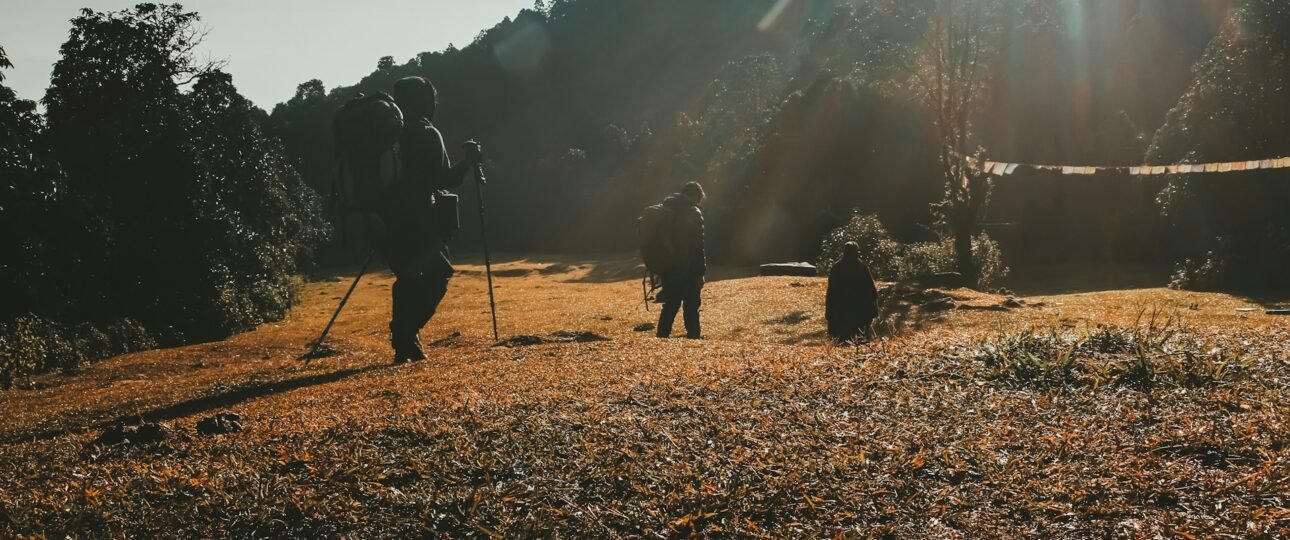
Introduction to Dhampus Australian Camp Trek
The first thing that strikes you about the view from Australian Camp is how close the mountains feel. Not in the abstract, poetic sense that travel writers use when they can’t think of anything specific to say — but literally, physically close.
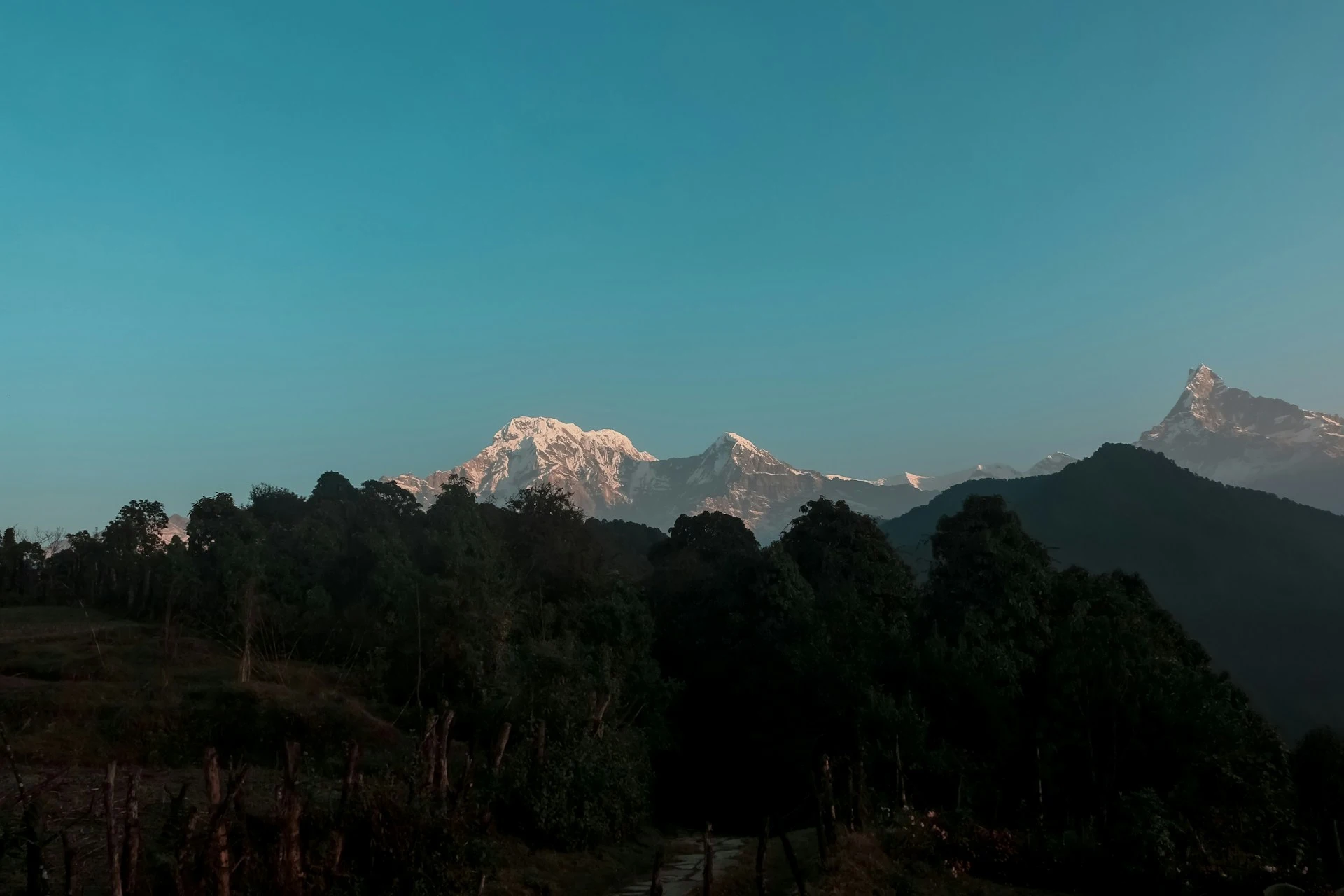
Machhapuchhre, the sacred unclimbed peak that the Nepalese call Fishtail for its twin summit, fills a disproportionate amount of the northern sky in a way that makes you briefly recalibrate your understanding of how tall a mountain actually is. Annapurna South sits to its left. Hiunchuli beyond that. The Dhaulagiri massif anchors the western horizon.
You are standing at 2,060 meters. You got here in about ninety minutes of walking from the roadhead. And nothing else you’ll see near Pokhara — not the famous Sarangkot sunrise platform, not the views from the lakeside — quite prepares you for this.
This guide exists because most of what’s written about the Dhampus Australian Camp Trek reads like it was written by the same person, about the same place, in the same afternoon.
What you actually need to know — what time to wake up to catch the mountain light before the clouds build, what Dhampus village feels like beyond the stock description of slate roofs and Gurung people, how to do this without a package, what the permit situation actually is in 2026, and honestly whether this trek or Poon Hill is right for you.
This detailed guide provides it.
Why is it Called Australian Camp?
Why does a hilltop in Nepal’s Annapurna foothills bear the name of a country on the other side of the world?
The answer depends on which version you believe, and there are at least four competing origin stories in circulation.
The most commonly cited explanation is that Australian trekkers and mountaineers frequented this site in the early years of Nepal’s trekking industry and used it as a resting camp. Over time, the teahouses that evolved from those camping grounds came to be associated with Australian visitors, and the name attached.
A second version, found on several local tourism sites, holds that the name actually began as “Austrian Camp” — that it was Austrian, not Australian, trekkers who established the site, and that local Nepali speakers, finding “Austrian” difficult to pronounce, shifted it to “Australian.” This version is plausible; the confusion between “Austria” and “Australia” is surprisingly common in Nepal, and several other regional sites have similar stories.
A third explanation, dates the Australian connection to the 1960s, when an early expedition party — Australian — passed through and camped here, spreading word of the viewpoint’s extraordinary panorama.
The honest answer is that all three versions are plausible and none is definitively documented. What is documented is the place’s local Nepali name: Thulo Kharka. It means “big pasture.” Before teahouses and trekkers, this hilltop ridge was a grazing ground for cattle and yak. The pastoral history is still visible in the broad, open character of the summit area — it does not feel like a forest summit but like a clearing, which it was.
The camp, whatever Australians or Austrians started it, has long since evolved into a proper cluster of teahouses and small lodges. Camping is still possible for those who want it. But the image most visitors have — of a remote canvas camp in wilderness — gives way, on arrival, to something more developed and more comfortable than the name implies.
What Australian Camp Actually Is — And What It Isn’t
Australian Camp is not a base camp for a mountain climb. It is not a campsite requiring you to bring a tent. It is a hilltop viewpoint and small teahouse settlement in the lower Annapurna Conservation Area, located approximately 28 kilometers northwest of Pokhara in Kaski District. The elevation is at between 2,055 and 2,165 meters; the most widely accepted figure is approximately 2,060 meters (6,758 feet).
The slight variations stem from different GPS readings taken at different points on the ridge — the actual summit area spans enough horizontal distance that readings at different spots do vary.
From this ridge, on a clear morning, you can see a continuous wall of Himalayan peaks:
- Machhapuchhre (6,993 m) in the center
- Annapurna South (7,219 m) to its left
- Hiunchuli (6,441 m), Annapurna IV (7,525 m)
- Annapurna III (7,555 m)
- Annapurna II (7,937 m)
- Lamjung Himal (6,983 m)
- and — on an especially clear day — the distant white profile of Dhaulagiri (8,167 m) to the west.
The teahouses here range from basic to genuinely comfortable. Most have private rooms or dormitory options, attached bathrooms (sometimes with hot water heated by solar or wood-fired boiler), and kitchens producing a reliable range of dal bhat, noodle dishes, eggs, and occasionally pancakes. Wi-Fi exists in one or two establishments with varying reliability. There is phone signal — NTC and Ncell — at the camp itself.
The hilltop functions as both a destination and a junction. From here you can descend to Dhampus village (30 minutes south), continue further down to Phedi for transport back to Pokhara, or take the ridge trail toward Pothana, which connects onward to the Mardi Himal trail and the main Annapurna Base Camp route. Understanding Australian Camp as a junction — not just a viewpoint — is key to understanding the trek’s value and its extensions.
The Single Most Important Thing Nobody Tells You: Cloud Timing
The number one disappointment on this trek — and the single practical gap in every existing guide — is arriving at Australian Camp for sunrise and finding cloud. Not because it’s cloudy. Because you didn’t know how the mountain weather works here, and you woke up at the wrong time or looked in the wrong direction.
Here is how it actually works.
In the Annapurna foothills, clear views are heavily time-dependent. In autumn (September through November), which is the peak season and best visibility window, mountains are typically sharp and clear from before sunrise until approximately 9 or 10 a.m. After that, valley thermals push cloud up the ridgelines and views deteriorate. By early afternoon, the peaks are often fully obscured. They may clear again briefly at sunset, particularly in October, when the post-monsoon air is at its driest.
In spring (March through May), the pattern is similar but the cloud builds faster — sometimes by 8 or 8:30 a.m. The rhododendron bloom is at its peak, the lower forests are spectacular, but the mountain window is shorter.
What this means practically: if you are spending a night at Australian Camp or Dhampus specifically for mountain views, set an alarm for 5:30 a.m. and be outside by 6:00 a.m. The pre-sunrise alpenglow — the way the high snow turns pink and then golden as the first light catches the peaks while the valleys are still dark — is the best version of this view and it lasts perhaps forty-five minutes. Don’t sleep through it.
If you arrive on an overcast day, don’t despair immediately. Cloud at the camp level does not always mean cloud above 3,000 meters. Peaks sometimes break through above a low layer in a way that produces dramatic partial views. Evening clears are most common in October. And if you genuinely spend a full overcast day on the ridge with no mountain view, Dhampus village itself — the architecture, the community, the forest walks — provides enough to make the trip worthwhile.
Dhampus Village: More Than A Waypoint
Dhampus is a Gurung village at approximately 1,650 meters (5,413 feet), about 30 minutes on foot below Australian Camp. It sits on a ridge with the Pokhara valley spreading below it to the south and the Annapurna range rising to the north — a position of almost theatrical advantage. On a clear day, the panoramic view from Dhampus is, if anything, slightly better organized than the view from the camp above it, because the ridge angle changes and you see more of the lateral mountain spread.
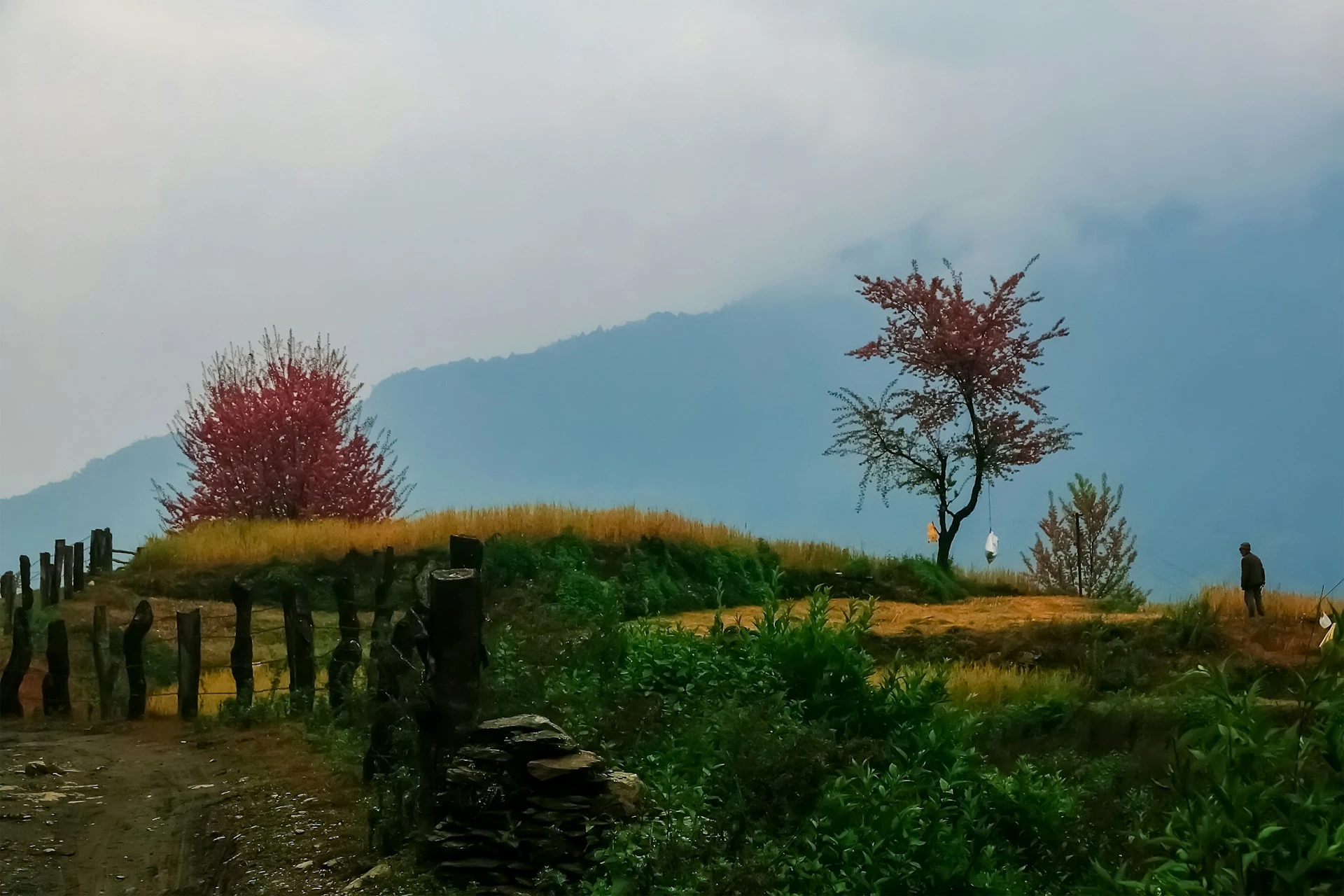
The village itself is physically distinctive in ways that set it apart from most places you’ll pass through in Nepal’s trekking corridors. The houses are built from local stone, with walls thick enough to hold warmth through cold nights and cool through warm afternoons. Roofs are flat slate. Courtyards are paved with stone and swept clean each morning by women who begin their days before dawn. Mani walls — long horizontal structures carved with the Buddhist mantra Om Mani Padme Hum — line the main pathways through the upper village. Prayer flags on tall bamboo poles snap in the ridge wind.
The Gurung people who inhabit Dhampus are one of Nepal’s hill ethnic groups with a long history as soldiers — Gurkha regiments recruited heavily from Gurung and Magar communities, and that history is present in the village in the form of retirement pensions, the relative material stability compared to similar-altitude communities elsewhere, and a certain ease and confidence in dealing with foreign visitors that doesn’t always come from the anxious hospitality of poverty.
Dhampus has seen enough trekkers to be comfortable around them without being transformed by them. The village core remains working and residential — fields are cultivated, children walk to school, old men sit in doorways in the morning sun with the specific contentment of people who have nowhere else to be. The teahouses and lodges are concentrated at the edges of the village and on the main trail, and they do not dominate the character of the place the way tourism infrastructure has swallowed some trail villages further up the Annapurna routes.
If you have two nights available for this trek — and if the question is whether to spend both at the camp above or one above and one in Dhampus — spend one in Dhampus. The village at dusk, with cooking fires lit and mountain silhouettes against the last western light, is not an experience you’ll find at the teahouse cluster above.
Dhampus Trek Route Options: 1 Day, 2 Days, Or 3 Days
The Dhampus Trek is a beginner trek in Nepal and it does not have a single canonical route. It has a core circuit that can be completed in any of three time frames, with meaningfully different experiences attached to each. Most articles give you one itinerary.
Here are all three, honestly assessed.
ONE DAY (Day hike only)
Start: Drive from Pokhara to Kande (approximately 27 km, one hour by private vehicle or shared jeep). Trek from Kande to Australian Camp: approximately 5 km, 1.5 to 2 hours, uphill through forest and past scattered settlements. Time at the camp. Optional descent to Dhampus (30 minutes) then continue to Phedi (1.5 hours) for vehicle back to Pokhara. Alternatively, return the same way to Kande.
Total trekking time: 4 to 6 hours round trip, or 5 to 7 hours with Dhampus detour.
Who this suits: Someone with only one day, physically comfortable with a few hours of uphill, who primarily wants the mountain view and a taste of the landscape. Be realistic: a single-day hike means you’re racing the cloud window. If you arrive at the camp by 9 a.m. you have the best chance of views. You will not experience Dhampus village in any meaningful way in a single day.
TWO DAYS, ONE NIGHT (The standard version)
Day 1: Drive Pokhara to Kande. Trek Kande to Australian Camp (1.5 to 2 hours). Afternoon at the camp — views, rest, explore. Overnight at Australian Camp teahouse.
Day 2: Wake before sunrise, watch mountain alpenglow and early morning light. After breakfast, descend to Dhampus (30 minutes), explore the village. Continue down to Phedi (1.5 hours). Drive back to Pokhara.
Total trekking: approximately 6 to 7 hours across two half-days.
Who this suits: Most people searching for this trek. You get the sunrise, you get Dhampus, and you’re back in Pokhara by early afternoon of Day 2. This is the sweet spot between depth and brevity.
THREE DAYS (The circuit version)
This extends the standard route to include Pothana and optionally connects to Sarangkot.
Day 1, you reach Australian Camp via Kande.
Day 2, you descend to Dhampus and continue walking the ridge to Pothana (1,700 m), a quiet and less-visited forest village with strong Annapurna and Fishtail views. From Pothana, trail options open toward the Mardi Himal route (which continues for several more days) or toward Forest Camp. Day 3, You descend to a road point and return to Pokhara. Alternatively, the circuit can loop around to Sarangkot for a sunrise there before the final descent.
Who this suits: Someone who wants a proper short trek experience with multiple village stays and varying terrain, not just a viewpoint visit. This version gives you the forest, multiple cultural stops, and the ridge panorama from different angles.
The important thing to understand about all three versions: the differences are in cultural depth and physical satisfaction, not in difficulty. The hardest day on the three-day circuit is still easier than the hardest day on Poon Hill. The altitude difference across all versions is negligible. What changes is how much of the place you actually experience.
The Approach: Kande Or Phedi?
Kande (also spelled Khande) is the most common starting point and sits on the Pokhara-Baglung Highway, accessible by shared jeep or private vehicle in about one hour from Pokhara. The trail from Kande to Australian Camp is approximately 5 kilometers, gains about 450 meters of elevation, and passes through mixed forest and small settlements. It takes most fit walkers 1.5 to 2 hours at a comfortable pace. This is a well-maintained trail, largely stone-paved in sections, and is the preferred approach for most trekkers.
Phedi is a lower starting point used by trekkers coming from the Dhampus direction on the return, and occasionally as an alternate start. A 30-minute drive from Pokhara, it sits at lower elevation and the approach to Dhampus from here takes slightly longer — approximately 2 hours of steeper climbing through farmland and rhododendron forest before reaching the village. Many guides and agencies use Kande for the ascent and Phedi for the descent as a natural circuit.
The practical advice: start from Kande (shorter approach to the camp), descend via Dhampus to Phedi (lets you experience the village on the way down when your legs are fresher from rest). This is the most efficient use of both trailheads.
Permits: For Dhampus Camp Trek in 2026
The Dhampus Australian Camp Trek passes through the Annapurna Conservation Area. The required permit is the ACAP — Annapurna Conservation Area Permit. The current fee is NPR 3,000, approximately USD 22, for foreign nationals. This is the only permit actively checked at trailhead entry points on Annapurna trails.
Regarding the TIMS Card: as of 2025-2026, TIMS is no longer enforced in the Annapurna region. ACAP checkpoints verify only the conservation area permit. Multiple articles still list TIMS as a requirement for this trek; those articles have not been updated and the information is incorrect. You do not need a TIMS Card for the Dhampus Australian Camp Trek.
Where to get the ACAP permit: it can be obtained at the Nepal Tourism Board office in Thamel, Kathmandu, or at ACAP checkpoints at the trailhead. Most trekking agencies include this in package prices. Independent trekkers should purchase it in Kathmandu or Pokhara before departure; the checkpoint at Kande does collect fees, but purchasing in advance avoids queuing time.
One important policy update that affects independent and group trekkers alike: following a significant increase in rescue operations involving unguided foreign trekkers — the number rose by nearly 40 percent between 2015 and 2025 — the Government of Nepal now requires foreign trekkers on most Himalayan routes to trek with a licensed guide.
Enforcement on the lower Annapurna trails including the Dhampus circuit is less strict than on Everest or Langtang routes, but the regulation exists and trekkers should be aware of it. For a route as short and well-marked as this one, a guide’s primary value is cultural and logistical rather than navigational — but hiring one is both legally correct and economically meaningful for the local community.
Difficulty of Dhampus Trek
“Easy to moderate” is the universal description of this trek, and it is accurate as far as it goes. But “easy to moderate” means different things to different people, so here is a more detailed account.
The Kande to Australian Camp section climbs approximately 450 meters over 5 kilometers. There are sections of stone staircase, some of which are steep. For someone who walks regularly, or who has done any hiking at all, this is a 90-minute effort that produces a light sweat but not distress. For someone who is genuinely sedentary and has not exercised much in the months before travel, it may be harder than expected. The altitude — maxing at approximately 2,060 meters — is unlikely to produce altitude sickness in any normally healthy person who ascends at this pace. It is significantly below the threshold where AMS becomes a serious concern.
The descent from Australian Camp through Dhampus to Phedi is approximately 1,100 meters of total descent over several hours. Descending steep stone trails is harder on knees than climbing. Trekking poles are genuinely useful here, especially on wet days when slate steps become slippery.
For children: this trek works well with children above approximately 7 or 8 years old who are comfortable walking for a couple of hours without being carried. Younger children are possible with porter assistance. The trail is not technical and there are no exposure sections. The cultural encounters at Dhampus are often more engaging for children than the mountain views.
For older or less mobile travelers: the route is walkable for people in their sixties and seventies who are reasonably fit. The stone paving actually helps on uneven ground. Porters are easily hired at a daily rate of approximately NPR 2,500 to 3,500, and are well worth hiring if you are carrying more than 10 kilograms or if your knees are uncertain on descents.
Australian Camp Trek Cost
Package tour (guide, transport, permits, accommodation, meals, 2 days): USD 80 to 150 per person depending on group size and agency quality. Solo travelers pay the higher end; groups of four or more bring costs down. Packages from reputable Pokhara-based agencies typically include better cultural access and genuine guidance.
Where to hire a guide independently: the Pokhara Tourism office on Lakeside can direct you to registered local guides. Alternatively, your accommodation in Pokhara will almost certainly know trustworthy local guide contacts. Avoid booking with someone who approaches you unsolicited at the bus park.
Extending The Trek: Places Near Dhampus Australian Camp Trek
The Australian Camp and Dhampus sit at the junction of several longer routes. If you find yourself with more time than expected, or if you want to build something more substantial around this core trek, the following connections are practical.
To Sarangkot: From Dhampus, a trail leads west along the ridge toward Sarangkot (1,592 m), Pokhara’s famous sunrise viewpoint. This walk takes approximately 3 to 4 hours and provides consistent ridge views throughout. Sarangkot is more developed than Dhampus — it has a cable car, multiple restaurants, and a viewpoint platform — but the sunrise there is genuinely one of Nepal’s most-photographed moments. Combining both in a 3-day circuit gives you the best of both viewpoints.
To Pothana: Heading east from Dhampus, the trail continues through forest to Pothana (1,700 m), a quiet village with strong views of Fishtail and Dhaulagiri. Pothana sees far fewer visitors than Dhampus and has a more rural character. From Pothana, the trail continues toward Forest Camp and the start of the Mardi Himal route.
To the Mardi Himal trail: From Pothana or Forest Camp, trekkers who want to continue can join the Mardi Himal trail toward Low Camp (2,990 m) and beyond. This effectively converts a 3-day Dhampus circuit into the start of a Mardi Himal trek — useful for anyone whose plans have become more flexible, which happens frequently in Nepal.
Packing For This Trek
Footwear: Solid walking shoes or light hiking boots. Full-shank mountaineering boots are overkill. Running shoes are workable in dry conditions but will struggle on wet stone descents. The key is ankle support — stone staircases on the descent reward footwear with some lateral stability.
Layers: A base layer, a mid-layer fleece or light down jacket for the camp and mornings (temperatures at 2,060 m in the evening can reach 8 to 12 degrees Celsius even in October, and colder in winter months), and a waterproof outer layer for the occasional afternoon cloud. You will not need a serious down parka. You will feel the cold before sunrise if you’re outside for the mountain light.
Water: Carry at least 1.5 liters from Kande. Water refills are available at the camp and at Dhampus. Purification tablets or a Steripen are recommended for tap water or stream sources.
Camera/phone: The sunrise light on Machhapuchhre is among the most photographed moments on any short trek in Nepal. Make sure you have battery. Bring a power bank — charging options exist at the camp but are not always reliable overnight.
Cash: Bring sufficient Nepali rupees. No ATMs on the trail. The last reliable ATM is in Pokhara. Most teahouses do not accept cards.
Sunscreen and sunglasses: The ridge is exposed and the UV at altitude is stronger than most visitors expect, even on cool days.
What to leave behind: Your heaviest gear. Porters are available and affordable if you need them, but this trek does not require a large pack. A single 20-litre daypack with the above essentials, a change of clothes, and a good sleep layer is sufficient for two days.
FREQUENTLY ASKED QUESTIONS
- Is a guide required for the Dhampus Australian Camp trek?
Legally, the Government of Nepal requires foreign trekkers to trek with a licensed guide on Himalayan routes. Enforcement on this specific short route is less stringent than on longer circuits, but the regulation applies. - How physically fit do I need to be?
You need to be comfortable walking uphill for 90 minutes at a moderate pace. No prior trekking experience is required. If you can walk at a normal pace for two hours in your home city without distress, you can do this trek. - What if it’s cloudy? Will I still see the mountains?
Cloud is a real possibility, particularly in the afternoon and during the monsoon months. The most reliable clear view window is early morning — be outside before sunrise. October offers the best visibility overall. If views are important to you, plan for an overnight stay so you have both evening and morning windows. - Can I do this trek in winter?
Yes. December and January bring cold nights (below 5 degrees Celsius at the camp) but clear, crisp air and excellent visibility. The trail is walkable without snow gear in most winters. Bring a proper warm layer and expect fewer other trekkers — which many people find to be winter’s main advantage. - What is the food like?
Standard Nepali teahouse food: dal bhat (the definitive dish — rice, lentil soup, vegetable curry, pickles), instant noodles, fried rice, eggs, toast, and at better establishments, vegetable curries and momos (steamed dumplings). Dal bhat is filling, nutritious, and cheap, and comes with unlimited refills at most teahouses. Eating it for breakfast, lunch, and dinner is not a hardship — it is a reasonable pleasure. - Is Dhampus village actually worth a stop or is it just marketing?
It is genuinely worth a stop. Dhampus retains its character as a working Gurung village in a way that many higher-altitude trail villages have lost. The architecture, the community atmosphere, and the mountain views from the village itself justify the 30-minute descent from the camp. If your itinerary includes Dhampus as an overnight stay rather than a passing-through, you will leave with a more complete picture of what the lower Annapurna region actually contains.
A Final, Honest Note about Dhampus Australian Trek
The Dhampus Australian Camp Trek will not be the hardest thing you’ve ever done, and it will not produce the most extreme mountain photographs in your collection. If you come looking for solitude and raw wilderness, be aware that this is one of the most accessible viewpoints near Pokhara — on a clear October morning, you will share the ridge with other people.
What it will give you, consistently and reliably, is this: the feeling of arriving somewhere genuinely beautiful with relatively modest effort, of waking up before dawn in a cold room in a Himalayan village, of stepping outside and watching Machhapuchhre turn from grey silhouette to burning gold as the first sun hits the snow above 6,000 meters.
That feeling is not diminished by the fact that it takes 90 minutes to reach. The mountains don’t measure the quality of the experience by how hard you worked to see them. They are what they are, and from Australian Camp on a clear morning, they are extraordinary.
And if your appetite for Nepal’s lesser-known trails has grown after Dhampus, the Ruby Valley Trek is worth serious consideration. It runs through one of the Himalaya’s most overlooked corridors — fewer trekkers, genuine village life, and mountain views that rival anything on the Annapurna circuit — all within a week’s itinerary.