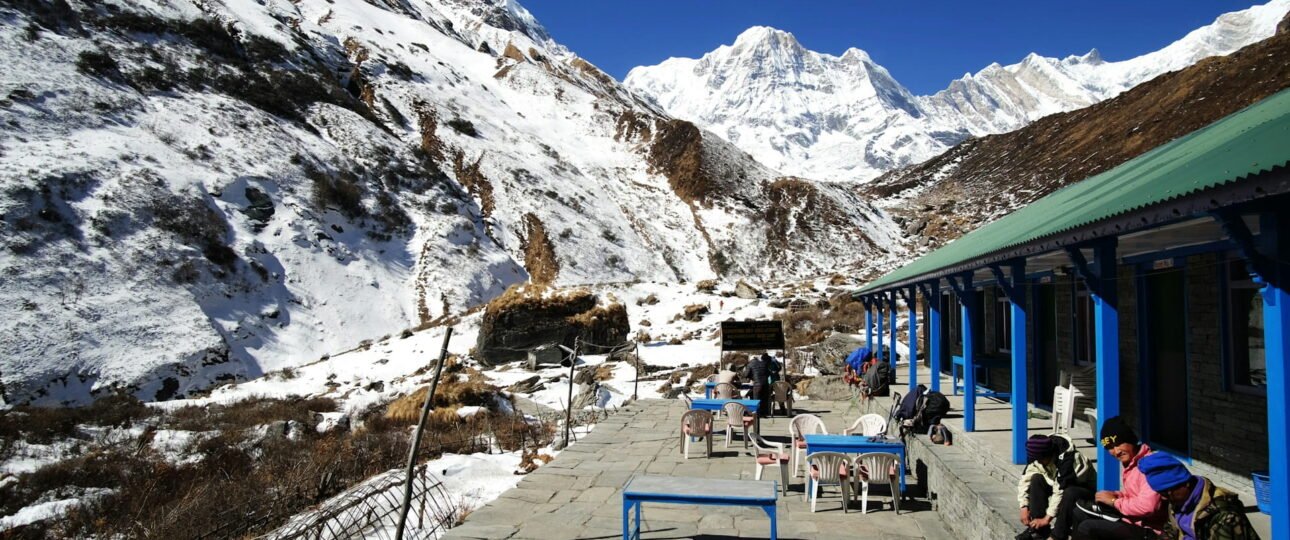
Annapurna Base Camp Trek Accommodation
The Annapurna Base Camp trek is not a camping trek. You will sleep in teahouses almost every night — and once you experience them, you’ll understand why trekkers love this route as much for the journey as for the destination.
That distinction matters for planning purposes more than it might initially seem. No tent, no sleeping mat, no camp stove, no food supply to carry — the logistics of shelter and food are handled at every overnight stop by a teahouse. What changes along the route is how much comfort those teahouses offer and how far below “hotel standard” each successive stop sits as you gain altitude. Understanding that gradient — what you get in Ghandruk versus what you get at Annapurna Base Camp — is the most practically useful thing this guide can give you.
Accommodation on the Annapurna Base Camp Trek is provided in traditional teahouses — family-run mountain lodges located in villages spaced roughly one day’s walk apart. Rooms are basic twin-share with shared bathrooms, and there is a heated dining hall. Facilities become progressively simpler above 3,000 m, with the most basic lodges at Machhapuchhre Base Camp (MBC) and Annapurna Base Camp (ABC).
This guide covers every major overnight stop on the standard route, what to realistically expect at each, the costs you’ll encounter at each elevation band, the booking question (advance vs. walk-in), and the practical items that make the teahouse experience more comfortable regardless of which stop you’re at.
What a Teahouse Actually Is
Teahouses are small family-run lodges scattered across every village along the trail. They’re the heart of trekking culture in Nepal. Each teahouse offers a room, a meal, and more often than not, a genuinely warm welcome from the family running it. They range from simple wooden structures at higher elevations to surprisingly well-equipped lodges in larger villages like Ghorepani and Chhomrong.
The standard room across the route is twin-sharing — two single beds, a small table, hooks on the wall for hanging gear, and a window. Shared bathrooms (with squat or Western toilet) are common throughout, with attached bathrooms available in the larger, lower-altitude villages. The dining hall is the social center of every teahouse: a communal room with shared tables, often the warmest space in the building due to a central heater or stove, where every trekker arriving that evening ends up together regardless of which agency or nationality they belong to.
In 2026, teahouse standards along the ABC route are more consistent than ever, especially in the most popular overnight villages. The quality improvements are most visible at Chhomrong, Bamboo, and the lower sanctuary stops. Above 3,000 m, the physical constraints of high-altitude construction mean the improvements reach a ceiling — walls become thinner, pipes freeze more readily, and the standard is genuinely basic by necessity rather than by lack of effort.
The Accommodation Map: Village by Village
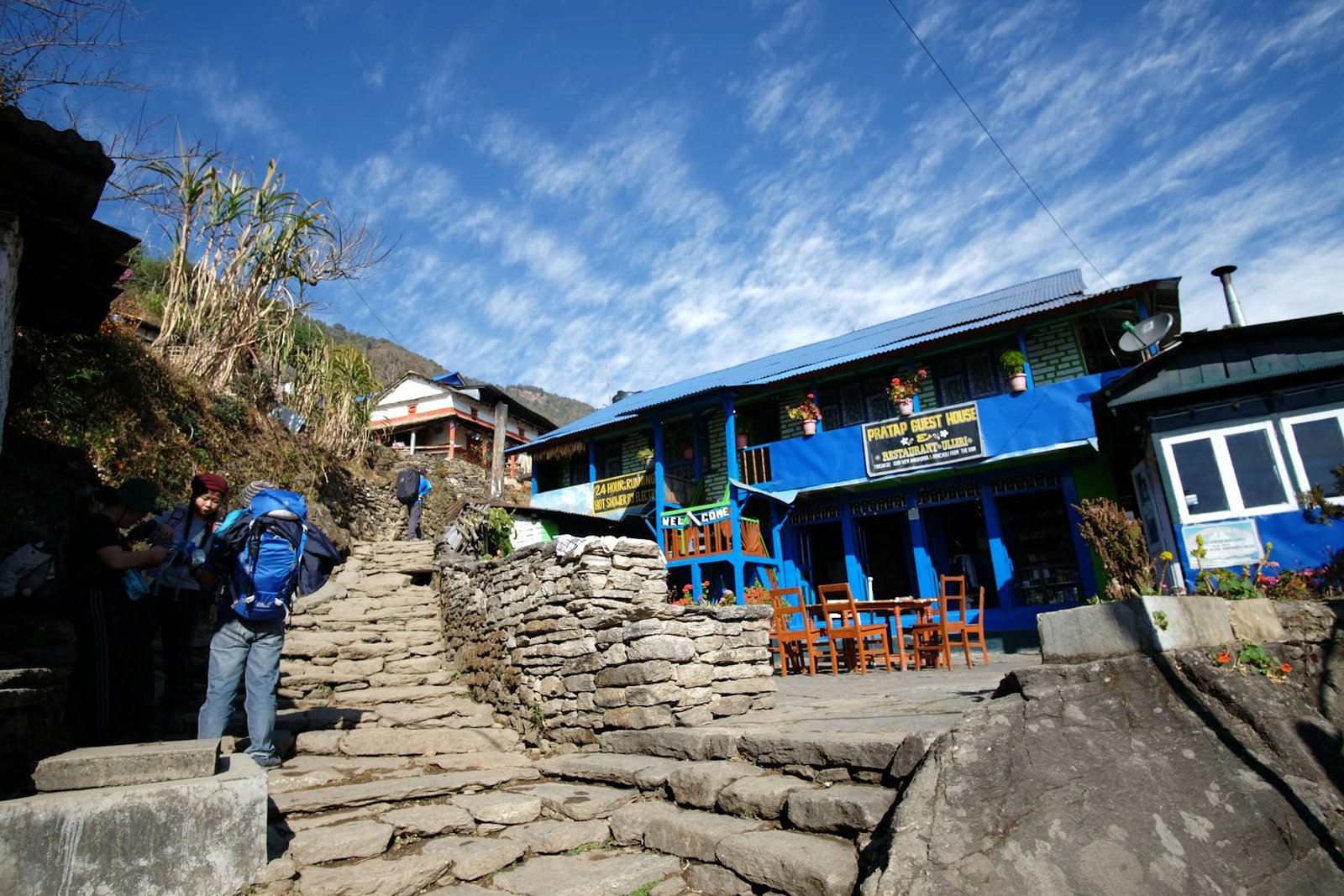
Pokhara — Your Pre-Trek Base
The trek begins in Pokhara, which offers accommodation across every price range from budget guesthouses in Lakeside to comfortable hotels. Most trekkers spend one to two nights in Pokhara before and after the trek. This is the place to stock up on items you’ve forgotten, withdraw sufficient Nepali rupees (no reliable ATMs above Pokhara), and confirm your permits.
No special planning is needed for Pokhara accommodation — the Lakeside area alone has hundreds of options across every budget.
Ghandruk (2,020 m) — The Cultural Gateway
Villages like Ghandruk and Chhomrong provide a fascinating cultural experience alongside the natural beauty of the Annapurna region.
Ghandruk is one of the largest and most-visited Gurung villages in Nepal, and it shows in the accommodation standard. Multiple teahouses and lodges operate here, with room quality noticeably higher than the upper route — attached bathrooms in some lodges, consistent hot water, reliable electricity, and strong enough phone signal for calls and basic internet. Food menus here are the most varied you’ll see on the trek, and the village itself — stone-paved lanes, traditional houses, a well-maintained monastery, and Annapurna South looming directly above — is worth spending a proper evening in rather than treating as a transit stop.
Some trekkers skip Ghandruk entirely on shorter itineraries, taking the more direct Nayapul-Tikhedhunga-Ulleri-Chhomrong route. Both approaches are legitimate — the Ghandruk route adds cultural depth and a gentler acclimatization; the direct route is faster.
Accommodation standard: Good. Multiple teahouses with attached and shared bathrooms. Most reliable hot water on the route.
Chhomrong (2,170 m) — The Last Comfortable Night
Chhomrong is the largest and most important village before you enter the Annapurna Sanctuary proper. Its significance goes beyond comfort: a wider food menu, reliable hot showers, and room upgrades before the upper mountain strips amenities down to the essentials. The teahouses here are genuinely welcoming, often family-run operations with decades of experience hosting trekkers. Rooms come with comfortable beds, decent cushions, and electric blankets in some lodges — a luxury that won’t exist above this point.
Chhomrong is the strategic supply and rest point of the route. Here, food is 30-50% cheaper than anything above, hot showers work reliably, every device can be charged, and the accommodation genuinely delivers on comfort in a way that the upper sanctuary cannot.
The practical advice that most guides provide and trekkers often don’t follow: charge everything, shower properly, stock up on snacks at Chhomrong’s shops before continuing into the sanctuary. Above here, prices rise and availability of everything narrows.
Chhomrong sits on a ridge with outstanding views of Annapurna South and Machhapuchhre — the teahouse dining rooms in the upper village face directly north toward both peaks, making evening meals here particularly memorable.
| Item | Typical Cost at Chhomrong |
|---|---|
| Room (twin-share) | NPR 500 |
| Dal Bhat | NPR 520–650 |
| Hot shower | NPR 100 |
| WiFi | NPR 200 |
| Device charging | NPR 100 per device |
Accommodation standard: Good to very good. Best comfort-to-altitude ratio on the route. Attached bathrooms available at several lodges.
Sinuwa (2,340 m) — The Day After Chhomrong
Sinuwa is reached after a steep descent from Chhomrong and a subsequent climb — a section of trail that accounts for some of the day’s effort before you arrive. Sinuwa functions primarily as a lunch stop, though 2-3 basic teahouses accommodate trekkers overnighting here. Most standard itineraries push through Sinuwa to Bamboo or stop here only if the day’s pace demands it.
The accommodation is basic — simple rooms, shared bathroom, limited menu. Nothing wrong with it, but it isn’t a destination stop.
Accommodation standard: Basic. Suitable for an overnight if needed; most trekkers continue to Bamboo.
Bamboo (2,310 m) — Forest Camp
Bamboo sits in a dense section of bamboo and rhododendron forest that gives it a distinctly different atmosphere from the ridge-top villages above and below. The teahouses here are clean and functional — more substantial than Sinuwa, with a reliable if limited menu, shared bathrooms, and a pleasant forest setting that feels appropriately mid-journey.
Villages like Chhomrong, Bamboo, Deurali, Machhapuchhre Base Camp, and ABC have all seen some upgrading as trekking demand has grown. Bamboo specifically has benefited from improved construction in recent years — the teahouses are more weatherproof than they were and the dining facilities are more consistent.
Several trekkers overnight at Bamboo on the descent from ABC rather than pushing further down, which can make it a pleasant decompression stop.
Accommodation standard: Basic but solid. Reliable shelter, limited menu, shared facilities. A good overnight on either direction.
Himalaya (2,900 m) — Before the Sanctuary Entry
Himalaya village marks the point where the valley closes in and the terrain shifts toward the high sanctuary approach. The teahouses here are functional — similar standard to Bamboo, perhaps slightly more basic, with the cold beginning to be felt more noticeably in the evenings. Most itineraries use Himalaya as a lunch stop or a strategic overnight depending on pacing.
Hinko Cave (3,139 m) is a notable landmark on the approach above Himalaya — a large overhanging rock formation that historically provided emergency shelter and is now passed on the trail without stopping.
Accommodation standard: Basic. Appropriate as an overnight if your pacing requires it; the menu becomes more limited here.
Deurali (3,200 m) — The Psychological Turning Point
Deurali marks the psychological turning point where accommodation transitions from “basic but okay” to “survival shelter that happens to charge money.” Expect to possibly share rooms with 3-4 other trekkers during peak season. Walls become thinner — sometimes just plywood sheets — beds simplify to wooden frames with foam pads, blankets multiply but can’t overcome the cold, and the temperature drops dramatically, to 0°C or below at night.
This is the honest description of Deurali’s accommodation, and it’s worth knowing before you arrive rather than after. The teahouses are genuine — they provide shelter, meals, and warmth in the dining area — but they don’t apologize for being what they are, which is high-altitude structures built under difficult logistical conditions.
Hot showers are listed at many Deurali teahouses but are often unavailable. WiFi is nominal. The dining hall heater is the social and thermal center of the evening. Wrap up well and bring your sleeping bag.
| Item | Typical Cost at Deurali |
|---|---|
| Room (twin-share) | NPR 500 |
| Dal Bhat | NPR 750–800 |
| Hot shower | NPR 250 (often unavailable) |
| WiFi | NPR 300 |
| Device charging | NPR 200 |
Accommodation standard: Basic to very basic. Essential shelter with limited amenities. Sleeping bag mandatory.
Machhapuchhre Base Camp / MBC (3,700 m) — High Altitude Minimalism
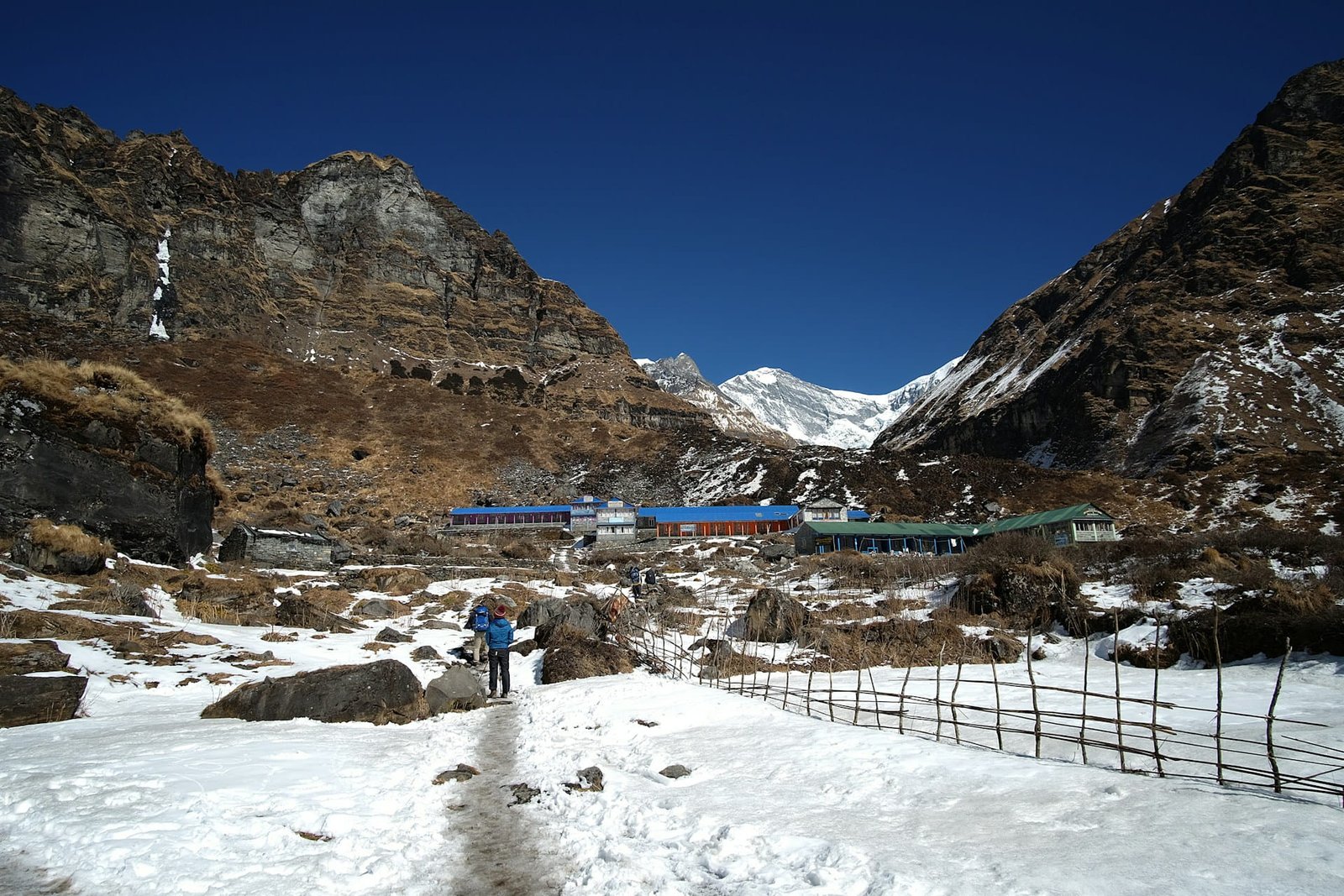
MBC sits beneath the iconic fishtail silhouette of Machhapuchhre (6,993 m), and the teahouses here are a study in high-altitude minimalism. Rooms are small metal-sheeted or wooden structures that provide shelter but nothing resembling comfort. Pipes freeze at night, making running water unreliable.
MBC is the last overnight stop before Annapurna Base Camp, and most trekkers spend at least one night here either on the ascent or the descent. The views from MBC are among the most dramatic of the entire trek — Machhapuchhre’s twin-peaked summit directly above, the Annapurna massif filling the northern skyline, and the sanctuary walls closing around the valley.
A sleeping bag rated to -10°C is essential; blankets alone are not sufficient at high altitude. At MBC in October or November, temperatures at night can drop to -10°C or below. The blankets provided are heavy and multiple, but they are not a substitute for a proper sleeping bag at this elevation.
Meals at MBC are simple dal bhat, noodles, and hot drinks. The menu exists; it’s functional. Don’t arrive expecting the Chhomrong dining experience.
| Item | Typical Cost at MBC |
|---|---|
| Room (twin-share) | NPR 500–700 |
| Dal Bhat | NPR 750–850 |
| Hot shower | NPR 350 (rarely available) |
| WiFi | NPR 300 (rarely works) |
| Device charging | NPR 200–250 |
Accommodation standard: Very basic. Structural shelter, minimal amenities, genuine cold. Sleeping bag non-negotiable.
Annapurna Base Camp (4,130 m) — The Summit of Teahouse Accommodation
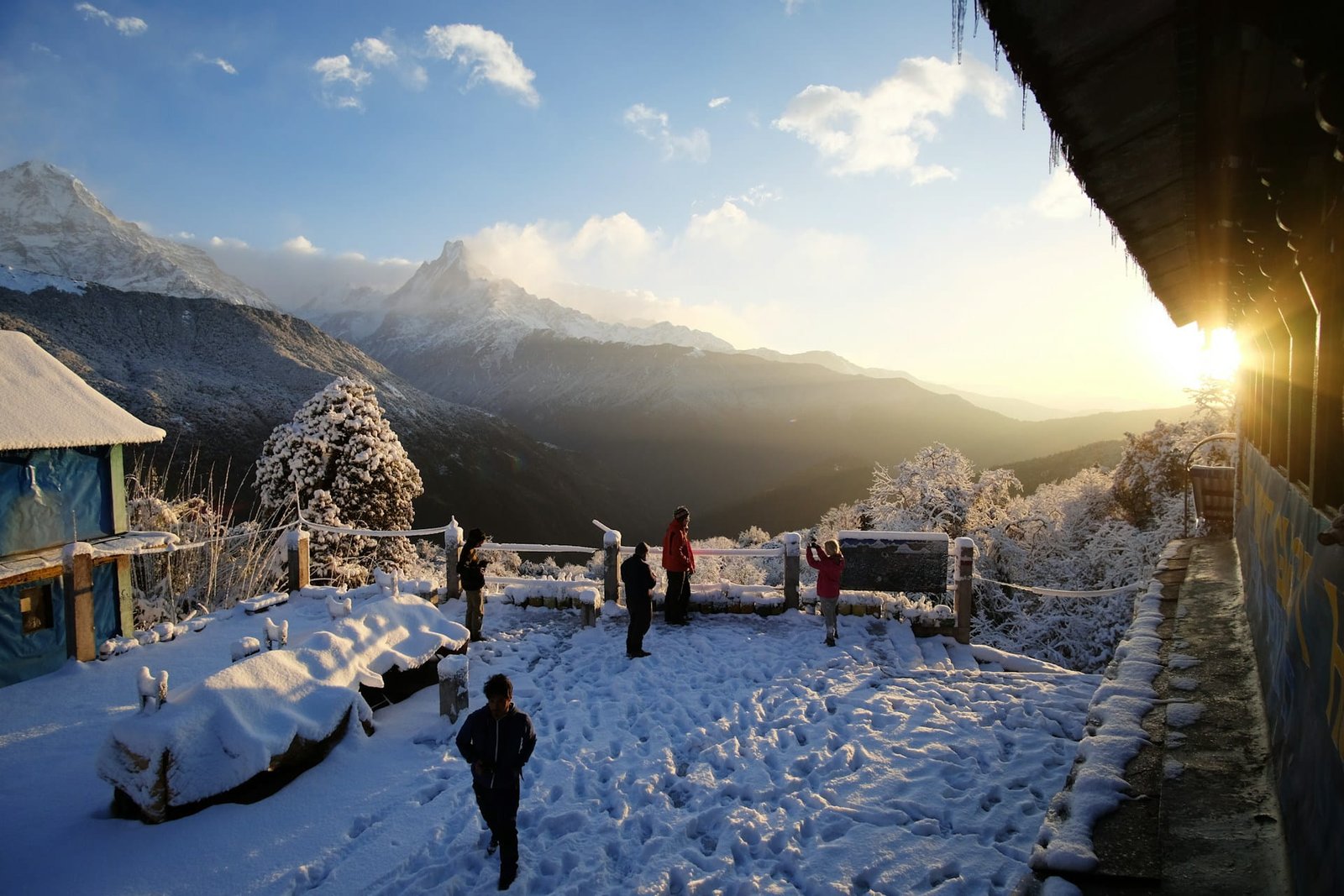
The highest point of the trek is Annapurna Base Camp at 4,130 metres (13,550 feet).
Yes, there is accommodation at ABC itself. Several teahouses operate year-round (or near year-round, with some closing in deep winter) at 4,130 m, and spending a night here rather than day-tripping up from MBC is a genuinely different experience. The pre-dawn clarity at ABC on a still morning — the full 360-degree wall of Annapurna I (8,091 m), Annapurna South (7,219 m), Hiunchuli (6,441 m), and Machhapuchhre above you in every direction — is an experience that the MBC day-trip version doesn’t fully replicate.
Annapurna Base Camp has accommodation where trekkers can spend the night, and although the lodging is basic, it is comfortable enough. “Comfortable” at 4,130 m means a bed, heavy blankets (bring your sleeping bag regardless), and a dining area that serves hot food and drinks. Hot showers don’t reliably exist here. WiFi exists nominally and rarely works. The rooms are simple. None of this diminishes the experience of waking up inside the Annapurna Sanctuary with those peaks immediately above you.
Accommodation standard: Very basic by any normal measure, extraordinary by context. Bring your sleeping bag, expect nothing in the way of amenities, and the setting does all the work.
The Altitude-Comfort Gradient: A Reference Table
| Village | Altitude | Room Standard | Hot Shower | WiFi | Sleeping Bag Needed |
|---|---|---|---|---|---|
| Ghandruk | 2,020 m | Good | Yes (reliable) | Yes | No (useful) |
| Chhomrong | 2,170 m | Good | Yes (reliable) | Yes | No (useful) |
| Sinuwa | 2,340 m | Basic | Sometimes | Limited | Recommended |
| Bamboo | 2,310 m | Basic | Sometimes | Limited | Recommended |
| Himalaya | 2,900 m | Basic | Rarely | Rarely | Yes |
| Deurali | 3,200 m | Very basic | Rarely | Rarely | Yes |
| MBC | 3,700 m | Very basic | Rarely | Rarely | Essential |
| ABC | 4,130 m | Very basic | No | No | Essential |
Advance Booking vs. Walk-In: When Each Applies
In most seasons, teahouses operate on a walk-in basis, and trekkers simply arrive and request a room. However, during peak trekking seasons — October–November and March–April — popular villages such as Ghorepani, Chhomrong, and Annapurna Base Camp can fill by early afternoon. Guided groups usually reserve rooms in advance through their trekking agency. Independent trekkers can call lodges directly using contact details on trail signage. Outside peak season, including the monsoon months of June to August, rooms are almost always available without advance arrangement.
The critical villages where advance booking matters in peak season are Chhomrong, MBC, and ABC. These three fill fastest — Chhomrong because it’s the largest comfortable stop, MBC and ABC because capacity is physically limited at high altitude. If you are trekking with an agency, your guide calls ahead each morning for that evening’s stop. Independent trekkers should either call ahead from the morning’s stop or start early enough to arrive before afternoon, when the limited rooms fill.
During October specifically, MBC and ABC teahouses can be full by 2-3 p.m. on busy days. The solution is a morning departure from the previous stop and arrival by early afternoon.
What to Bring for Teahouse Trekking
The teahouse system handles shelter and food. What it doesn’t provide — or provides unreliably above 3,000 m — is warmth during sleep, personal hygiene, power, and entertainment during rest days. Pack accordingly.
| Item | Why It Matters |
|---|---|
| Sleeping bag (-10°C rated) | Blankets alone are insufficient above Deurali. Non-negotiable at MBC and ABC. |
| Sleeping bag liner | Adds warmth and hygiene independent of teahouse bedding |
| Power bank (20,000 mAh) | Charging is expensive and unreliable above Chhomrong. A large power bank pays for itself by day three. |
| Biodegradable wet wipes | Hot showers become unavailable above Deurali for most trekkers. Wet wipes handle basic hygiene on the upper route. |
| Earplugs | Teahouse walls are thin. In peak season, neighboring rooms and early risers are audible. |
| Headlamp with spare batteries | Teahouse corridors and bathroom trips at night. Essential. |
| Lock for room | Basic personal security for daypacks and valuables. |
| Cash in Nepali rupees | No ATMs above Pokhara. Budget NPR 5,000-8,000 per day for food, accommodation, and extras at higher stops. |
Costs: What to Budget Per Day
Trail costs increase with altitude — supply logistics above 3,000 m push every price upward. Here is a realistic daily accommodation-and-meals budget by elevation band:
| Elevation Band | Representative Stops | Daily Budget (room + meals) |
|---|---|---|
| Below 2,500 m | Ghandruk, Chhomrong | NPR 1,500–2,500 (USD 11–19) |
| 2,500–3,000 m | Sinuwa, Bamboo, Himalaya | NPR 2,000–3,000 (USD 15–22) |
| 3,000–3,500 m | Deurali | NPR 2,500–3,500 (USD 19–26) |
| Above 3,500 m | MBC, ABC | NPR 3,000–4,500 (USD 22–33) |
Add NPR 100-350 per day for hot showers (where available), NPR 200-300 per session for WiFi (where it works), and NPR 100-300 per device for charging. A realistic additional daily budget for these extras is NPR 500-1,000 (USD 4-7), dropping to near zero above MBC where these services are rarely functional.
Annapurna Base Camp Trek Accommodation on Route Variations
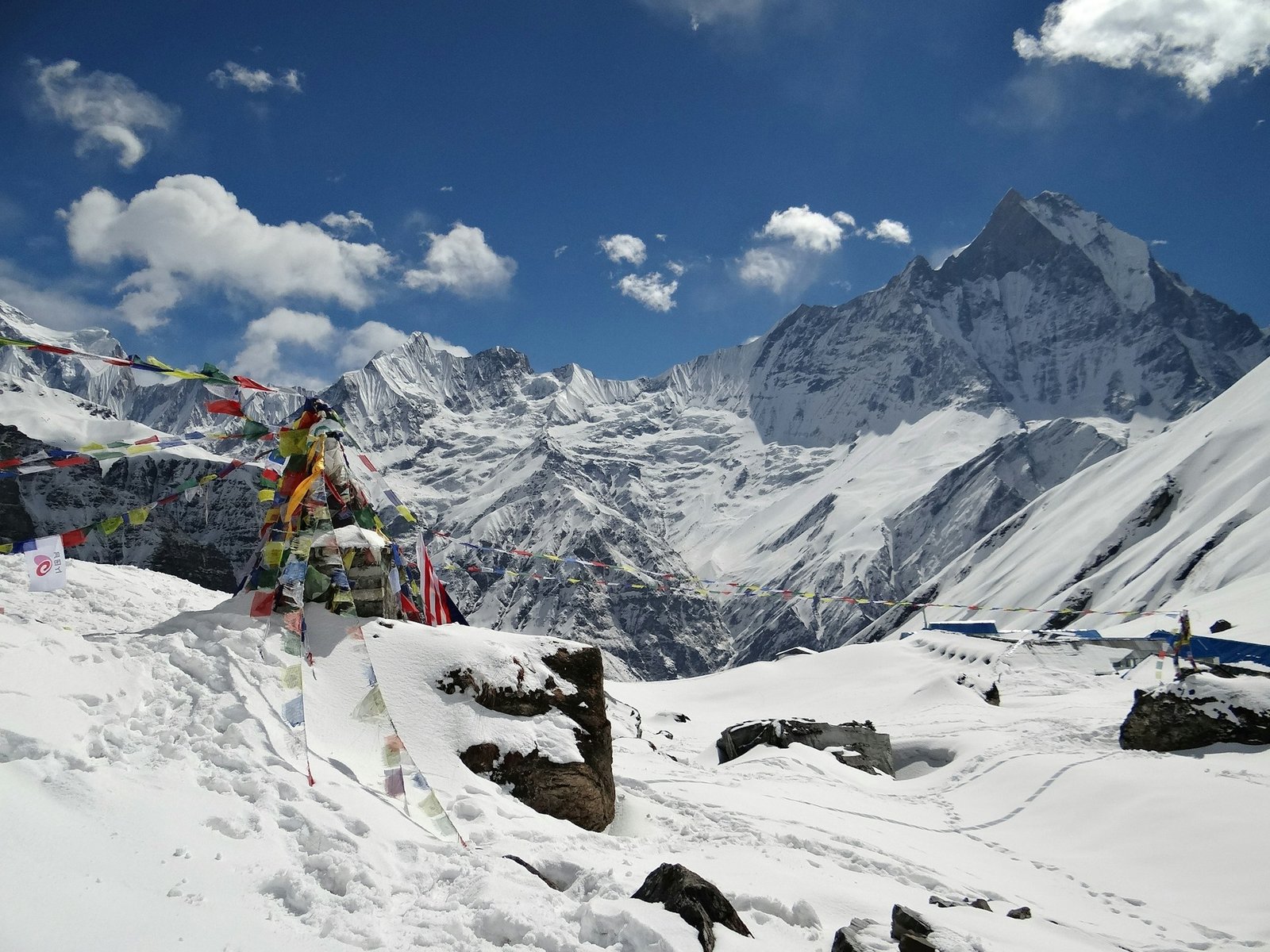
The standard route above assumes the most common Nayapul-Ghandruk-Chhomrong approach. Several variations exist:
- Via Ghorepani and Poon Hill: Some itineraries approach the sanctuary via Ghorepani (2,860 m) and Tadapani (2,630 m) before joining the main route at Chhomrong. Ghorepani has excellent teahouse accommodation — multiple well-established lodges, reliable hot showers, and the Poon Hill sunrise addition. Tadapani is smaller with limited teahouses but comfortable for an overnight.
- Jhinu Danda hot springs: Located at approximately 1,780 m, Jhinu Danda sits on the descent route from Chhomrong toward Nayapul. It offers natural hot springs that are genuinely restorative after days at altitude, and the teahouses here have improved significantly in recent years. Most trekkers stop for a hot spring dip regardless of whether they overnight — but spending a final night here before the road is a pleasant way to decompress.
Frequently Asked Questions about Annapurna Base Camp Trek Accommodation
- Is there accommodation at Annapurna Base Camp itself?
Yes. Several teahouses operate at ABC (4,130 m) and provide basic but functional shelter, meals, and hot drinks. Spending a night here rather than returning to MBC for the sunset and pre-dawn views is an option that many trekkers find worthwhile despite the basic conditions. - Do I need to book teahouses in advance?
During peak season (October-November and March-April), advance booking is strongly recommended for Chhomrong, MBC, and ABC, which fill fastest. Your guide will typically call ahead each morning. Outside peak season, walk-in is generally fine throughout the route. - What is the coldest teahouse stop?
Annapurna Base Camp at 4,130 m — temperatures can drop to -10°C or below overnight. MBC at 3,700 m is similarly cold. A sleeping bag rated to -10°C is essential for both. - Are there attached bathrooms on the route?
At lower villages (Ghandruk, Chhomrong, and sometimes Sinuwa), attached bathrooms exist at some teahouses. Above Sinuwa, shared bathrooms are standard throughout. - Can I get WiFi on the ABC trek?
WiFi is available at Ghandruk, Chhomrong, and Sinuwa with reasonable reliability. Above these villages, WiFi becomes increasingly unreliable and is essentially unavailable at MBC and ABC. A local SIM card with a data plan works better than teahouse WiFi at mid-altitudes. - Are there electricity and charging points?
Yes — at most teahouses, for a fee of NPR 100-300 per device. Reliability decreases with altitude; above Himalaya village, carry a power bank rather than relying on teahouse charging points. - Is camping possible instead of teahouses?
Technically possible but largely unnecessary given the comprehensive teahouse network. The ABC route is designed for teahouse trekking. Camping adds significant weight and logistics complexity without any practical advantage on this specific route. - Do teahouses have hot showers?
Yes, most teahouses offer hot showers for NPR 200-500, usually gas or solar-heated. Above MBC, hot showers become rare or unavailable, so most trekkers skip washing for the final 1-2 nights. - What kind of food is available at teahouses along the route?
Standard teahouse menus feature dal bhat, noodles, momos, soup, and basic breakfast items like porridge and eggs. Prices increase with altitude due to portering costs, with dal bhat typically costing NPR 400-600 more at ABC than in Ghandruk. - Do I need my own sleeping bag, or can I rent one?
Most trekkers rent a sleeping bag in Kathmandu or Pokhara rather than carrying one from home, with rentals costing around $1-2 per day. A -10°C to -15°C rated bag is recommended given conditions at MBC and ABC. - How much does teahouse accommodation cost on the ABC trek?
Room rates are generally low (NPR 200-500 per night, sometimes free with meal purchases), but this is offset by higher food and drink prices as altitude increases. Budget roughly $20-30 per day total for accommodation and meals combined. - Are rooms private or shared at ABC trek teahouses?
Most teahouses offer private twin rooms as standard, though walls are often thin plywood partitions offering limited soundproofing and privacy. Dormitory-style rooms are uncommon on this route compared to some other Nepal treks. - What should I expect from teahouse beds and bedding?
Beds typically include a mattress, pillow, and sometimes a blanket, but blankets alone are insufficient at higher elevations. A proper sleeping bag is necessary from Deurali or Himalaya village upward. - Is heating available in teahouse rooms?
No — rooms are unheated throughout the route. Heating (usually a wood or dung-burning stove) is only found in shared dining areas, which become the social and warming hub each evening. - How far apart are teahouse stops on the standard itinerary?
Daily walking times between teahouse stops range from 4 to 7 hours, with common overnight stops at Ghandruk, Chhomrong, Bamboo/Dovan, Himalaya, Deurali, MBC, and ABC. - Can solo female trekkers expect safe, comfortable accommodation?
Yes, the ABC route is considered one of the safer and more established teahouse treks in Nepal, with family-run lodges and a steady flow of trekkers throughout the season. Booking through a guide adds an extra layer of security and room prioritization. - What altitude sickness risks relate to accommodation choices at ABC?
Since ABC (4,130 m) is reached in a single push from MBC, some trekkers choose to overnight at MBC first, or descend to MBC/Deurali to sleep after a day visit to ABC, following the “climb high, sleep low” principle to reduce AMS risk.
Conclusion to Annapurna Base Camp Trek Accommodation
The teahouse system on the ABC trek is one of the most successful pieces of trekking infrastructure anywhere in the Himalayas — a network of family-run lodges that makes a genuinely high-altitude experience accessible without camping, cooking, or carrying heavy loads. It works best when you understand its altitude gradient: comfortable in Ghandruk and Chhomrong, functional in Bamboo and Himalaya, essentially minimal at MBC and ABC. That gradient isn’t a failure of the system — it’s the physical reality of operating lodges at 3,700 and 4,130 m under serious logistical constraints.
Pack your sleeping bag, carry a power bank, withdraw enough Nepali rupees in Pokhara to cover the full trek, and adjust your comfort expectations to track the altitude gain. Do that, and the teahouse experience — the warm dining halls, the family hospitality, the unexpected quality of a dal bhat at 3,000 m after a hard day of walking — becomes one of the most enjoyable parts of the trek rather than something to get through on the way to the views.