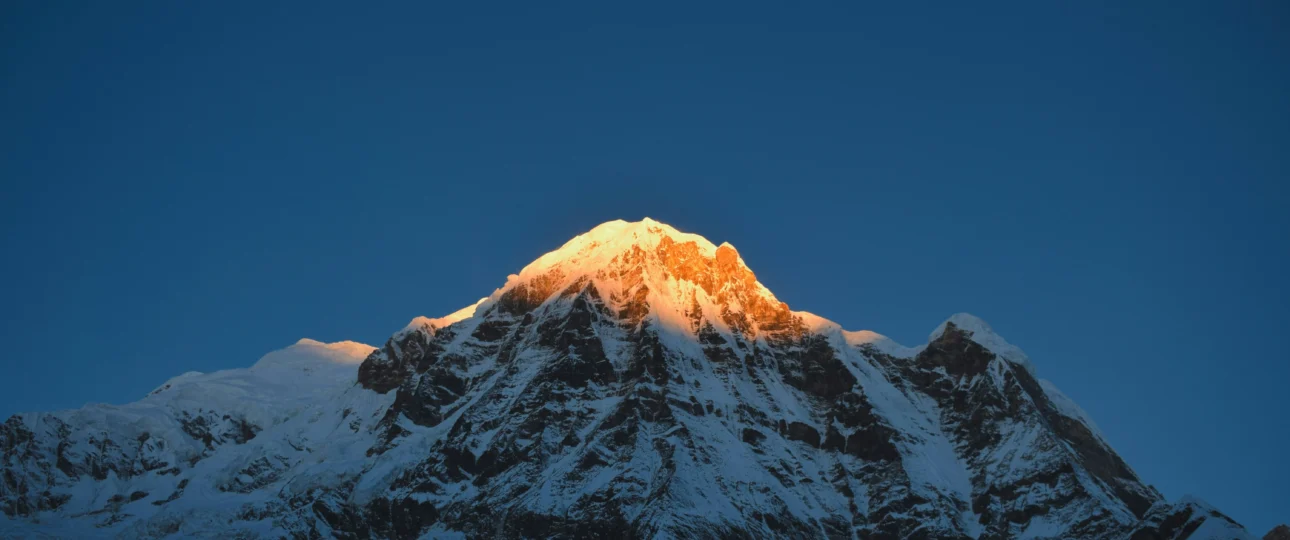
Annapurna Base Camp elevation
Annapurna Base Camp sits at 4,130 metres (13,550 feet) above sea level. That is the number most people are looking for, and it is the highest point you sleep at on the classic trek. If you’ve seen slightly different figures elsewhere — 13,549 ft in one place, 13,551 ft in another — that’s just rounding between metres and feet, not a real disagreement. The camp is 4,130 m. Full stop.
The more useful question is what that altitude actually does to a trek. At 4,130 m the air holds roughly 40% less oxygen than at sea level, which is enough to slow you down and, if you climb too fast, make you unwell — but it is also low enough that a reasonably fit person with no mountaineering background can reach it safely. That combination is the whole story of Annapurna Base Camp: high enough to feel like a genuine Himalayan achievement, low enough to stay within reach of ordinary trekkers.
This guide breaks down where 4,130 m sits within the wider trek, how you get there stage by stage, how much altitude you actually gain, and — the part most pages skip — what the height means for your body and your planning.
The short answer, in numbers
| Metric | Figure |
|---|---|
| Annapurna Base Camp elevation | 4,130 m (13,550 ft) |
| Highest point you sleep on the trek | Annapurna Base Camp (4,130 m) |
| Last stop before ABC | Machhapuchhre Base Camp — 3,700 m |
| Typical trailhead elevation | ~1,000–1,300 m (Nayapul / Kimche area) |
| Approximate net height gain to ABC | ~3,000–3,300 m, depending on start point |
| Oxygen available at ABC vs sea level | roughly 60% |
| Highest peak overhead | Annapurna I — 8,091 m (world’s 10th highest) |
Everything below explains why these numbers matter and how to use them.
What 4,130 metres actually means on the ground
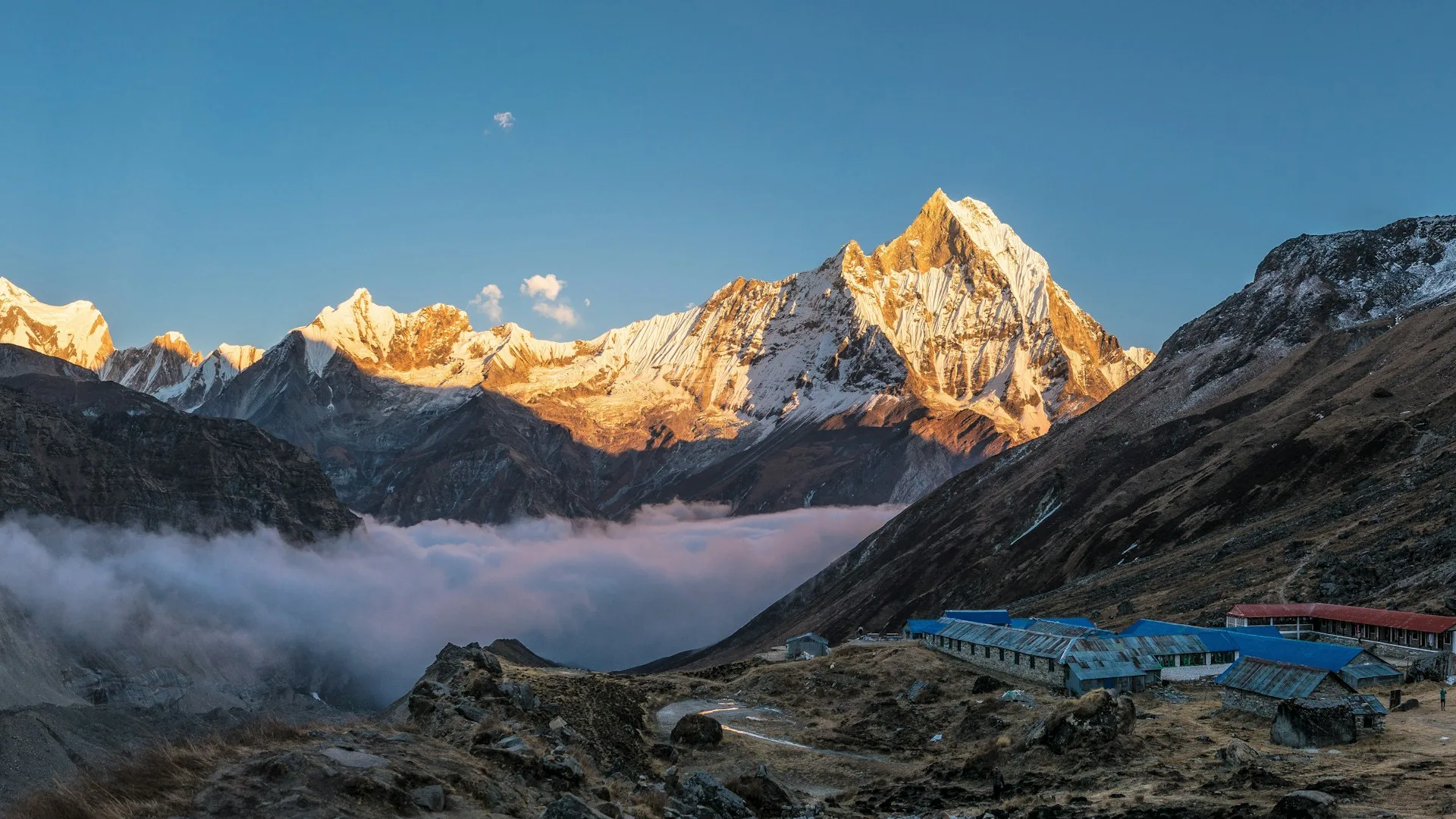
Annapurna Base Camp isn’t a mountaineering base camp in the working sense of Everest — you won’t be sharing it with expedition teams heading for the summit most of the year. It’s the deepest point trekkers reach inside the Annapurna Sanctuary, a high glacial basin ringed almost completely by peaks. Stand at the camp and you’re at the bottom of a natural amphitheatre: Annapurna I rises to 8,091 m directly ahead, with Annapurna South (7,219 m), Hiunchuli (6,441 m) and the fishtail summit of Machhapuchhre (6,993 m) closing the circle around you.
The 4,130 m figure matters for three practical reasons.
First, it sets the altitude-sickness risk. The threshold where the body starts to struggle to adjust is around 2,500 m, and the risk rises the higher and faster you go. At 4,130 m you are firmly in the zone where altitude illness is possible — not likely if you pace yourself sensibly, but possible. This is why the number is worth respecting rather than just admiring.
Second, it tells you how much climbing is involved. From a low trailhead near 1,000 m, reaching 4,130 m means a lot of vertical over several days. The trek isn’t technical — there’s no rope, no ice axe, no scrambling — but there are long staircase days that a flat elevation figure hides.
Third, it explains the temperature. ABC is high enough that even in peak trekking season, nights at the camp routinely drop below freezing while the lodges lower down stay mild. The altitude, not just the season, is what makes the top of this trek cold.
The elevation profile: how you actually get to 4,130 m
One thing that surprises first-timers is that you don’t simply climb from low to high. The trail into the Sanctuary rolls up and down for the first few days, losing height at river crossings before clawing it back on the far side. That “rollercoaster” is normal for this part of Nepal, and it’s part of why the trek covers more vertical than the headline gain suggests.
Here is the classic progression on the commonly used Ghandruk-side route. Exact figures vary a little between operators and maps — a few waypoints (Deurali, Dovan) are quoted anywhere within a 50–100 m band — but the shape is consistent.
| Stage | Approx. elevation | Notes |
|---|---|---|
| Nayapul (common trailhead) | ~1,070 m | Warm, subtropical start; some itineraries drive higher to Kimche |
| Ghandruk | ~1,940 m | Large Gurung village; first big mountain views |
| Chhomrong | ~2,170 m | Gateway to the inner Sanctuary; the last real village |
| Sinuwa | ~2,360 m | Reached after a steep drop-and-climb from Chhomrong |
| Bamboo | ~2,310 m | Forested valley; you’re back near river level here |
| Dovan | ~2,500–2,600 m | Trees begin to thin |
| Deurali | ~3,230 m | Entering the alpine zone; above 3,000 m from here |
| Machhapuchhre Base Camp (MBC) | ~3,700 m | Last overnight stop before ABC; used to break the climb |
| Annapurna Base Camp (ABC) | ~4,130 m | Highest point; final push from MBC |
Notice the middle of the table. Between Chhomrong and Deurali the trail dips into forest and hovers around 2,300–2,600 m for a while before the real climbing starts. That flat-ish stretch is a gift: it gives your body time near the same altitude before the steep push into thin air.
The final section from Machhapuchhre Base Camp to Annapurna Base Camp is the one to watch. It’s only around 430 m of gain over a short distance, but it’s the highest, thinnest air on the trek, and plenty of fit people find themselves stopping to breathe on a slope they’d stroll up at home. Most good itineraries sleep at MBC (3,700 m) specifically so this last climb happens fresh in the morning rather than at the end of a long day.
How much altitude do you really gain?
Two numbers get quoted, and both are correct — they just measure different things.
- Net gain to the top: from a low trailhead near 1,070 m to ABC at 4,130 m is roughly 3,060 m of net elevation.
- Total cumulative gain: because the trail keeps rising and falling, the total uphill you climb over the trek is higher — commonly cited around 3,300 m or more, depending on your exact route and starting point.
For planning, the daily figure is what actually matters. On a well-paced ABC itinerary you gain roughly 400–700 m of sleeping altitude per day in the higher sections. That’s within the range altitude-medicine guidelines consider reasonable, and it’s the main reason ABC has a gentler reputation than treks that push you up faster.
If an itinerary tries to rush the top — say, jumping from Bamboo all the way to ABC in a single push — that’s a red flag for altitude risk, not a sign of efficiency.
What the altitude does to your body
This is the part that turns a number into a decision. The good news first: 4,130 m is a moderate high altitude, not an extreme one. Serious high-altitude illness is far more associated with the 5,000 m-plus zone. But moderate does not mean zero risk, and the way you climb matters more than how fit you are.
Acute mountain sickness (AMS), in plain terms
Above roughly 2,500 m, unacclimatised people can develop acute mountain sickness. It usually shows up within 6 to 12 hours of gaining altitude, and the classic signs are headache plus one or more of nausea, dizziness, fatigue, and poor sleep. It feels a lot like a hangover, and it’s your body telling you it hasn’t caught up with the altitude yet.
On the ABC trek you cross the 2,500 m line early and spend your final two nights well above 3,000 m, so mild symptoms are common and usually manageable. The important distinction is between feeling off and getting worse:
- Mild AMS — a manageable headache, some breathlessness on climbs, broken sleep — often settles with rest, fluids, and not going higher until you feel better.
- Worsening symptoms — a headache that won’t lift, vomiting, confusion, loss of coordination, or breathlessness at rest — are warning signs. The correct response is to stop ascending and descend. Going down even a few hundred metres is the single most reliable treatment.
Fitness does not protect you here. Strong, athletic trekkers get AMS too, sometimes precisely because they push the pace. Susceptibility is largely individual and hard to predict in advance, which is why the safe approach is behavioural, not based on how tough you think you are.
This is general information, not medical advice. If you have a heart or lung condition, are pregnant, or have had altitude problems before, talk to a doctor familiar with travel or altitude medicine before booking. Some trekkers use preventive medication such as acetazolamide, but whether it’s appropriate for you is a conversation for your doctor, not a website.
How to keep the altitude manageable
The measures that actually work are unglamorous and consistent with mainstream altitude-medicine guidance:
- Climb slowly, especially in sleeping altitude. The widely used rule of thumb above about 3,000 m is to raise where you sleep by no more than roughly 500 m a day, building in an easier day when you’ve gained a lot. ABC’s standard itineraries are already built around this idea.
- Don’t skip the Machhapuchhre Base Camp night. Sleeping at 3,700 m before the final climb is a built-in acclimatisation step. Bagging ABC and MBC in one rushed day removes it.
- Drink more than feels necessary and eat properly, even if appetite drops at altitude.
- Treat a headache as information. If it isn’t improving, don’t climb higher that day.
- Know the exit. Descent is the cure. A good guide watches for this so you don’t have to self-diagnose.
Is the trek hard? Reading difficulty through the altitude
Annapurna Base Camp is usually rated moderate, and the altitude is a big reason it isn’t rated harder. At 4,130 m you avoid the punishing thin air of the 5,000 m treks, and the trail is a walking route throughout — no technical sections.
What the elevation figure doesn’t capture is the stairs. Large stretches of the lower and middle trail are stone staircases, and days like the Chhomrong descent-and-climb involve serious quad-burning up-and-down even though the net altitude change is small. So the honest difficulty picture is: not dangerously high, not technical, but genuinely tiring on the legs, with a thin-air final day that demands a slow, steady pace.
Can beginners do it?
Yes, and many do — this is one of the more beginner-friendly Himalayan treks in Nepal, largely because of that manageable 4,130 m ceiling and the gradual daily gain. A beginner who trains a little (hill walking, stairs, some cardio in the weeks before) and takes the acclimatisation itinerary seriously has a very good chance of reaching the top comfortably. What beginners underestimate isn’t the altitude so much as the sustained day-after-day walking on steep ground. Preparation should target endurance and legs, not just lung capacity.
How ABC’s height compares with other Nepal treks
Putting 4,130 m next to Nepal’s other famous routes is the fastest way to understand where it sits on the difficulty scale. The pattern is clear: ABC is the accessible high-altitude option — a real Himalayan altitude without the extreme-elevation days of the marquee treks.
| Trek | Highest point | Roughly how high |
|---|---|---|
| Ghorepani Poon Hill | ~3,210 m | Lower — a gentle introduction |
| Annapurna Base Camp | ~4,130 m | Moderate high altitude |
| Langtang Valley (Kyanjin area) | ~4,700–5,000 m | Higher, quieter |
| Everest Base Camp | ~5,364 m (Kala Patthar ~5,545 m) | Significantly higher |
| Annapurna Circuit (Thorong La) | ~5,416 m | Higher, with a big pass day |
Everest Base Camp tops out more than 1,200 m higher than ABC, sleeps you higher for longer, and generally carries a greater altitude-illness risk and a longer, costlier itinerary. The Annapurna Circuit’s Thorong La pass is higher still. If ABC’s 4,130 m is your first serious altitude, it’s a sensible rung on the ladder before those bigger objectives.
When to go, and how altitude shapes the seasons
The two best windows are spring (March–May) and autumn (late September–November), for stable weather and clear mountain views. Altitude interacts with the season in a way worth planning around:
- Autumn brings the clearest skies and the most reliable high-mountain views after the monsoon — the classic choice.
- Spring adds blooming rhododendron forests on the lower trail and warming temperatures, though afternoon cloud can build.
- Winter (December–February) is doable but the upper Sanctuary is cold and snow near ABC and MBC can raise avalanche and trail concerns.
- Monsoon (June–August) brings rain, leeches on the forested sections, cloud that hides the peaks, and slippery stone steps.
Whatever the month, remember that ABC’s altitude makes the top of the trek cold at night year-round. Pack for below-freezing nights at the camp even in the middle of a warm season.
Permits and the rules that come with the region
You don’t need a permit for the altitude, but you do need paperwork to enter the conservation area the trek passes through. For 2026, Annapurna Base Camp requires:
- Annapurna Conservation Area Permit (ACAP) — around NPR 3,000 for foreign nationals (SAARC nationals pay less; children under 10 are typically exempt).
- TIMS card (Trekkers’ Information Management System) — around NPR 2,000, which helps authorities locate trekkers in an emergency.
That’s roughly NPR 5,000 (about US$38–40) in total, though the rupee figure is fixed and the dollar equivalent moves with the exchange rate. Nepal now also requires trekkers in the Annapurna region to be accompanied by a licensed guide arranged through a registered agency, so fully independent solo trekking is no longer the norm here. Permit rules and fees do change, so confirm the current requirements close to your departure. A reputable operator will arrange all of this as part of a package, so it rarely becomes something you handle yourself.
Common misconceptions about the Annapurna Base Camp elevation
“4,130 m isn’t that high, so I don’t need to worry about altitude.” It’s moderate, not trivial. You still cross the 2,500 m risk threshold and sleep above 3,700 m. Respect it, and it stays easy; ignore it, and a fast ascent can still make you ill.
“If I’m fit, I won’t get altitude sickness.” Fitness and altitude tolerance are largely unrelated. Pace, hydration, and acclimatisation matter far more than your gym numbers.
“The base camp is the only high bit.” The final MBC-to-ABC climb is highest, but you also spend a night at Machhapuchhre Base Camp (3,700 m), and the trail is above 3,000 m for the last stretch. The high zone is a day and a half, not a single moment.
“Everest Base Camp and Annapurna Base Camp are about the same.” They’re over 1,200 m apart in altitude, with meaningfully different risk, cost, and duration. ABC is the gentler introduction.
Planning your Annapurna Base Camp trek with Wonderhikes Nepal
If reading through the altitude profile has made one thing clear, it’s that reaching 4,130 m safely is less about being an athlete and more about walking a sensibly paced, well-supported route with someone who knows when to slow you down. That’s the practical value a good local operator adds — the itinerary is already built around acclimatisation, the permits and licensed guide are handled, and there’s someone watching for the early signs of altitude trouble so you don’t have to second-guess yourself on the trail.
Wonderhikes Nepal runs Annapurna Base Camp treks on itineraries designed around gradual altitude gain, including the standard Machhapuchhre Base Camp night before the final climb, so the highest, thinnest part of the trek happens when you’re rested. If you’re weighing up whether ABC’s altitude is right for you — or comparing it against Poon Hill as a warm-up or Everest Base Camp as a bigger step up — that’s exactly the kind of thing worth talking through before you book, rather than deciding from a table alone.
Frequently asked questions about Annapurna Base Camp Elevation
1. What is the elevation of Annapurna Base Camp?
Annapurna Base Camp is at 4,130 m (13,550 ft) above sea level. That’s the highest point you sleep at on the trek.
2. Why do some sources say 13,549 ft and others 13,551 ft?
It’s rounding. Converting 4,130 m to feet lands around 13,549–13,551 ft depending on the rounding used. The metric figure — 4,130 m — is the fixed one.
3. What is the highest point on the Annapurna Base Camp trek?
Annapurna Base Camp itself, at 4,130 m. Unlike some treks, the destination is also the highest point — there’s no higher pass to cross.
4. How much altitude do you gain on the ABC trek?
Net gain from a low trailhead near 1,070 m to ABC is roughly 3,060 m. Because the trail rises and falls, total cumulative climbing is higher, often around 3,300 m depending on your route.
5. How high is Machhapuchhre Base Camp?
Around 3,700 m. It’s the last overnight stop before Annapurna Base Camp and an important acclimatisation point.
6. Is Annapurna Base Camp high enough to cause altitude sickness?
Yes, it’s possible. You cross the ~2,500 m risk threshold early and sleep above 3,700 m near the top. Symptoms are usually mild if you ascend gradually, but the risk is real and worth managing.
7. At what altitude does altitude sickness usually start?
Generally above about 2,500 m, with symptoms often appearing within 6–12 hours of gaining height. On this trek you pass that line in the first couple of days.
8. Does being fit prevent altitude sickness?
No. Susceptibility is largely individual and doesn’t track with fitness. Slow ascent, hydration, and rest matter far more than how strong you are.
9. How do I reduce the risk of altitude sickness on ABC?
Ascend gradually (keeping sleeping-altitude gains modest above 3,000 m), don’t skip the Machhapuchhre Base Camp night, stay hydrated, and descend if symptoms worsen. Talk to a doctor about preventive medication if you’re concerned.
10. Is the Annapurna Base Camp trek hard because of the altitude?
The altitude is moderate, not extreme — it’s one reason ABC is rated only moderate. The bigger physical challenge is the long stone staircases and the up-and-down terrain, plus a thin-air final climb.
11. Can beginners reach Annapurna Base Camp?
Yes. The manageable 4,130 m ceiling and gradual daily gain make ABC one of the more beginner-friendly Himalayan treks. Basic endurance training beforehand helps more than anything.
12. How does ABC’s elevation compare with Everest Base Camp?
Everest Base Camp is about 5,364 m — more than 1,200 m higher — with greater altitude risk, a longer itinerary, and higher cost. ABC is the more accessible high-altitude trek.
13. How cold does it get at Annapurna Base Camp?
Cold enough to drop below freezing at night year-round because of the altitude, even in peak season. Lower villages stay much milder. Pack for sub-zero nights at the top regardless of the month.
14. How many days does it take to reach 4,130 m?
Most itineraries reach ABC in about 4–6 walking days on the way up, with the full round trip commonly taking 7–12 days depending on route and starting point.
15. Do I need a permit because of the altitude?
Permits aren’t tied to altitude — they’re for entering the conservation area. For 2026 you’ll need the ACAP and TIMS card (around NPR 5,000 combined), plus a licensed guide. A trekking operator normally arranges all of it.